How Economic Conference Affects Pacific
pp. 5-6 · Read in the full issue
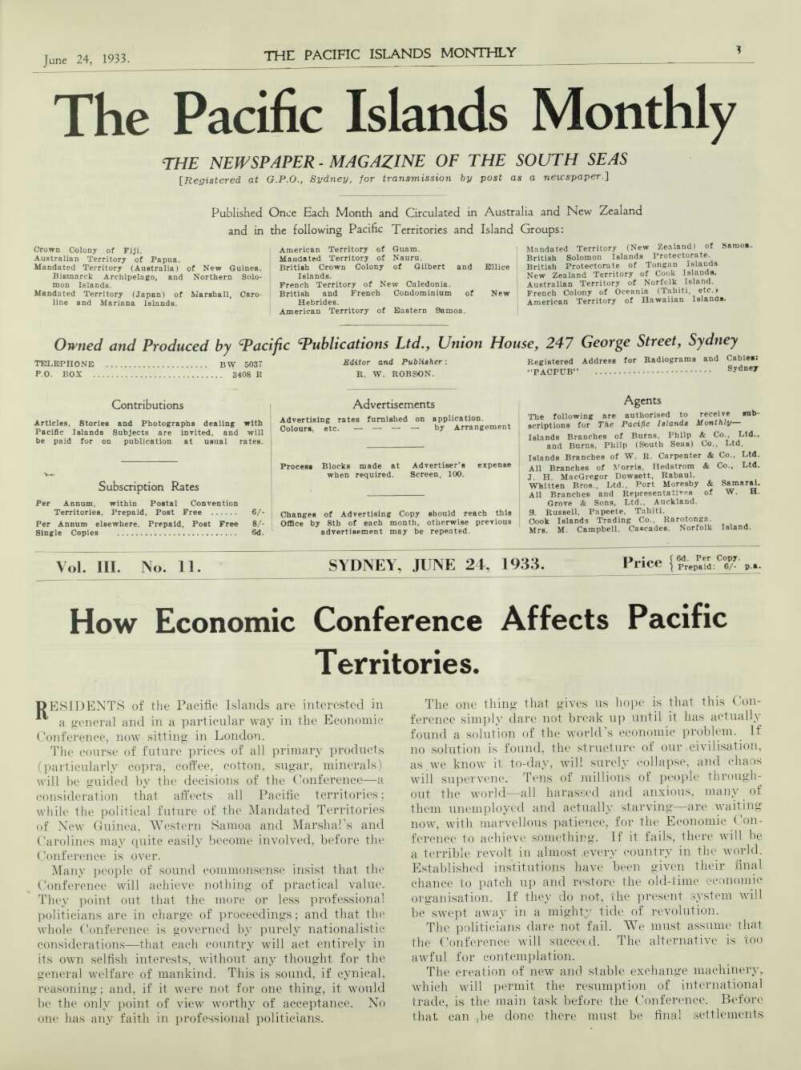
Territories.
RESIDENTS of the Pacific Islands are interested in a general and in a particular way in the Economic Conference, now sitting in London.
The course of future prices of all primary products (particularly copra, coffee, cotton, sugar, minerals) will be guided by the decisions of the Conference —a consideration that affects all Pacific territories; while the political future of the Mandated Territories of New Guinea, Western Samoa and Marshall and Carolines may quite easily become involved, before the Conference is over.
Many people of sound commonsense insist that the Conference will achieve nothing of practical value.
They point out that the more or less professional politicians are in charge of proceedings; and that the whole Conference is governed by purely nationalistic considerations —that each country will act entirely in its own selfish interests, without any thought for the general welfare of mankind. This is sound, if cynical, reasoning; and, if it were not for one thing, it would be the only point of view worthy of acceptance. No one has any faith in professional politicians.
The one thing that gives us hope is that this Con ference simply dare not break up until it has actually found a solution of the world’s economic problem. If no solution is found, the structure of our civilisation, as we know it to-day, will surely collapse, and chaos will supervene. Tens of millions of people through out the world —all harassed and anxious, many of them unemployed and actually starving—are waiting now, with marvellous patience, for the Economic Con ference to achieve something. If it fails, there will be a terrible revolt in almost every country in the world.
Established institutions have been given their final chance to patch up and restore the old-time economic organisation. If they do not, the present system will be swept away in a mighty tide of revolution.
The politicians dare not fail. We must assume that the Conference will succeed. The alternative is too awful for contemplation.
The creation of new and stable exchange machinery, which will permit the resumption of international trade, is the main task before the Conference. Before that can ,be done there must be final settlements
regarding war debts and tariff barriers—the two main causes of the depression—and of a dozen subsidiary problems. When it is done, commodity prices will soon move back to a level which will permit the world to settle down again to normal employment. It would not surprise this writer in the least if there were then a great boom in the Pacific Islands. There should come, at last, with the aid of aviation, radio and greatly improved shipping services, fuller oppor tunities for the development of their enormously rich and almost untapped resources.
So much for the general outlook. It is not dis couraging. Hard-pressed planters and traders, who have endured so much, must just hang on grimly for a little longer, and keep their assets intact and their eye on the Economic Conference. They will be wise to ignore all the flapdoodle that is written and talked about overproduction. The trouble is not over production: it is the present inability to consume.
The capacity of the world to consume is almost unlimited—provided that there is exchange machinery to take care of distribution. It is the breakdown of exchange machinery that has brought the world into its present muddle. If the Conference will overcome that difficulty, the law of supply and demand, operating in a normal world, will effectively regulate production.
The political question is not so prominent just now, but it will become acute, before the Conference is over. Dr. Hugenberg, leader of the German delegation in London, has gone back to Germany, with angry gestures, because his fellow-delegates would not support his demand for the return of the German Colonies. That means nothing. It may be taken as certain that, when the Conference reaches the bargaining stage, Germany’s demand for the return
of the more valuable of her former African and Pacific territories, will be pressed with great vigour.
It is as well to recognise that there is in Germany a very active, well-organised body known as “Korag” (formed of the initial letters of a long name) which is supported by all sections of the nation and which carries on a ceaseless agitation, the purpose of which is to compel the League of Nations to remove the Mandatories from control of the former Colonies, and return them to Germany. This movement lost some of its ginger in the political turmoil of recent years; but, with the establishment of orderly government under Herr Hitler, there are many indications that “Korag's" demands will become one of the liveliest subjects in international politics. Germany will insist that these former Colonies are necessary for her future development, both as sources of raw material and as an outlet for Germany’s growing population.
The German claim that the League of Nations has the power to return the former Colonies to Germany will be contested by the other nations concerned.
Their argument is that, under the Peace Treaty made at Versailles, the German Colonies were taken from Germany finally and irrevocably, as part of the war penalty imposed upon her, and that the Allied nations handed them over to the League of Nations to be distributed equitably, and in accordance with the rights of the subject peoples concerned, among the Allied nations. The League has power to insist that the former German Colonies are fairly and properly administered by the countries exercising the respective Mandates, but it has no power to over-ride the Versailles Treaty.
But much of what was decided, at Versailles and Geneva, in the years following the war, is now in the melting-pot at the London Conference; and Germany is not going to neglect the opportunity thus presented.