Ministerial Tour Of New
pp. 42-45 · Read in the full issue
Guinea And Papua.
Legislative Council Is Formally Opened.
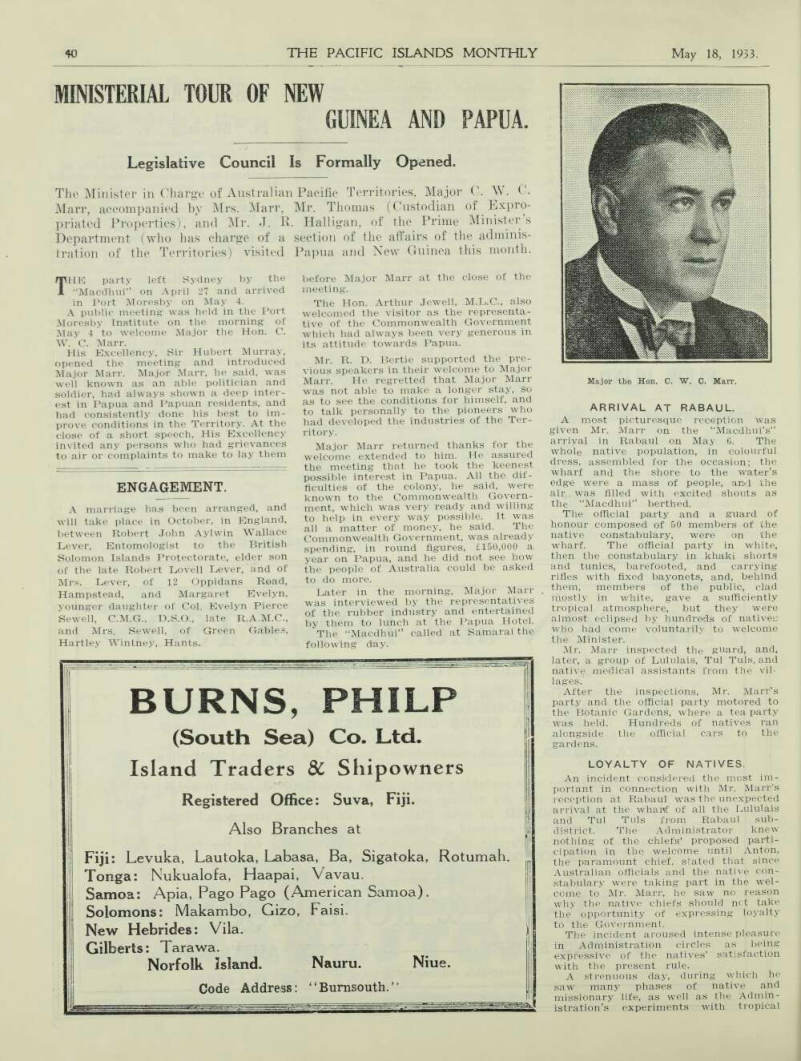
The Minister in Charge of Australian Pacific Territories, Major C. W. C.
Marr, accompanied by Mrs. Marr, Mr. Thomas (Custodian of Expro priated Properties), and Mr. J. R. Halligan, of the Prime Minister’s Department (who has charge of a section of the affairs of the adminis tration of the Territories) visited Papua and New Guinea this month.
THE party left Sydney by the “Macdhui” on April 27 and arrived in Port Moresby on May 4.
A public meeting was held in the Port Moresby Institute on the morning of May 4 to welcome Major the Hon. C.
W. C. Marr.
His Excellency, Sir Hubert Murray, opened the meeting and introduced Major Marr. Major Marr, he said, was well known as an able politician and soldier, had always shown a deep inter est in Papua and Papuan residents, and had consistently done his best to im prove conditions in the Territory. At the close of a short speech, His Excellency invited any persons who had grievances to air or complaints to make to lay them
before Major Marr at the close of the meeting.
The Hon. Arthur Jewell, M.L.C., also welcomed the visitor as the representa tive of the Commonwealth Government which had always been very generous in its attitude towards Papua.
Mr. R. D. Bertie supported the pre vious speakers in their welcome to Major Marr. He regretted that Major Marr was not able to make a longer stay, so as to see the conditions for himself, and to talk personally to the pioneers who had developed the industries of the Ter ritory.
Major Marr returned thanks for the welcome extended to him. He assured the meeting that he took the keenest possible interest in Papua. All the dif ficulties of the colony, he said, were known to the Commonwealth Govern ment, which was very ready and willing to help in every way possible. It was all a matter of money, he said. The Commonwealth Government, was already spending, in round figures, £150,000 a year on Papua, and he did not see how the people of Australia could be asked to do more.
Later in the morning, Major Marr was interviewed by the representatives of the rubber industry and entertained by them to lunch at the Papua Hotel.
The “Macdhui” called at Samarai the following day.
Arrival At Rabaul.
A most picturesque reception was given Mr. Marr on the “Macdhui’s” arrival in Rabaul on May 6. The whole native population, in colourful dress, assembled for the occasion; the wharf and the shore to the water’s edge were a mass of people, and the air was filled with excited shouts as the “Macdhui” berthed.
The official party and a guard of honour composed of 50 members of the native constabulary, were on the wharf. The official party in white, then the constabulary in khaki shorts and tunics, barefooted, and carrying rifles with fixed bayonets, and, behind them, members of the public, clad mostly in white, gave a sufficiently tropical atmosphere, but they were almost eclipsed by hundreds of natives who had come voluntarily to welcome the Minister.
Mr. Marr inspected the guard, and, later, a group of Lululais, Tul Tuls, and native, medical assistants from the vil lages.
After the inspections, Mr. Marr’s party and the official party motored to the Botanic Gardens, where a tea party was held. Hundreds of natives ran alongside the official cars to the gardens.
Loyalty Of Natives,
An incident considered the most im portant in connection with Mr. Marr’s reception at Rabaul was the unexpected arrival at the wharf of all the Lululais and Tul Tuls from Rabaul sub district. The Administrator knew nothing of the chiefs’ proposed parti cipation in the welcome until Anton, the paramount chief, stated that since Australian officials and the native con stabulary were taking part in the wel come to Mr. Marr, he saw no reason why the native chiefs should net take the opportunity of expressing loyalty to the Government.
The incident aroused intense pleasure in Administration circles as being expressive of the natives’ satisfaction with the present rule.
A strenuous day, during which he saw many phases of native and missionary life, as well as the Admin istration’s experiments with tropical
Major the Hon. C. W. C. Marr.
agriculture, was spent by Mr. Marr fol lowing his arrival in Rabaul.
On the morning of May 8 he motored to Keravat Experimental Plantation, passing on the 35 miles’ drive numerous plantations and native villages. At Keravat, the Director of Agriculture (Mr. Murray), and other officials showed Mr. Marr nearly every plant of agricultural value capable of being grown in the territory—delicately beau tiful kapok trees from Java, coffee plants, king coconuts, taro, tapioca, sugar, oil palm, rice, and many others.
The whole effect of the plantation was a representation in miniature of the economic resources and potentialities of the territory.
Visit To Missions.
Returning to Rabaul, Mr. Marr visited Vunairima Methodist Mission, one of the largest Methodist Missions in the territory, towards which Mr.
Stewart (the Minister for Commerce) has given large sums, and has estab lished and equipped a hospital. The Rev. L. A. McArthur showed the visitors native boys and girls learning to read and write their own language in copybooks, which displayed hand writing the equal of any in Australian schools.
In the afternoon Mr. Marr visited the Sacred Heart Mission at Kokopo, con ducted by the Catholic Church since 1882.
In a speech of welcome at Vunapope, Bishop Vesters spoke of the wish of the missionaries to co-operate in harmony with the Australian Administration.
Half-caste and native children who are educated at the Mission paraded with Australian flags and Union Jacks and wore red, white and blue sashes.
Mr. Marr read a special message to the children from the Apostolic Dele gate (Archbishop Cattaneo), Mr. Marr then visited the village of Kokopo, where he was the guest of the European residents at a tea-party.
Later the party witnessed a sing-sing.
Wearing long skirts of coconut fibre and elaborate headdresses of casso wary, cockatoo, and bird of paradise feathers, with their bodies painted and their hair artificially colored white, red and yellow, the natives leapt high in the air and danced continuously to the warlike beat of kundu drums and the chanting of wild choruses by the women.
When the party left at 6 o’clock the sing-sing was still in full swing.
Opening Of Legislative
Council.
In the afternoon of May 9, Mr. Marr officially opened the newly formed Legislative Council of New Guinea, which was the reason for the visit of the party.
Mr. Marr was received by Brigadier- General Griffiths and given a general salute by a guard of native police boys, carrying rifles and fixed bayonets, after which Mr. Marr inspected the guard, who wore khaki tunics, shorts, and peaked caps, and were bare footed.
Some distance away stood a group of natives wearing laplaps of many colours, but the crowd of whites and natives was much smaller than that which met Mr. Marr on the wharf on Sunday.
The Council Chamber is a fairly small room, raised high from the ground on piles. It accommodated only a few spectators, and several sat
on the wide verandah, which runs the length of the building. A feature of the speeches was appreciation of the granting of a measure of self government and determination to watch the well-being of natives as well as whites, emphasis being laid upon the obligations conferred by the League of Nations mandate.
The building, which is all of wood, is light and airy and, being built off the ground on piles is most suitable for assemblies in the humid climate of Rabaul. There was an entire absence of rhetoric in the speeches, which were formal in the extreme, members and residents appearing to view the cere mony with the greatest respect.
Mr. Marr’S Speech.
In declaring the first meeting of the Legislative Council open, Mr. Marr re ferred to the Council’s obligation to all the inhabitants. He quoted the peace treaty and said: ‘‘We would emphasise that it is the aim and the obligation of the mandatory power to carry out the trusts reposed in it not
only to the letter but in accordance with the spirit and intention under lying the mandate. The Common wealth Government is now calling upon the residents of this Territory to come forward with their specialised know ledge of local affairs to assist in the achievement of this trust.”
Mr. Marr at the outset, read a
message from the Governor-General (Sir Isaac Isaacs), conveying to the whole population of the Territory a cordial message of goodwill and sin cere wishes for a happy future. The message said that under the enlight ened care and leadership of Australia, the Territory had already made marked and lasting progress, both material and
spiritual, and he hoped that the re cent Commonwealth legislation would be a means of fulfilling to the utmost the primary and commanding trust of guarding and advancing the well being and development of the inhab itants, and, consistently with that, of promoting the general prosperity of the Territory.
The Prime Minister (Mr. Lyons) also sent a message of greeting and good wishes. He said the progress made by the Territory, under ordinances, fully warranted the action of the Common wealth Government in granting a new measure of local Government. They felt confident that the Council would be always guided by the consideration of the welfare of the whole of the in habitants of the Territory, and re minded them that the mandate con ferred much more an obligation than a benefit upon the power taking it up, since the principle had to be applied that the well-being and the development of peoples not yet able to stand by themselves formed a sacred trust of civilisation, an obligation that the Commonwealth Government had at all
times endeavoured, in relation to New Guinea and other territories, to fulfil.
Mr. Marr quoted the prophetic words of Sir William MacGregor, in formally declaring Papua a British possession in 1888 —“So much still remains to be made known in regard to the capabili ties of this great country that at pre sent no human eye can see far into its future. But we know well, from the rich experience gained elsewhere, that the material and economic develop ment of British New Guinea can safely be left to the energy, industry, and perseverance of our own race when their inherent qualities can fairly be brought to bear on the task. And the Queen’s sovereignty here will be a guarantee that every effort will be made to educate the native race and impart to them the great sublime truths of the Christian religion; and to teach them to value and respect law and order, and to appreciate justice. May God grant that our Sovereign’s rule of British New Guinea may secure pros perity, happiness, and contentment to the Queen’s subjects here, both old and new, and that the people of this land, now declared a British possession, may for all time look up with true loyalty and devotion to that flag which we are now to salute.”
Mr. Marr said that Sir William Mac Gregor’s few sentences enunciated a great British ideal —industry, honesty, and justice —which applied to the Ter ritory in the future as in the past, must eventually place New Guinea in the forefront of the producing countries of the world. The country’s growth and importance would confer greater responsibilities on its citizens with a right and a duty to make decisions of great moment. To-day’s ceremony in augurated the machinery to enable them to do so.
Mr. Marr paid a tribute to the un tiring efforts and deep interest of the first Administrator, General Wisdom, to whom largely was due the Leagues expressed approval of Australia’s administration.
Administrator's Reply.
Brigadier-General Griffiths, in reply, thanked Mr. Marr for performing the opening ceremony, and thanked the Governor-General (Sir Isaac Isaacs) and the Prime Minister (Mr. Lyons) for their messages. He emphasised that each non-official member had been appointed not as a representative of a particular section of the community, but of the whole, which fact, he felt confident, everyone would keep in mind when dealing with the affairs of the Territory.
Brigadier-General Griffiths said that the council would always endeavour to take a sane, reasonable view of affairs, and that the native population, equally with Europeans, would receive every consideration. “We all realise that the prosperity of the European residents and the development of the native population go hand in hand,” he said.
“One is dependent solely on the other.
The prosperity of the Europeans largely depends on native labour, and the development and advancement of the native race depends upon the means which the prosperity of the European residents provides. We have great faith in our Territory which is endowed by nature with an that makes for success, and we are determined to make it a success and to make Australia proud of its Ter
ritory and its administration. As an administration we must admit that in the past we have made mistakes at times, and no doubt shall in the future, but such mistakes will always be honest ones, made with the best in tentions.”
He expressed appreciation of the assistance at all times rendered to the Administration by mission bodies, and regretted that it was not considered reasonably practical to include repre sentatives of the predominant denomi nations on the council, though under the Act it would always be possible for them to place their views before the council.
Visit To Hospitals.
Before the ceremony, Mr. Marr paid a morning visit to the Rapindik native hospital. A feature of the hospital is the x-ray plant. Later, accompanied by Mrs. Marr, he called at the Euro pean hospital at Namanula.
After the ceremony of opening the Legislative Council, the party boarded the "Macdhui” for Lindenhafen en route to Salamaua and the goldfields.
At Lindenhafen.
Lindenhafen lived up to its reputa tion of being the wettest place on earth when the official party visited it. The ‘‘Macdhui’’ had to feel its way through heavy rain and rain fell in torrents most of the time Mr. Marr was ashore, where he visited the desic cated coconut factory. While his in spection was proceeding, Mrs. Francis, wife of the manager, entertained Mrs.
Marr at morning tea.
Goldfields’ Welcome.
The population of Salamaua turned out en masse to greet the official party when the “Macdhui’’ reached the port on the morning of May 11, and after a civic reception, Mr. Marr and party boarded ’planes for a flight to Wau via Lae.
The journey was made in perfect flying conditions and, on arrival at Wau, the visitors were received by Mr.
Hambridge, chairman of directors, and Mr. Harrison, general manager of New Guinea Goldfields.
Later, at Bulolo, they were received and entertained by the officials and staff of the Bulolo Gold Dredging Co.
All members of the party expressed astonishment at the almost incredible amount of work that has been carried out on the New Guinea fields and the fact that every pound of material had been carried in by ’plane especially impressed them on a tour of the works and settlement.
Adventurers In Hospital.
At Salamaua Hospital in the morning, Mr. Marr met two adventurers from the gold country—Mr. J. K. McCarthy, patrol officer of the Morobe district, who is recuperating from two arrow wounds received in a skirmish with wild natives a fortnight ago; and Mrs.
Doris Booth, who owns and manages the mine, Cliffside, on the Bulolo River, employing 91 native boys.
Mr. McCarthy told, how, during a patrol near the Papuan border at a point two days’ march from Otibanda police station on Surprise Creek, he and the police boys arrested 12 prisoners and were bringing them in to custody when they fell into an ambush.
In the next ward was Mrs. Booth, of "Mountains, Gold, and Can nibals,” who is recovering from an
attack of malaria. Mrs. Booth is a young slip of a woman, cultured, vivacious, and seemingly more suited to a city life than a life among savages.
She has been in the Territory for 12 years, first coming to the goldfields without experience of mining in 1924, and she has been living here ever since, with occasional vacations.