Naval Bases.
pp. 30-31 · Read in the full issue

Pacific Travellers’ Stories of Naval Bases.
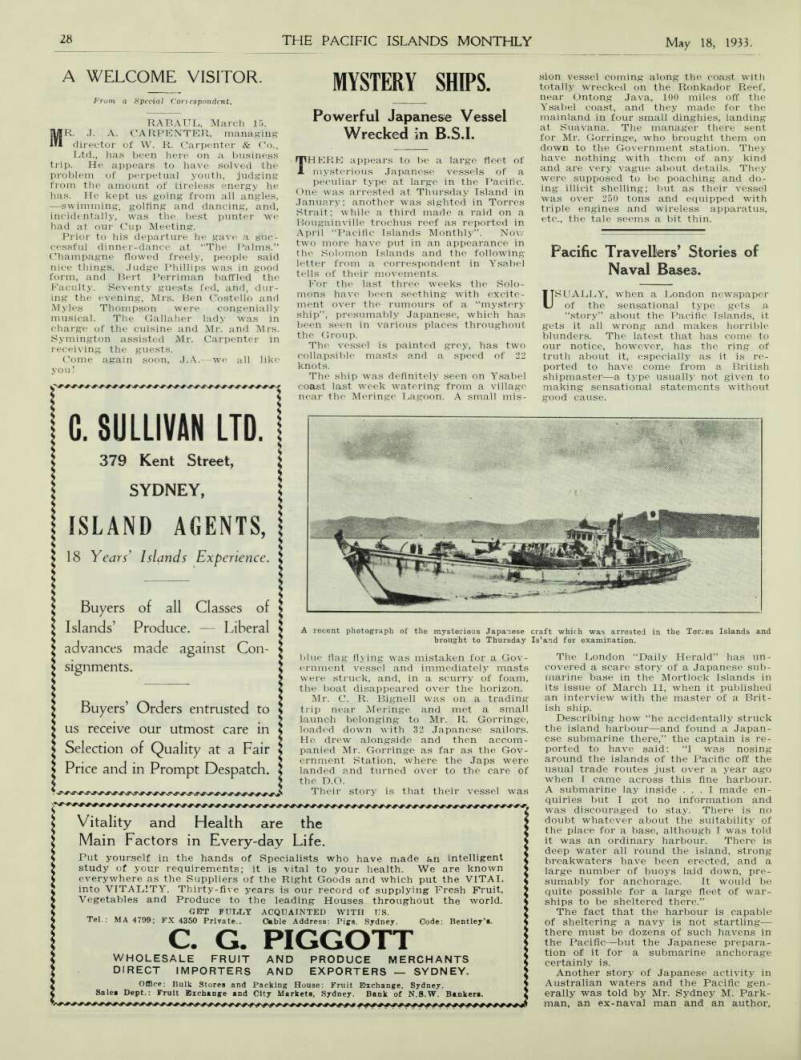
USUALLY, when a London newspaper of the sensational type gets a “story” about the Pacific Islands, it gets it all wrong and makes horrible blunders. The latest that has come to our notice, however, has the ring of truth about it, especially as it is re ported to have come from a British shipmaster—a type usually not given to making sensational statements without good cause.
The London “Daily Herald” has un covered a scare story of a Japanese sub marine base in the Mortlock Islands in its issue of March 11, when it published an interview with the master of a Brit ish ship.
Describing- how “he accidentally struck the island harbour —and found a Japan ese submarine there,” the captain is re ported to have said: “I was nosing around the islands of the Pacific off the usual trade routes just over a year ago when I came across this fine harbour.
A submarine lay inside ... I made en quiries but I got no information and was discouraged to stay. There is no doubt whatever about the suitability of the place for a base, although I was told it was an ordinary harbour. There is deep water all round the island, strong breakwaters have been erected, and a large number of buoys laid down, pre sumably for anchorage. It would be quite possible for a large fleet of war ships to be sheltered there.”
The fact that the harbour is capable of sheltering a navy is not startling— there must be dozens of such havens in the Pacific —but the Japanese prepara tion of it for a submarine anchorage certainly is.
Another story of Japanese activity in Australian waters and the Pacific gen erally was told by Mr. Sydney M. Park man, an ex-naval man and an author,
who arrived in Sydney by the tourist steamer “Ulysses”.
Interviewed by “The Sydney Morning Herald”, Mr. Parkman said it was “com mon knowledge in Cairns that Japanese beche-de-mer fishers have been taking soundings within the Great Barrier Reef and that, consequently, the Japanese are in possession of charts much better than those issued by the British Admiralty”.
"The Japanese are not doing that for fun,” declared Mr. Parkman, who em phasised the potentialities of Cairns as a forward cruiser and submarine base.
There are big openings with deep water in the Barrier Reef, sufficient for the requirements of the Navy,” he said, “and no enemy could possibly approach a fleet anchored at Cairns. The anchorage is perfectly safe. As far as the protection of the Pacific was concerned, Singapore was of no use. Hongkong was a death trap because a fleet could be hemmed in by mining its two approaches, Cairns, therefore, with its natural Barrier Reef defences, appealed to him as a defen sive base.
Mr. Parkman, who was enthusiastic about the tourist possibilities of the Barrier Reef, said that it was the pub licity it had received after the last tour ist cruise that had induced him to make the voyage. Unfortunately, the time was all too short in this truly remarkable place. The more it is known, the greater number of visitors will come to see it, he said, in urging Australians to give it wide publicity.