Blood-Thirsty Men Of Western Papua.
pp. 32-33 · Read in the full issue
How The Terrible Tugere Were Suppressed.
(Written for “The Pacific Islands Monthly” by Mollie Lett, Pt. Moresby, Papua.)
THE surmise that two young men from Thursday Island met their death recently at the hands of the Tugere while cruising the Torres Strait Islands, by Dutch New Guinea, brings to mind the early history of the Tugere and the incessant warfare that existed at one time between the tribes of New Guinea.
The most bloodthirsty were the Tugere. Headhunters and raiders, periodically they came past the Dutch border in their fighting canoes to re turn before the south east winds to their homes with victims and booty.
They laid waste the country-side, ravaging and burning as they ad vanced. The neighbouring tribes were no match for them. From the Bens bach River to the Mai-Kussa, including the islands of Saibai, Duaun and Boigu —the inhabitants took to the swamps and remained there until the raiders re treated.
As a body of men the Tugere were as fine and spectacular a tribe as could be found in the whole of New Guinea.
They were formidable in their fighting gear, with grotesque nose ornaments, and were armed with spears and clubs.
Tall, muscular and capable looking, of a light brown colour, with strong features, they stood out in contrast to the decadent people of the surround ing tribes who had from fear existed in the hidden water ways for genera tions. Their forces were surprisingly large for any tribe of New Guinea.
Captain Strachan, on his expedition to the Mai-kussa, west of the Fly River, in 1884 and 1885, met an advancing party on their annual raid and, from
his account, he was attacked by at least a thousand. He and his men were compelled to abandon their ves sel and retire overland, but failed to intimidate the Tugere even with Win chester rifles.
Mr. John Douglas, Special Commis sioner to New Guinea in 1886, com mented on the savagery of this tribe.
He said they involved themselves in ceaseless inter-tribal warfare, feuds and bloodshed, and decimated the countryside for miles. Their sacrifices were revolting, and their cruelty sur passed that of any tribe known; and Mr. Douglas doubted whether a day passed in the whole Protectorate in his time, without some murder or mass acre taking place. From one end of New Guinea to the other, a chronic
state of inter-tribal hostility pre vailed.
Sir William McGregor, Administrator of British New Guinea, was the first white man to get in touch with this tribe on anything like friendly terms.
In 1890, determined to relieve the western tribes from the terror caused by “this chimera,’’ he set out with a party for the western border, to visit the districts beyond the Mai-Kussa, and intercept them on their annual raid. He startled a band of gaily dressed warriors as he approached a village near the Dutch border, “and,” wrote Sir William, “I heard something beating on the creek, and a thrilling strain of a Papuan paean reached the ear. I suspected that we had at last met the Tugere Pirates. With a re sounding ‘Miro Miro’ (peace) from the crew and friendy signs, the drums ceased and weapons were lowered. An understanding was established and they lost their timidity in time as their numbers increased. About a hundred warriors gathered round and indicated by gestures that they were travelling eastwards to raid.”
It was the intention of Sir William McGregor to land at this stage, but he
found that they were well within Dutch Territory. He then turned east to dis pute their passage into British New Guinea. However, the motives of the party had roused the suspicions of the Tugere, and they became cautious and withdrew.
On his return from the west, Sir William insisted that these inroads must cease at any cost. He advised that they should get in touch with the Dutch authorities on the matter and proposed a station near the western border, with a force strong enough to stop invasions.
In 1890, a government station was fixed on Mabaduan Hill, near the entrance of the Kawa-Kussa, with Mr.
Cameron in command as Resident Magistrate, and later George Wriford, Commandant of the Native Armed Constabulary, and five men were sent as an added precaution. The marauders came over the border in 1891-2, annihilated a tribe near the Mai- Kussa, and crossed as far as the Gov ernment station; but escaped into the Dutch Territory with their victims be fore the force dispatched from Port Moresby could reach them.
Negotiations with the British and Dutch authorities over these inroads, resulted in an agreement in 1893, over a new boundary. This was the Bens
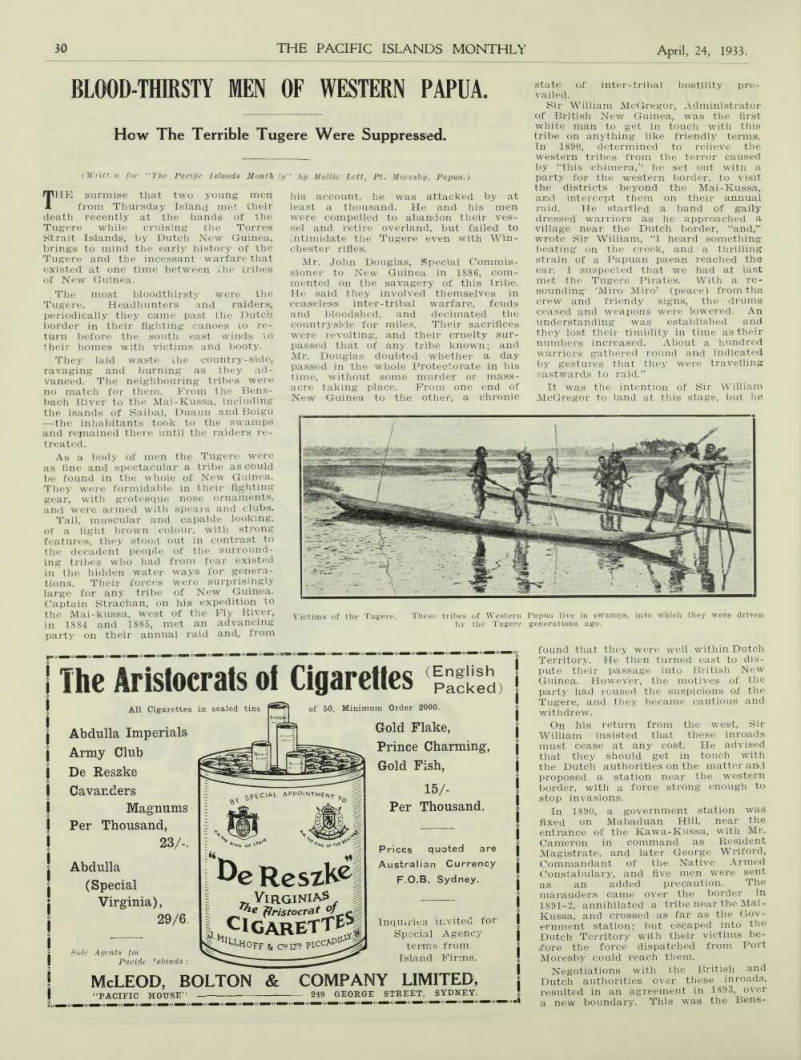
Victims of the Tugere. These tribes of Western Papua live in swamps, into which they were driven by the Tugere generations ago.
bach River, which had the advantage that both British and Dutch vessels could lie in wait to keep the Tugere in check as they advanced.
In 1896 the Tugere had at last their first serious set-back. They were met in their canoes off the mainland and drifted ashore. Four white men and twenty native police took part in the attack, routed them, and captured forty of their canoes. The sufferings and misery of the Tugere as they re treated from their refuge on the Mai- Kussa, overland through hostile coun try, was more than sufficient to dis courage their efforts for two or three years, though isolated attacks fol lowed.
The British and Dutch authorities met at Daru in 1900 to collect evidence of these massacres. They proceeded further west to the Morehead River, where not only were their police attacked, but the raiders caught red handed. A massacred village and headless victims told their own story and further evidence was unnecessary.
This last measure broke the defiance of the pirates. They lost confidence in their superiority, and from then on wards their invasions into Papua de creased.
But the terror of the Tugere still lives in the memory of the western people; the wholesale slaughter of the raiders and their sacrificial orgies will not easily be forgotten by the tribes which were once powerful clans and which still exist in privation in scat tered groups in the hidden waterways and swamps where they were driven in their flight.
Headhunting and raiding was a necessary part of the Tugere social
system, as it is to-day amongst the tribes not yet under control in the interior. They were committed either to pay back or to revenge some death by “Puri-Puri,” or simply to secure the social distinction of the homicide — a mark of prowess without which a man was cif no account in his own village. If every murder had to be re venged, incessant fighting had to con tinue; for, once the paying back sys tem was in full swing, the merry game went on until either side was exter minated. Ritual and ceremony per meated the whole existence of this tribe.
The fact that headhunting was not a crime at all, in the eyes of these people, but a solemn act of revenge and a passionate need, did not mitigate the horror of those days in the eyes of the Government, or restrain them in their determination to reduce the massacres.
The steady pacification of all the tribes of New Guinea was their ultimate goal.
There are to-day, some anthropolo gists who find certain justification for headhunting, as a part of the fecundity cult of some tribes, or as a means of placating the spirits of their dead.
They sympathise with the hunter of heads aud the cannibal.
Howevey the Government of Papua, to-day as in 1890, has no admiration for the picturesque or the bizarre.
Neither has it any interest in theories of the magic properties of human flesh or severed head.
No sympathy with the gay abandon of the raiding party can excuse the welter of bloodshed, which once pre vailed throughout Papua and which still continues at times outside the limits of government influence to-day.