An Impartial Man Looks at Samoa
pp. 5-8 · Read in the full issue
By Gordon Thomas, F.R.A.S., Etc.
IT is really a very difficult matter for that rather mysterious being —the man in the street—to form an adequate and logical opinion on such problems so widely discussed as India, Ireland and Samoa.
There has been so much propa ganda for and against. The pub licity agents of both sides have kept many linotypes working overtime, and if the man in the street —who is nobody else but you and I—con fines his reading to but one side of the question, he naturally becomes possessed of but one viewpoint.
I have always contended, and I hope I shall always continue to do so, that there are two sides to every question; and with this idea upper most in my mind during my recent travels in New Zealand I collected on every opportunity, facts, figures and expressions of opinion in con
Recently, when Mr. Gordon Thomas—a well-known resident of New Guinea, and a writer on many political and scientific subjects connected with the South Seas —was leaving for Auckland, we asked him to "take a look at the Samoan problem and let us know what he thought of it."
Mr Thomas not only looked: he appears to have made a thorough in spection; and his conclusions will he found hereunder. Like old Mr Roger de Goverley, he discovered that much may he said on both sides.
nection with Samoa and its prob lems.
In Auckland I was courteously received by the Hon. O. F. Nelson, as well as the editor of “The New Zealand Samoan Guardian”, Mr.
Andrew. I also made contact with many professional and business men whose interests demanded that they should be au fait with Samoan conditions. In Wellington I was as equally courteously received by the representative of the Government, who furnished me with all the in formation I asked for.
As a consequence I had informa tion from the principals of both sides, supplemented by the mews of the professions and commerce. With this valuable collection in hand, I sat me down to consider the problem with an open mind; but in which I must admit was a slight sentimental leaning towards the exiled Nelson and the well-beloved Samoans.
Sentiment and logic, however, do not and may not go hand in hand.
One is the antithesis of the other, so with this idea in view, I waged a
mental battle to eliminate my sen
timental leanings.
If one is studying the Irish or the
Indian problems, one must first be
come acquainted with the funda
mental characteristics of those
races: The development of physical
and mental traits; their psychologi
cal outlook; their natural tenden
cies and idiosyncracies. So, with the
Samoan problem, I sought me out
authoritative data which would
give me idea of the Samoan
character divested of its present
day influence from our own West
ern intriguing civilisation.
In Arnold Toynbee’s “Survey of
International Affairs” I found the
following information;—
The following are circumstances which throw light on events in Western Samoa during the period under review.
The date of this note is 23rd June, 1930: (1) Since its first impact with "civilisation" Samoa has played a part in international affairs quite dispropor tionate to its size, its population or its real importance. The Samoans have seen themselves and their little country the object of serious and lengthy dis cussion between Great Powers, and the result has been a not unnatural assump tion on their part that the Samoan people and the Samoan islands are and must be considerable factors in world affairs. (2) The history of Samoa, so far as we know it, has been a series of inter necine quarrels, agitation and disturb ances of varying severity. It is un necessary to call attention to the diffi culties experienced in pre-German days; the Germans had trouble from time to time and on occasion took drastic measures to deal with a serious situa tion; while New Zealand itself had a foretaste of the present difficulties in 1920. (3) The Samoans have a constitu tional leaning towards political intrigue, largely fostered no doubt by their form of family life and family dignities and the keen rivalry between numerous chiefs. It has been said that political discussion is the national pastime of the Samoans, who love nothing better than to gather in interminable fonos and to discuss in the minutest detail and at inordinate length any subject that is temporarily uppermost in their minds. (4) The Samoan has no need to work for his living—his modest wants are supplied by Nature with the smallest assistance from the hand of man. As a consequence his time is almost en tirely at his disposal for lengthy meet ings and debates; and, what is more important, there is no economic sanc tion to prevent his carrying on such a movement as the Mau indefinitely. In deed, he undoubtedly enjoys the intrigue and the accompanying sense of im portance. (5) The Samoan is at an early stage in the conflict between his traditional mode of life and western civilisation; and in consequence his intellect, not perhaps over-strong in respect of his own customary affairs, is not capable of appreciating in their proper pros pective the objects or the methods of modern administration. (6) Samoa contains an extraordinary
number of chiefs or persons of importance in comparison with its total population.
Roughly speaking, one out of every three adult males in the Territory is a chief, and each chief pays a jealous regard to his personal dignity and that of his family in relation to the growing or fading authority of other and rival chiefs and families. As one result, any chief who is distinguished either by Government appointment or indeed by Samoan selec tion is in a short period the object of the jealousy of his former peers, with a resultant tendency to a rapid and general loss of confidence. (7) Samoa contains a remarkably high proportion of half-castes to pure whites, and these half-castes are very largely concentrated at the same point as the pure Europeans, namely Apia. In the circumstances some sense of antagonism to the pure European on the part of the half-caste (with his traditional in feriority complex) has been inevitable. (8) At the outset of its administra tion the New Zealand Government took the step of placing the half-caste on all fours in every respect with the pure European. This may have been wise or unwise, but one result has been that where any antagonism, justifiable or otherwise, develops between the half caste and the pure European, the half caste is in a position to outnumber and outvote the pure white. (9) The half-caste with his Samoan connection and his intimate knowledge of the Samoan language and customs is in a more favourable position than the pure European to influence the sensi tive native opinion, at all times easily confused by a question of any com plexity. (10) The climate and the isolation of the Territory have an undoubted effect upon the mentality of Europeans resid ing in Samoa for a lengthy period, while the paucity of inhabitants brings into
full play all the “small town” charac teristics of gossip, jealousy and petty intrigue. (11) From another point of view a real difficulty has been to find suitable officers for native administration. New Zealand has, of course, no trained reser voir of native administrators such as is at the disposal of Great Britain, and it is felt that the Samoan Service as a whole has been at times to some extent defective from , the point of view of both the machinery of administration and of contact with the Samoans themselves.
Attempts are being made to remedy this, but difficulty will still be experi enced—at any rate in the immediate future—in finding suitable men for the Native Department with the necessary knowledge of the language and the cus toms and traditions of the people.
There are few experts on the Samoan, and among the few some belong to the “beach-comber” class (who could not possibly be made use of by the Adminis tration), while the remainder for the most part belong to the various mis sionary services. It is from the latter class that the principal officials in the Native Department have been selected in the past. (12) Finally, among the imponderables —and one which, it is believed, has played a very large part in the situa tion —has been the personal antipathy of Mr. Nelson and his family for Sir George Richardson.
I have no reason to suspect that
Toynbee’s description of the quali
ties of the Samoans is anything but
impartial and truthful.
We have, therefore, on the one
hand, the proud, independent
Samoan race, accustomed to parley
ing on equal terms with great Euro pean Powers; whilst on the other hand, we have the somewhat mili tantly inclined New Zealand Ad ministration tackling with a certain degree of apprehension and nerv ousness the care of its first “Colony”.
The Administration is beset with many difficulties, chief amongst which is its lack of knowledge of Samoan psychology and a greater ignorance of the complex nature of the “local born Europeans” or half caste population which, according to recent figures, number over 3000.
Of one thing I am sure: Had the Samoans — from the first — been gov erned by a tactful Administration with a knowledge of local condi tions and of the Samoan mind, much — if not all — the trouble could have been avoided. Whereas now there exists what may be truly described as a stalemate; though I am in clined to think that the Man has a lesser number of pieces on the board than the Administration and could the orators be furnished with a new and all-absorbing topic on which to concentrate their natural powers of rhetoric, the Mau and its present grievances would evaporate as the morning mists before the brilliant rays of the rising sun.
Space here will not enable me to detail the myriad complex phases that assail both sides. Even the fun damental cause of the trouble is de bated. One says one thing; the other another.
The New Zealand Government declared that the Administration copra-selling policy was responsible for much of the trouble. Mr. Nelson contradicts that, adding that the Administration’s copra-selling was not introduced until March, 1927, and the “trouble” commenced much earlier. Then a third party, in the form of “The Samoan Times’” comments on the contro versy and states the merchants’ op position to the Administration’s scheme dated from 1925.
And so it goes on, ad infinitum: Statements, contradictions, corrob orations, until the useless circle of controversy is completed and Truth seems hidden in a mass of verbiage.
In dozens of instances have I com pared statements and contradic tions and found invariably that most pernicious of all compositions:
A grossly exaggerated statement with but the vestige of truth which makes an absolute denial impos sible.
There are countless facets to this Samoan gem, which should natur ally be set amidst the tranquility of the Pacific, instead of riding bois teriously in such troubled waters.
There is the “Samoan Petition, 1921,” addressed to the British, United States and German Govern ments by the Man representatives, which claims to consist of 95 per cent, of the native inhabitants and describes the old Treaties made be tween the Powers and the Govern ment of Samoa back in 1878 and later.
There is to be considered “The Original Organic Law and Bill of Rights, 1873, and Constitution of Samoa, 1875,” both of which point to Samoa’s responsibility as a self governing power and is an argu ment in favour of the Samoan Man date being raised from a “C” to a “B” class Mandate.
There is also Mr. O. F. Nelson’s petition to the League of Nations, which consisted of 16 printed pages with 28 pages of annexures.
And then, not to be forgotten, is the very instructive pamphlet writ ten by a one-time Registrar of the Auckland University, Mr. A. B.
Chappell, M.A., entitled “The Stir in Samoa,” which purports to be an independent review of the whole situation and deals in no little measure with the political propa ganda used by the Leader of the Opposition during a New Zealand election in 1928 and is a document that warrants careful study.
There is also the finding of the
Samoan Commission in 1927. A commission which was, according to Mr. Nelson, “unfair and partisan.”
And, further, the report of the Permanent Mandates Commission to the League of Nations which “considered none of the charges of any importance against the Admin istration which have been made in the various petitions has been sub stantiated.”
So many facets! So many moves upon the “Checker boards of nights and days.” And all for, what?
The preservation of the bureau cratic pride of a young Dominion experimenting with its first “colony”?
The proud obstinacy born of a slight to the hypersensitive ego of a successful local-born European in Samoa?
There have been mistakes on both sides. There has been unmitigated bitterness fostered by introspection and narrowed vision; colossal ego ism and, above all else, a persist ently encouraged misunderstanding of the other fellow’s viewpoint.
A little less self-assertiveness and a little more self-effacement will do much to bring both sides to a bet ter understanding. There must be giving and taking on both sides be fore a reconciliation is possible.
Neither should have all. Neither should give all. * * * “Your term of deportation ex pired last December.” I remarked to the Hon. O. F. Nelson, at the be ginning of February. “When do you contemplate returning?"
“That,” replied Taisi, “is on the lap of the gods.”
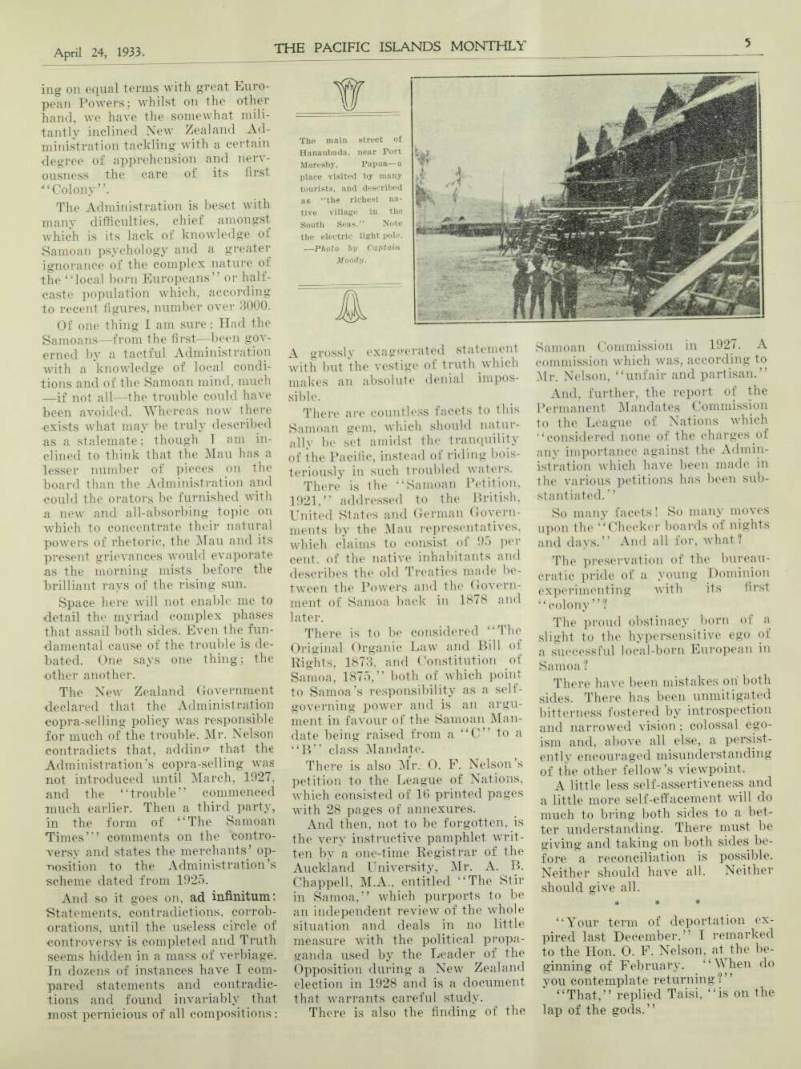
The main street of Hanaubada, near Port Moresby, Papua—a place visited by many tourists, and described as “the richest na tive village in the South Seas." Note the electric light pole.
Photo by Captain Moody.
His answer made me wonder; and then I realised that this much talked-of man who had championed a cause so persistently was a local born European with the blood of Northern Vikings and Southern Samoans in his veins, and he pos sessed a quality unknown to those against whom he was waging war.
He had an intimate knowledge of Samoan psychology. He knew only too well that a European’s word once given to a native was a bond —a sacred promise to be fulfilled.
He had undertaken to bring to a satisfactory conclusion the desires so volubly expressed by the Samoan chiefs and orators. Up to the pre sent he had failed, despite the fight he had put up which had echoed round the world and occupied the attention of judges, commissions and international tribunals. Is it not possible that his return is being delayed on account of that very knowledge he possesses of the na tive mind and the possible attitude which may be adopted towards him if he returns with an unfulfilled promise ? (It is announced elsewhere that Mr. Nelson and his family leave N.Z. for Samoa early next month. —Ed. P.I.M.) Both the Samoan Administration and Taisi should drop their narrow policies of personal animosities and concentrate their energies on bigger issues; allow their horizons to broaden; compromise. There must be give-and-take for both parties before a thorough reconciliation can be brought about. Create a new vital interest for the orators; ad vance the Samoan Mandate to “B” class; and let the Administration cease its copra-purchase scheme. * * * An official was endeavouring to impress upon a Samoan the insigni ficant size of his islands as com pared with the countries of the great Powers of the world. A map of the world was unfolded.
“See,” said the official, pointing to the small dots in the Pacific rep resenting Samoa, “those are your islands.”
“I see,” the native replied, still increduously, “but who made the map?"
That is the position in Samoa to day.
At midnight on June 29, a census of the non-indigenous population of the Mandated Territory of New Guinea will be taken. The District Officers of the various districts will be responsible for the distribution and collection of the census papers.