British Administrative Prestige And
pp. 42-43 · Read in the full issue
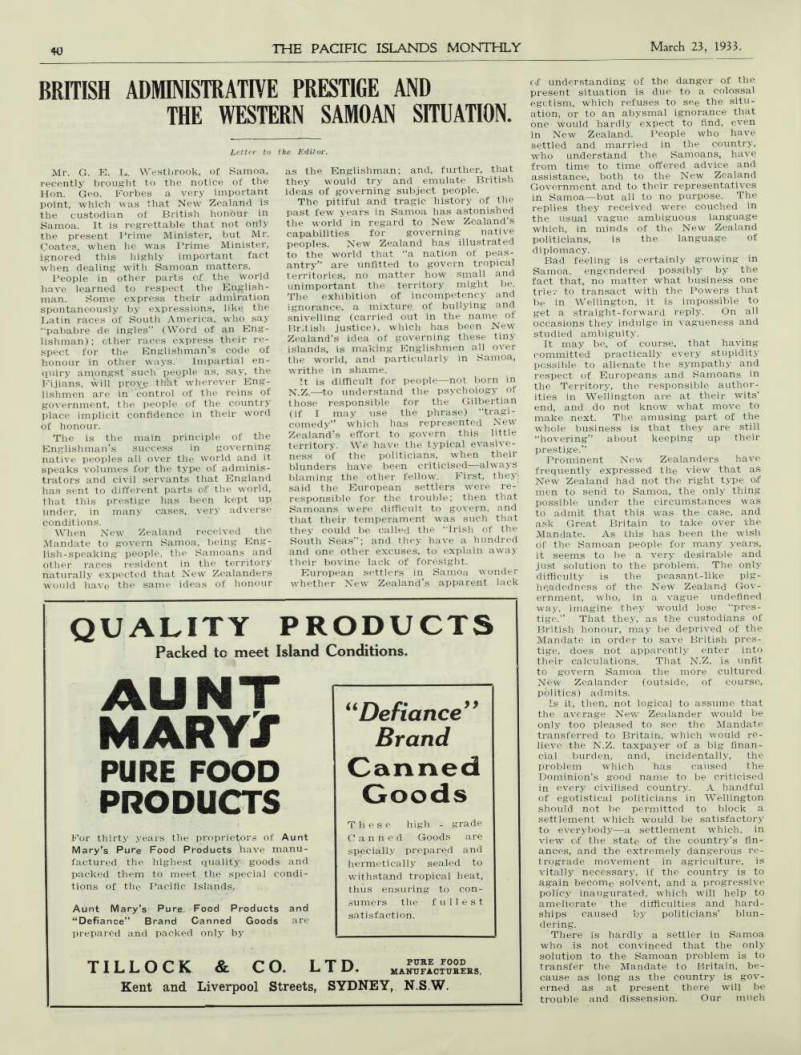
The Western Samoan Situation.
Letter to the Editor.
Mr. G. E. L. Westbrook, of Samoa, recently brought to the notice of the Hon. Geo. Forbes a very important point, which was that New Zealand is the custodian of British honour in Samoa. It is regrettable that not only the present Prime Minister, but Mr.
Coates, when he was Prime Minister, ignored this highly important fact when dealing with Samoan matters.
People in other parts of the world have learned to respect the English man. Some express their admiration spontaneously by expressions, like the Latin races of South America, who say “pababre de ingles” (Word of an Eng lishman); other races express their re spect for the Englishman’s code of honour in other ways. Impartial en quiry amongst such people as, say, the Fijians, will prove that wherever Eng lishmen are in control of the reins of government, the people of the country place implicit confidence in their word of honour.
The is the main principle of the Englishman’s success in governing native peoples all over the world and it speaks volumes for the type of adminis trators and civil servants that England has sent to different parts of the world, that this prestige has been kept up under, in many cases, very adverse conditions.
When New Zealand received the Mandate to govern Samoa, being Eng lish-speaking people, the Samoans and other races resident in the territory naturally expected that New Zealanders would have the same ideas of honour
as the Englishman; and, further, that they would try and emulate British ideas of governing subject people.
The pitiful and tragic history of the past few years in Samoa has astonished the world in regard to New Zealand’s capabilities for governing native peoples. New Zealand has illustrated to the world that “a nation of peas antry” are unfitted to govern tropical territories, no matter how small and unimportant the territory might be.
The exhibition of incompetency and ignorance, a mixture of bullying and snivelling (carried out in the name of British justice), which has been New Zealand’s idea of governing these tiny islands, is making Englishmen all over the world, and particularly in Samoa, writhe in shame.
It is difficult for people—not born in N.Z. —to understand the psychology of those responsible for the Gilbertian (if I may use the phrase) “tragi comedy” which has represented New Zealand’s effort to govern this little territory. We have the typical evasive ness of the politicians, when their blunders have been criticised —always blaming the other fellow. First, they said the European settlers were re responsible for the trouble; then that Samoans were difficult to govern, and that their temperament was such that they could be called the “Irish of the South Seas”; and they have a hundred and one other excuses, to explain away their bovine lack of foresight.
European settlers in Samoa wonder whether New Zealand’s apparent lack
cf understanding of the danger of the present situation is due to a colossal egotism, which refuses to see the situ ation, or to an abysmal ignorance that one would hardly expect to find, even in New Zealand. People who have settled and married in the country, who understand the Samoans, have from time to time offered advice and assistance, both to the New Zealand Government and to their representatives in Samoa —but all to no purpose. The replies they received were couched in the usual vague ambiguous language which, in minds of the New Zealand politicians, is the language of diplomacy.
Bad feeling is certainly growing in Samoa, engendered possibly by the fact that, no matter what business one trie? to transact with the Powers that be in Wellington, it is impossible to get a straight-forward reply. On all occasions they indulge in vagueness and studied ambiguity.
It may be, of course, that having committed practically every stupidity possible to alienate the sympathy and respect of Europeans and Samoans in the Territory, the responsible author ities in Wellington are at their wits’ end, and do not know what move to make next. The amusing part of the whole business is that they are still “hovering” about keeping up their
prestige.”
Prominent New Zealanders have frequently expressed the view that as New Zealand had not the right type of men to send to Samoa, the only thing possible under the circumstances was to admit that this was the case, and ask Great Britain to take over the Mandate. As this has been the wish Of the Samoan people for many years, it seems to be a very desirable and just solution to the problem. The only difficulty is the peasant-like pig headedness of the New Zealand Gov ernment, who, in a vague undefined way, imagine they would lose “pres tige.” That they, as the custodians of British honour, may be deprived of the Mandate in order to save British pres tige, does not apparently enter into their calculations. That N.Z, is unfit to govern Samoa the more cultured New Zealander (outside, of course, politics) admits.
Is it, then, not logical to assume that the average New Zealander would be only too pleased to see the Mandate transferred to Britain, which would re lieve the N.Z. taxpayer of a big finan cial burden, and, incidentally, the problem which has caused the Dominion’s good name to be criticised in every civilised country. A handful of egotistical politicians in Wellington should not be permitted to block a settlement which would be satisfactory to everybody —a settlement which, in view of the state of the country’s fin ances, and the extremely dangerous re trograde movement in agriculture, is vitally necessary, if the country is to again become solvent, and a progressive policy inaugurated, which will help to ameliorate the difficulties and hard ships caused by politicians’ blun dering.
There is hardly a settler in Samoa who is not convinced that the only solution to the Samoan problem is to transfer the Mandate to Britain, be cause as long as the country is gov erned as at present there will be trouble and dissension. Our much
vaunted “British justice” (not very evident in Samoa) demands an early settlement of this question, in fairness to the Samoans and European settlers. New Zealand has worn the cap and bells for the League of Nations quite long enough.
I am, etc.,
Dirigo.
Apia,
Jan. 6, 1933.
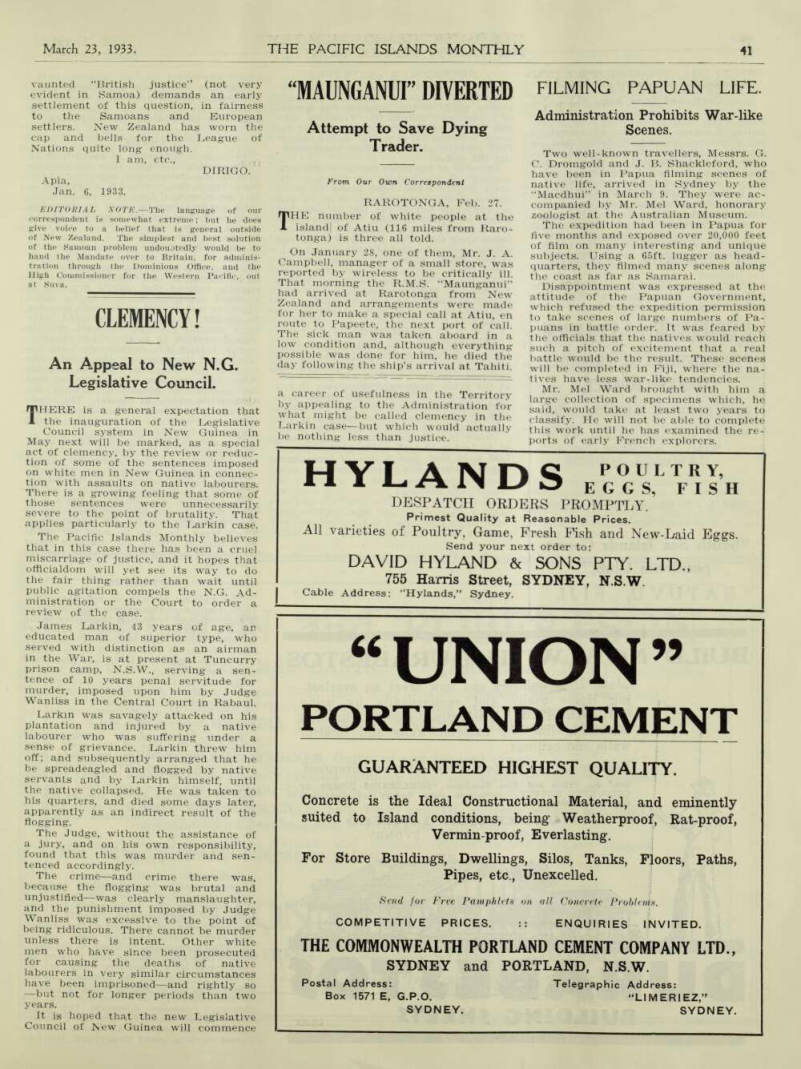
EDITORIAL NOTE. —The language of our correspondent is somewhat extreme; but he does give voice to a belief that is general outside of New Zealand. The simplest and best solution of the Samoan problem undoubtedly would be to hand the Mandate over to Britain, for adminis tration through the Dominions Office, and the High Commissioner for the Western Pacific, out at Suva.