Dairying Industry In Fiji.
pp. 29-30 · Read in the full issue
Interesting Development In Tropical Country.
THAT dairying in Fiji will become a solidly profitable industry is the belief of many residents, among whom is Sir Maynard Hedstrom. He read a paper on “The Prospects of the Industry,” at a recent Agricultural Conference at Suva.
Assisted by an import tax of 4d. per lb. on butter, three dairy factories have been producing butter from cows pas tured on 8,000 acres of excellent dairy country. At present the industry gives employment to 52 families. The Agri cultural Department estimated the amount of butter produced and con sumed locally during 1933 at 300,000 lbs., and the capital invested in live stock, factories, machinery, farm buildings and equipment is £58,000, without the capital value of farm land.
The progress of the industry has been satisfactory, even when floods in the Rewa and Navua districts are taken into consideration. In 1921, 137,688 lbs. of butter valued at £13,887 were imported; and in 1932 the three factories supplied all local demands and have an exportable surplus of 250,000 lbs., valued at £11,000. The total out put in 1932 was estimated at 550,000 lbs.
Sir Maynard explained that the im port duty is still necessary, as over head and manufacturing charges are high, due to three small and widely scattered factories handling the output.
He is of opinion that the factories will be on a good payable basis when an output of 200 tons per annum is reached, but this, of course, depends on the price of butter in the London market.
An increase in production is almost assured, as a 25 per cent, increase In the number of milking cows is reckoned on during the next two years.
This estimate is not hastily arrived at but is borne out by the accurate re turns kept by the Fiji Pastoral Co. Ltd.
An increase in average production is also looked for, as herds are steadily being improved. Herd testing is more general throughout the Colony. The Fiji Pastoral Co. about two years ago engaged a qualified tester and is now reaping the benefit of his services. An extension and improvement of pastures —another factor in increased produc tion—is being made.
Sir Maynard Hedstrom, speaking of the influence of the tropics on butter fat production said: “It is sometimes suggested that in a tropical country cows will not give a reasonable yield of butter-fat, but this theory is not substantiated by experi ence in Fiji. Records of individual cows give some curious results: “The largest producer for a single lactation period was 56-F. (Jersey), which produced 485 lbs., but the lac tation period extended for 540 days.
The cow appears to be quite normal and is in calf again.
“Five Jerseys produced over 1 lb. of butter-fat per day, extended over what might be termed a normal lactation period, and probably the best of these
was Jersey 83-F. with 372 lbs. in 300 days—very nearly 1¼ lbs. per day.
“Only one Friesian is recorded as having produced over 1 lb. butter-fat per day and that is D.T.F. with 314 lbs. in 307 days.
“Curiously enough, this result is beaten by one of the ‘local cows’—B-92- F.—with 358 lbs. in 334 days.
“Out of the Fiji Pastoral Co.’s 700 or 800 cows there are about 100 which
produce over 300 lbs. butter-fat within the normal lactation period. Accord ing to our experience the locally bred heifers (grade Jersey and grade Fries ian) are at least equal to their im ported grade Jersey or Friesian dams.
A cow producing over 300 lbs. butter fat on plain pasture with no artificial feeding would be considered a good cow anywhere.
“In 1924 I visited one of the show dairy farms of Denmark, where the poorest producing cow on the farm re turned 400 lbs. butter fat per annum, but that result was achieved by lavish and scientific feeding—each cow re ceived a balanced ration suited to her requirements and a separate ledger ac count was kept for each cow in which she-was charged with the value of the
food supplied and credited with the value of butter fat produced.
“The results so far achieved in Fiji lead one to cherish the hope that in seven or eight years’ time there will be some dairy farms on which the aver age production per cow will be not less than 200 lbs. butter fat per annum.
When that average has been reached there will be no doubt as to dairying proving profitable in Fiji.”
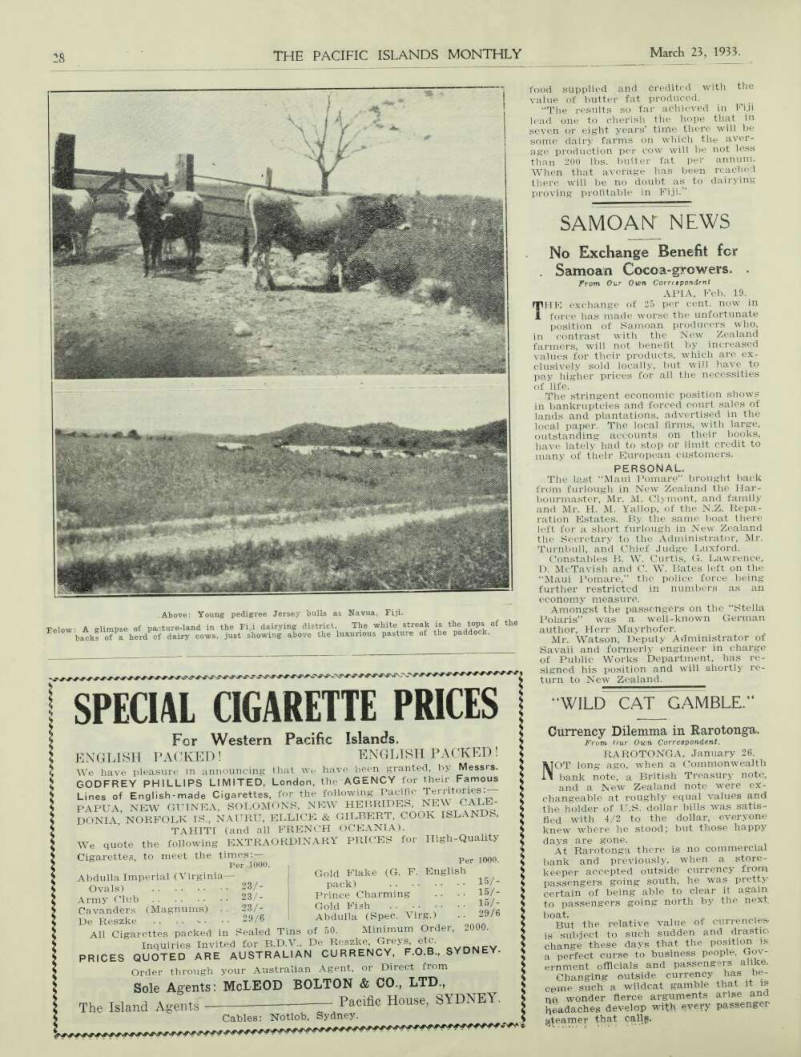
Above: Young pedigree Jersey bulls at Navua, Fiji.
Below: A glimpse of pasture-land in the Fiji dairying district. The white streak is the tops of the backs of a herd of dairy cows, just showing above the luxurious pasture of the paddock.