Literary Sewage And The South Seas.
p. 20 · Read in the full issue
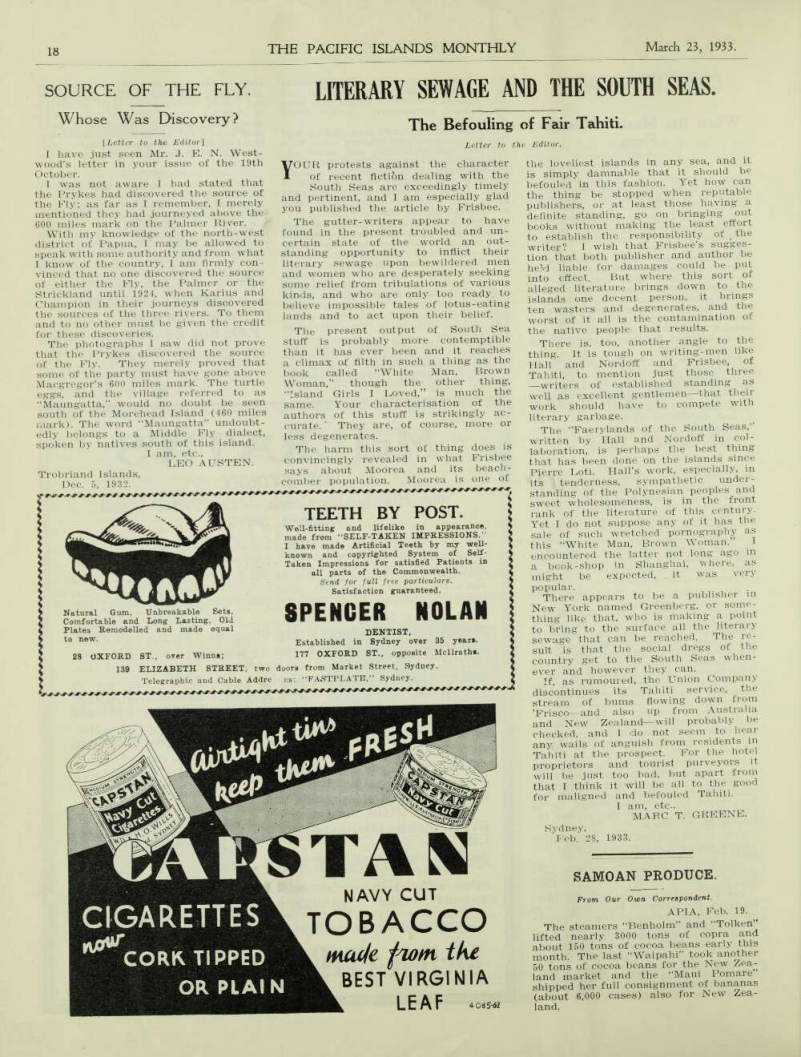
The Befouling of Fair Tahiti.
Letter to the Editor.
YOUR protests against the character of recent fiction dealing with the South Seas are exceedingly timely and pertinent, and I am especially glad you published the article by Frisbee.
The gutter-writers appear to have found in the present troubled and un certain state of the world an out standing opportunity to inflict their literary sewage upon bewildered men and women who are desperately seeking some relief from tribulations of various kinds, and who are only too ready to believe impossible tales of lotus-eating lands and to act upon their belief.
The present output of South Sea stuff is probably more contemptible than it has ever been and it reaches a climax of filth in such a thing as the book called “White Man, Brown Woman,” though the other thing, “Island Girls I Loved,” is much the same. Your characterisation of the authors of this stuff is strikingly ac curate. They are, of course, more or less degenerates.
The harm this sort of thing does is convincingly revealed in what Frisbee says about Moorea and its beach comber population. Moorea is one of
the loveliest islands in any sea, and it is simply damnable that it should be befouled in this fashion. Yet how can the thing be stopped when reputable publishers, or at least those having a definite standing, go on bringing out books without making the least effort to establish the responsibility of the writer? I wish that Frisbee’s sugges tion that both publisher and author be held liable for damages could be put into effect. But where this sort of alleged literature brings down to the islands one decent person, it brings ten wasters and degenerates, and the worst of it all is the contamination of the native people that results.
There is, too, another angle to the thing. It is tough on writing-men like Hall and Nordoff and Frisbee, of Tahiti, to mention just those three —writers of established standing as well as excellent gentlemen —that their work should have to compete with literary garbage.
The “Faerylands of the South Seas,’’ written by Hall and Nordoff in col laboration, is perhaps the best thing that has been done on the islands since Pierre Loti. Hall’s work, especially, in its tenderness, sympathetic under standing of the Polynesian peoples and sweet wholesomeness, is in the front rank of the literature of this century.
Yet I do not suppose any of it has the sale of such wretched pornography as this “White Man, Brown Woman.” I encountered the latter not long ago in a book-shop in Shanghai, where, as might be expected, it was very popular.
There appears to be a publisher in New York named Greenberg, or some thing like that, who is making a point to bring to the surface all the literary sewage that can be reached. The re sult is that the social dregs of the country get to the South Seas when ever and however they can.
If, as rumoured, the Union Company discontinues its Tahiti service, the stream of bums flowing down from ’Frisco—and also up from Australia and New Zealand—will probably be checked, and I do not seem to hear any wails of anguish from residents in Tahiti at the prospect. For the hotel proprietors and tourist purveyors it will be just too bad, but apart from that I think it will be all to the good for maligned and befouled Tahiti.
I am, etc.,
Marc T. Greene.
Sydney, Feb. 28, 1933.