The Pacific Islands.
pp. 37-44 · Read in the full issue
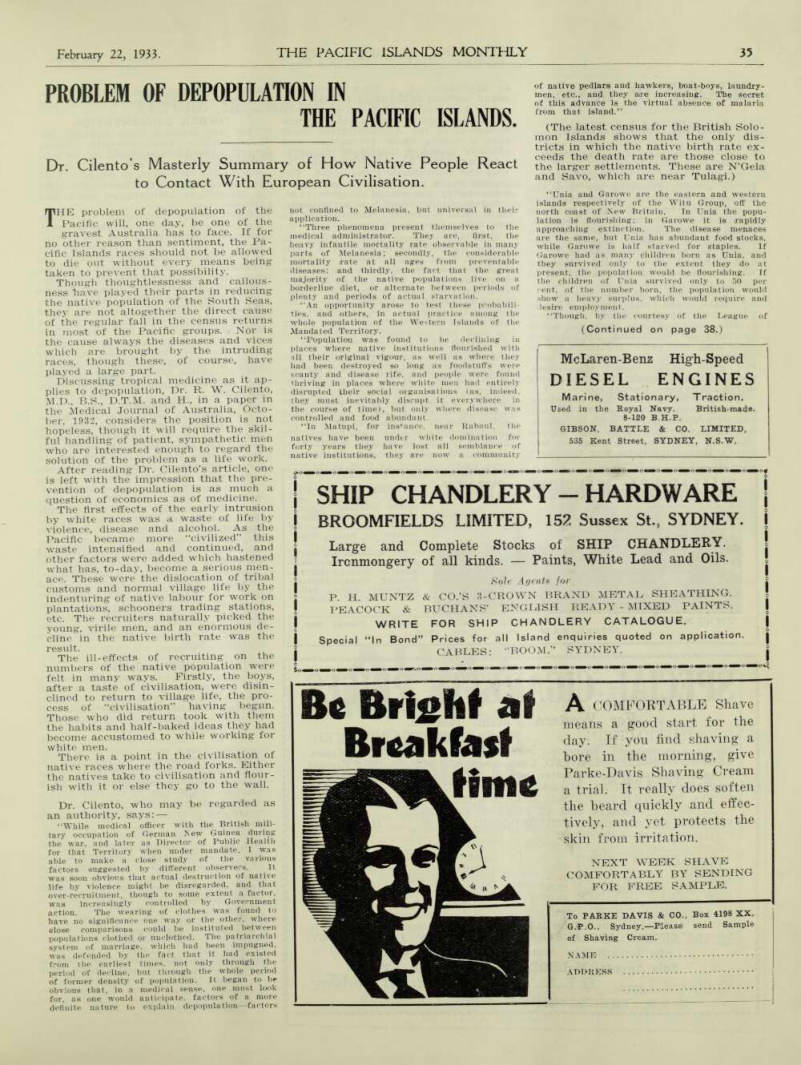
Problem Of Depopulation In
Dr. Cilento’s Masterly Summary of How Native People React to Contact With European Civilisation.
THE problem of depopulation of the Pacific will, one day, be one of the gravest Australia has to face. If for no other reason than sentiment, the Pa cific Islands races should not be allowed to die out without every means being taken to prevent that possibility.
Though thoughtlessness and callous ness have played their parts in reducing the native population of the South Seas, they are not altogether the direct cause of the regular fall in the census returns in most of the Pacific groups. Nor is the cause always the diseases and vices which are brought by the intruding races, though these, of course, have played a large part.
Discussing tropical medicine as it ap plies to depopulation, Dr. R. W. Cilento, M.D., B.S., D.T.M. and H., in a paper in the Medical Journal of Australia, Octo ber, 1932, considers the position is not hopeless, though it will require the skil ful handling of patient, sympathetic men who are interested enough to regard the solution of the problem as a life work.
After reading Dr. Cilento’s article, one is left with the impression that the pre vention of depopulation is as much a question of economics as of medicine.
The first effects of the early intrusion by white races was a waste of life by violence, disease and alcohol. As the Pacific became more “civilized” this waste intensified and continued, and other factors were added which hastened what has, to-day, become a serious men ace. These were the dislocation of tribal customs and normal village life by the indenturing of native labour for work on plantations, schooners trading stations, etc. The recruiters naturally picked the young, virile men, and an enormous de cline in the native birth rate was the result.
The ill-effects of recruiting on the numbers of the native population were felt in many ways. Firstly, the boys, after a taste of civilisation, were disin clined to return to village life, the pro cess of “civilisation” having begun.
Those who did return took with them the habits and half-baked ideas they had become accustomed to while working for white men.
There is a point in the civilisation of native races where the road forks. Either the natives take to civilisation and flour ish with it or else they go to the wall.
Dr. Cilento, who may be regarded as an authority, says: ‘‘While medical officer with the British mili tary occupation of German New Guinea during the war, and later as Director of Public Health for that Territory when under mandate, I was able to make a close study of the various factors suggested by different observers. It was soon obvious that actual destruction of native life by violence might be disregarded, and that over-recruitment, though to some extent a factor, was increasingly controlled by Government action. The wearing of clothes was found to have no significance one way or the other, where close comparisons could be instituted between populations clothed or unclothed. The patriarchial system of marriage, which had been impugned, was defended by the fact that it had existed from the earliest times, not only through the period of decline, but through the whole period of former density of population. It began to be obvious that, in a medical sense, one must look for, as one would anticipate, factors of a more definite nature to explain depopulation—factors
not confined to Melanesia, but universal in their application. ‘‘Three phenomena present themselves to the medical administrator. They are, first, the heavy infantile mortality rate observable in many parts of Melanesia; secondly, the considerable mortality rate at all ages from preventable diseases; and thirdly, the fact that the great majority of the native populations live on a borderline diet, or alternate between periods of plenty and periods of actual starvation. ‘‘An opportunity arose to test these probabili ties, and others, in actual practice among the whole population of the Western Islands of the Mandated Territory. ‘‘Population was found to be declining in places where native institutions flourished with all their original vigour, as well as where they had been destroyed so long as foodstuff’s were scanty and disease rife, and people were found thriving in places where white men had entirely disrupted their social organisations (as, indeed, they must inevitably disrupt it everywhere in the course of time), but only where disease was controlled and food abundant. ‘‘ln Matupi, for instance, near Rabaul, the natives have been under white domination for forty years they have lost all semblance of native institutions, they are now a community
of native pedlars and hawkers, boat-boys, laundry men, etc., and they are increasing. The secret of this advance is the virtual absence of malaria from that island.” (The latest census for the British Solo mon Islands shows that the only dis tricts in which the native birth rate ex ceeds the death rate are those close to the larger settlements. These are N’Gela and Savo, which are near Tulagi.) ‘‘Unia and Garowe are the eastern and western islands respectively of the Witu Group, off the north coast of New Britain. In Unia the popu lation is flourishing: in Garowe it is rapidly approaching extinction. The disease menaces are the same, but Unia has abundant food stocks, while Garowe is half starved for staples. If Garowe had as many children born as Unia, and they survived only to the extent they do at present, the population would be flourishing. If the children of Unia survived only to 50 per cent, of the number born, the population would show a heavy surplus, which would require and desire employment. ‘‘Though, by the courtesy of the League of
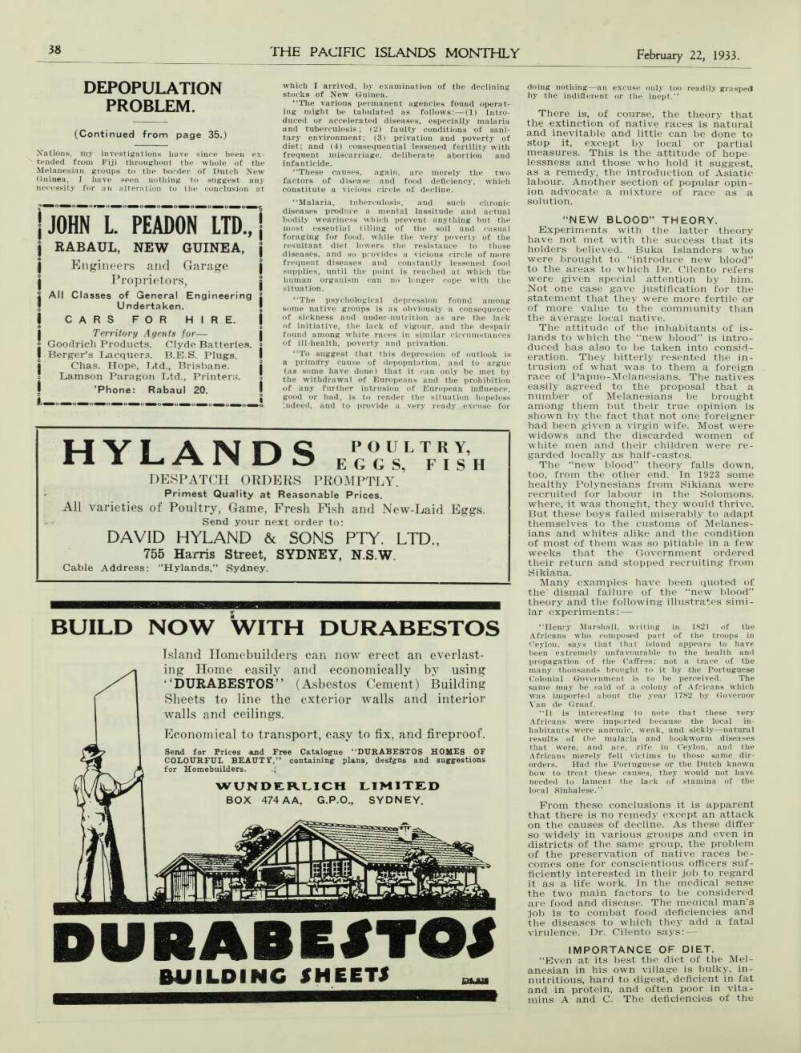
(Continued on page 38.)
Nations, my investigations have since been ex tended from Fiji throughout the whole of the Melanesian groups to the border of Dutch New Guinea, I have seen nothing to suggest any necessity for an alteration to the conclusion at
which I arrived, by examination of the declining stocks of New Guinea.
“The various permanent agencies found operat ing might be tabulated as follows;—(1) Intro duced or accelerated diseases, especially malaria and tuberculosis; (2) faulty conditions of sani tary environment; (3) privation and poverty of diet; and (4) consequential lessened fertility with frequent miscarriage, deliberate abortion and infanticide.
“These causes, again, are merely the two factors of disease and food deficiency, which constitute a vicious circle of decline.
“Malaria, tuberculosis, and such chronic diseases produce a mental lassitude and actual bodily weariness which prevent anything but the most essential tilling of the soil and casual foraging for food, while the very poverty of the resultant diet lowers the resistance to those diseases, and so provides a vicious circle of more frequent diseases and constantly lessened food supplies, until the point is reached at which the human organism can no longer cope with the situation.
“The psychological depression found among some native groups is as obviously a consequence of sickness and under-nutrition as are the lack of initiative, the lack of vigour, and the despair found among white races in similar circumstances of ill-health, poverty and privation.
“To suggest that this depression of outlook is a primary cause of depopulation, and to argue (as some have done) that it can only be met by the withdrawal of Europeans and the prohibition of any further intrusion of European influence, good or bad, is to render the situation hopeless indeed, and to provide a very ready excuse for
doing nothing—an excuse only too readily grasped by the indifferent or the inept.”
There is, of course, the theory that the extinction of native races is natural and inevitable and little can be done to stop it, except by local or partial measures. This is the attitude of hope lessness and those who hold it suggest, as a remedy, the introduction of Asiatic labour. Another section of popular opin ion advocate a mixture of race as a solution.
“New Blood” Theory.
Experiments with the latter theory have not met with the success that its holders believed. Buka Islanders who were brought to “introduce new blood” to the areas to which Dr. Cilento refers were given special attention by him.
Not one case gave justification for the statement that they were more fertile or of more value to the community than the average local native.
The attitude of the inhabitants of is lands to which the “new blood” is intro duced has also to be taken into consid eration. They bitterly resented the in trusion of what was to them a foreign race of Papuo-Melanesians. The natives easily agreed to the proposal that a number of Melanesians be brought among them but their true opinion is shown by the fact that not one foreigner had been given a virgin wife. Most were widows and the discarded women of white men and their children were re garded locally as half-castes.
The “new blood” theory falls down, too, from the other end. In 1923 some healthy Polynesians from Sikiana were recruited for labour in the Solomons, where, it was thought, they would thrive.
But these boys failed miserably to adapt themselves to the customs of Melanes ians and whites alike and the condition of most of them was so pitiable in a few weeks that the Government ordered their return and stopped recruiting from Sikiana.
Many examples have been quoted of the' dismal failure of the “new blood” theory and the following illustrates simi lar experiments: “Henry Marshall, writing in 1821 of the Africans who composed part of the troops in Ceylon, says that that island appears to have been extremely unfavourable to the health and propagation of the Caffres: not a trace of the many thousands brought to it by the Portuguese Colonial Government is to be perceived. The same may be said of a colony of Africans which was imported about the year 1782 by Governor Van de Graaf.
“It is interesting to note that these very Africans were imported because the local in habitants were anaemic, weak, and sickly—natural results of the malaria and hookworm diseases that were, and are, rife in Ceylon, and the Africans merely fell victims to those same dir orders. Had the Portuguese or the Dutch known how to treat these causes, they would not have needed to lament the lack of stamina of the local Sinhalese.”
From these conclusions it is apparent that there is no remedy except an attack on the causes of decline. As these differ so widely in various groups and even in districts of the same group, the problem of the preservation of native races be comes one for conscientious officers suf ficiently interested in their job to regard it as a life work. In the medical sense the two main factors to be considered are food and disease. The medical man’s job is to combat food deficiencies and the diseases to which they add a fatal virulence. Dr. Cilento says;
Importance Of Diet.
“Even at its best the diet of the Mel anesian in his own village is bulky, in nutritious, hard to digest, deficient in fat and in protein, and often poor in vita mins A and C. The deficiencies of the
diet are made up by the use from time immemorial of the growing shoots of plants, certain grasses, ferns and fruits, the raw liver of certain animals, and various kinds of fish. To provide a suf ficiency requires the unrestricted range of a considerable territory; and since the physical importance of vitamin ele ments in diet has been dimly recognised by the natives, and, as such, they have often come to figure largely in matters of tribal ritual and taboo, the protection of native institutions which have been built up round them, or the substitu tion for them of observances equally ef fective is important.
“. . . Restriction of families follows the reduction of food. In many localities in primitive Melanesia the usual outcome of a diminished food supply is the de struction of infants. In certain localities within recent times, as, for example, in the Markham Valley of Eastern New Guinea, infants are traded between neighbouring tribes as food.
“In more civilized communities, such as those of Fiji, the barbaric aspects of the subject are not seen and date back a hundred years. The population has reached a stage, in the neighbourhood of settlements, where it leases its land to Indian holders and lives on the rentals.
It grows very little native food, except the grosser staples, and supplements these bulky articles more and more, not with essential vitamins, but with tinned food from the stores.
“A curious fact presented to our Health Mission for the League of Na tions was the evidence at Vitogo, that the native women reach a stage of in fertility at an early age (perhaps after the birth of one child or two) and that this could be and often was corrected by introducing into the diet large quan tities of the growing shoots of plants and other items rich in vitamins, which no longer formed a part of their usual diet. This fact is in complete accord with recent investigations on the vita mins associated with fertility.
“In the second stage of adaption to European intrusion, therefore, and if the recent investigations into the import ance of foods are correct, it would be probable, considering the present routine diets of the native in his home, to find him poorly developed and short in sta ture, inclined to the prominent abdomen and the thin legs of malnutrition, lack ing in energy and initiative, though pos sessed of occasional endurance, particu larly prone to skin ulcerations and such indolent conditions, and liable to suc cumb very readily to respiratory dis eases, especially tuberculosis and pneu monia, and to diseases of the intestinal tract, such as bacillary dysentery. This precisely mirrors the condition that act ually is found.
“When free natives are brought from their village fastnesses to work under indenture upon plantations or as govern ment labourers, the whole problem of their diet and feeding is rendered much more complicated.
“To civilized people such a transfer seems a trivial matter, but to a native it is actually a period of most considerable danger. He has lived in his village from infancy, isolated from the outside world, and because he has been untouched by outside diseases he is surprisingly sus ceptible to them. Moreover, he has ac customed himself to feeding upon a diet which, though almost always below the optimum scale set by investigators, he has learned to assimilate to the satis faction at least of his minimal needs.
“Whether in his village or on a plan tation, then, once this isolation is in vaded and its specialized and unstable defences overset by new diseases,
anew environment, new conditions of work and new dietetic sub stitutes, the weaknesses of the native constitution are immediately manifest, and the problem of depopulation is seen in full operation.
“Finally, one of two things occurs.
Either the factors for decline predomin ate and the native race disappears—and this is rare, except in localized com munities —or adjustment become gradu ally complete and the native population begins to express this feature in a steady increase.
Three Stages.
“The end of the first stage may be seen in the New Hebrides; the second in all its phases in Melanesia; while the beginnings of a successful third stage are seen in Fiji, and are obvious in Samoa, and, of course, in New Zealand.
“Apart from the diseases introduced by white men, and deficiencies in protein and vitamin-rich stocks available to the natives, even the staple yams and taro . . . are threatened. With European plan tations come pests that attack these food staples. In several localities taro, which is the best of foodstuffs of the native Melanesian, can no longer be grown on account of the ravages of an introduced pest.”
Disease.
Of the diseases in the Pacific there are three which are almost prevalent. These are filariasis, fram boesia and hookworm. Leprosy is also prevalent in South Melanesia and is also present in North Melanesia. Tuberculosis and respiratory infections which are most common in the neighbourhood of white settlements with bacillary dysen tery and gonorrhoea. The last mentioned is widely spread and dysentery is mildly epidemic. This is the disease problem that must be tackled.
That the immigration of Asiatics has helped the spread of these diseases is shown by the fact that the distribution of amoebic dysentery coincides almost exactly with the distribution of Asiatic population and the same is true of hookworm.
Native administration, therefore, de pends for its success largely on public health and must go far beyond the range of ordinary medical work, as it em braces, medicine, anthropology and na tive agriculture.
Dr. Cilento stresses the vital need of co-operation through a centre for the adequate exchange of medical informa tion, opportunities for a wider field of interest and better prospects in medical and personal status for officers con cerned. His praise for the Sydney School of Public Health and Tropical Medicine is high.—W.B.