receive co-operation here Monopolies
p. 24 · Read in the full issue
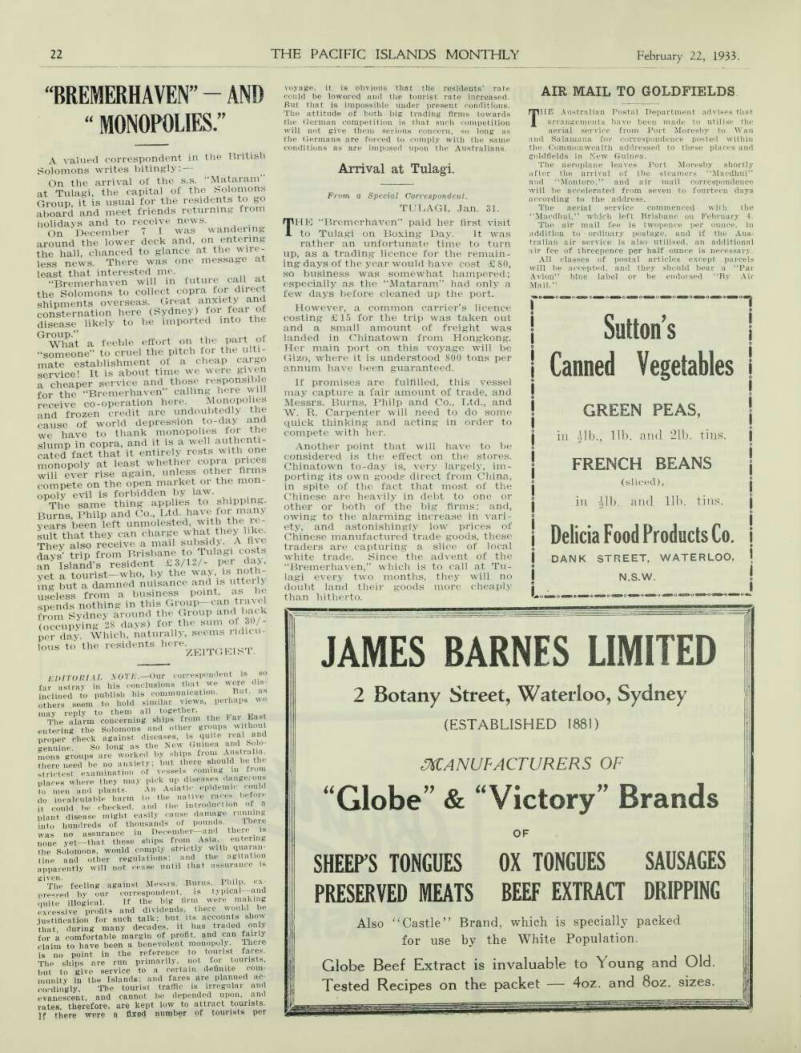
“Bremerhaven” — And
“Monopolies.”
A valued correspondent in the British Solomons writes bitingly: On the arrival of the s.s. “Mataram at Tulagi, the capital of the Solomons Group, it is usual for the residents to go aboard and meet friends returning from holidays and to receive news.
On December 7 I was wandering around the lower deck and, on entering the hall, chanced to glance at the wire less news. There was one message at least that interested me.
“Bremerhaven will in future call at the Solomons to collect copra for direct shipments overseas. Great consternation here (Sydney) for fear of disease likely to be imported into the Group.
What a feeble effort on the part of “someone” to cruel the pitch for the ulti mate establishment of a cheap cargo service! It is about time we were given a cheaper service and those responsible for the “Bremerhaven” calling here will
receive co-operation here Monopolies
and frozen credit are undoubtedly the cause of world depression to-day and we have to thank monopolies for the slump in copra, and it is a well authenti cated fact that it entirely rests with one monopoly at least whether copra prices will ever rise again, unless other firms compete on the open market or the mon opoly evil is forbidden by law.
The same thing applies to shipping.
Burns, Philp and Co., Ltd. have for many years been left unmolested, with the re sult that they can charge what they like.
They also receive a mail subsidy. A five days’ trip from Brisbane to Tulagi costs an Island’s resident £3/12/- per day, yet a tourist—who, by the way, is noth ing but a damned nuisance and is utterly useless from a business point, as he spends nothing in this Group can travel from Sydney around the Group and back (occupying 28 days) tor the sum of 30/per day. Which, naturally, seems ridicu lous to the residents here.
Zeitgeist.
EDITORIAL NOTE. —Our conrespondent is so far astray in his conclusions that we were dis inclined to publish his communication. But, as others seem to hold similar views, perhaps we may reply to them all together.
The alarm concerning ships from the far East entering the Solomons and other groups without proper check against diseases, is quite real and genuine. So long as the New Guinea and Solo mons groups are worked by ships from Australia, there need be no anxiety; but there should be the strictest examination of vessels coming in o places where they may pick up diseases dangerous to men and plants. An Asiatic epidemic could do incalculable harm to the native races before it could be checked, and the introduction ot a plant disease might easily cause damage running into hundreds of thousands of pounds. There was no assurance in December—and there is none yet—that these ships from Asia, entering the Solomons, would comply with quaran tine and other regulations; and the agitation apparently will not cease until that assurance is givn.
The feeling against Messrs. Burns, Philp, ex pressed by our correspondent, is typical and quite illogical. If the big firm were making excessive profits and dividends, there would be justification for such talk; but its accounts show that, during many decades, it has traded only for a comfortable margin of profit, and can fairly claim to have been a benevolent monopoly. There is no point in the reference to tourist fares.
The ships are run primarily, not for tourists, but to give service to a certain definite com munity in the Islands; and fares are planned ac cordingly. The tourist traffic is irregular and evanescent, and cannot be depended upon, and rates, therefore, are kept low to attract tourists.
If there were a fixed number of tourists per
voyage, it is obvious that the residents’ rate could be lowered and the tourist rate increased.
But that is impossible under present conditions.
The attitude of both big trading firms towards the German competition is that such competition will not give them serious concern, so long as the Germans are forced to comply with the same conditions as are imposed upon the Australians.