The Passing Of Primitive Man.
pp. 19-20 · Read in the full issue
Melake Tells of “Fashion B’long Before.”
Written for The Pacific Islands Monthly by William C. Groves.
IT is after midnight in this native village of Fisoa, in the north western corner of New Ireland, in the Melasian Islands of the Pacific.
I have just come in from a long night’s session with a group of Melake’s men-folk, visitors from his ma ternal village many miles distant.
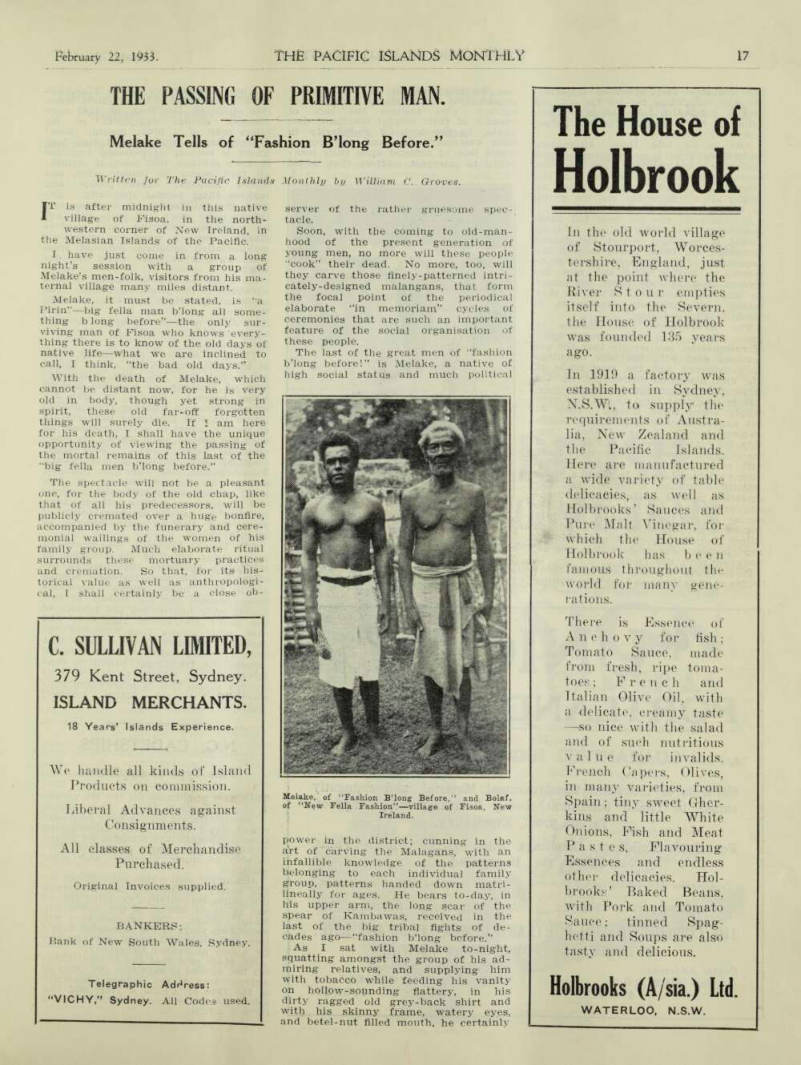
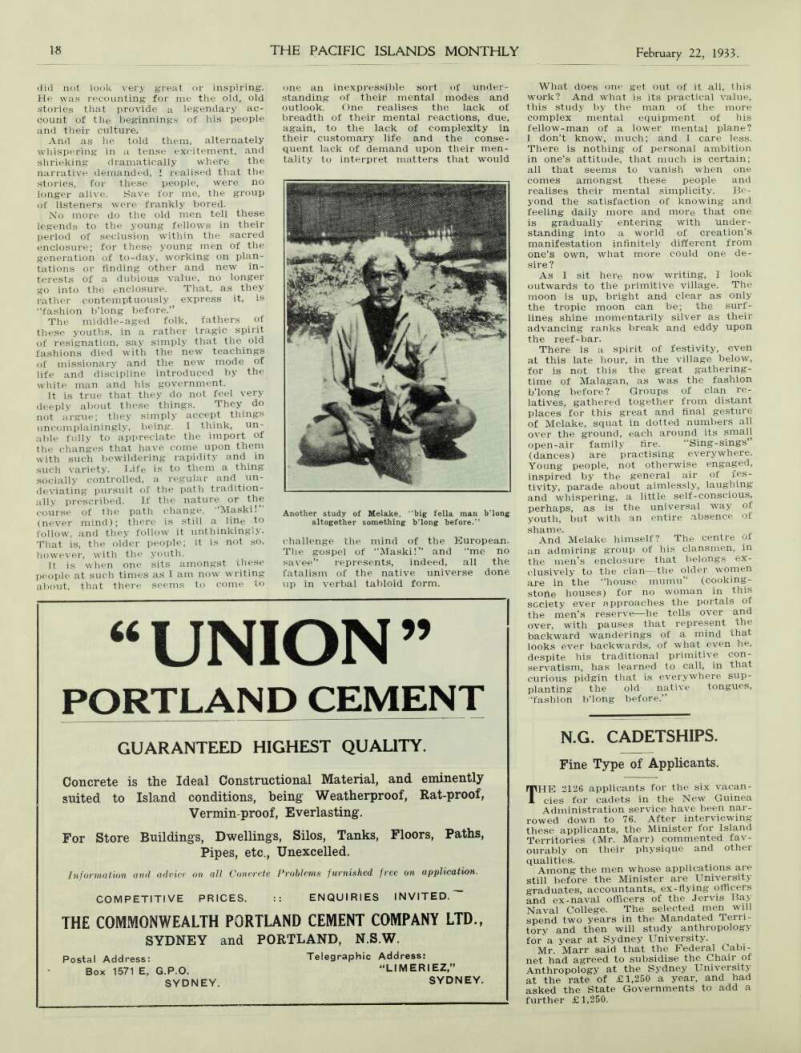
Melake, it must be stated, is ‘‘a Pirin”—big fella man b’long all some thing b'long before” —the only sur viving man of Fisoa who knows every thing there is to know of the old days of native life —what we are inclined to call, I think, “the bad old days.”
With the death of Melake, which cannot be distant now, for he is very old in body, though yet strong in spirit, these old far-off forg’otten things will surely die. If I am here for his death, I shall have the unique opportunity of viewing the passing of the mortal remains of this last of the “big fella men b’long before.”
The spectacle will not be a pleasant one, for the body of the old chap, like that of all his predecessors, will be publicly cremated over a huge bonfire, accompanied by the funerary and cere monial wailings of the women of his family group. Much elaborate ritual surrounds these mortuary practices and cremation. So that, for its his torical value as well as anthropologi cal, I shall certainly be a close ob
server of the rather gruesome spec tacle.
Soon, with the coming to old-man hood of the present generation of young men, no more will these people “cook” their dead. No more, too, will they carve those finely-patterned intri cately-designed malangans, that form the focal point of the periodical elaborate ‘‘in memoriam” cycles of ceremonies that are such an important feature of the social organisation of these people.
The last of the great men of “fashion b’long before!” is Melake, a native of high social status and much political
power in the district; cunning in the art of carving the Malagans, with an infallible knowledge of the patterns belonging to each individual family group, patterns handed down matri lineally for ages. He bears to-day, in his upper arm, the long scar of the spear of Kambawas, received in the last of the big tribal fights of de cades ago—“fashion b’long before.”
As I sat with Melake to-night, squatting amongst the group of his ad miring relatives, and supplying him with tobacco while feeding his vanity on hollow-sounding flattery, in his dirty ragged old grey-back shirt and with his skinny frame, watery eyes, and betel-nut filled mouth, he certainly
Melake, of “Fashion B’long Before" and Bolaf, of “New Fella Fashion" —village of Fisoa, New Ireland.
did not look very great or inspiring.
He was recounting for me the old, old stories that provide a legendary ac count of the beginnings of his people and their culture.
And as he told them, alternately whispering in a tense excitement, and shrieking dramatically where the narrative demanded, I realised that the stories, for these people, were no longer alive. Save for me, the group of listeners were frankly bored.
No more do the old men tell these legends to the young fellows in their period of seclusion within the sacred enclosure: for these young men of the generation of to-day, working on plan tations or finding other and new in terests of a dubious value, no longer go into the enclosure. That, as they rather contemptuously express it, is “fashion b’long before.”
The middle-aged folk, fathers of these youths, in a rather tragic spirit of resignation, say simply that the old fashions died with the new teachings of missionary and the new mode of life and discipline introduced by the white man and his government.
It is true that they do not feel very deeply about these things. They do not argue; they simply accept things uncomplainingly, being. I think, un able fully to appreciate the import of the changes that have come upon them with such bewildering rapidity and in such variety. Life is to them a thing socially controlled, a regular and un deviating pursuit of the path tradition ally prescribed. If the nature or the course of the path change, “Maski!” (never mind); there is still a line to follow, and they follow it unthinkingly.
That is, the older people; it is not so, however, with the youth.
It is when one sits amongst these people at such times as I am now writing about, that there seems to come to
one an inexpressible sort of under standing of their mental modes and outlook. One realises the lack of breadth of their mental reactions, due, again, to the lack of complexity in their customary life and the conse quent lack of demand upon their men tality to interpret matters that would
challenge the mind of the European.
The gospel of “Maski!” and “me no savee” represents, indeed, all the fatalism of the native universe done up in verbal tabloid form.
What does one get out of it all, this work? And what is its practical value, this study by the man of the more complex mental equipment of his fellow-man of a lower mental plane?
I don’t know, much; and I care less.
There is nothing of personal ambition in one’s attitude, that much is certain; all that seems to vanish when one comes amongst these people and realises their mental simplicity. Be yond the satisfaction of knowing and feeling daily more and more that one is gradually entering with under standing into a world of creation’s manifestation infinitely different from one’s own, what more could one de sire?
As I sit here now writing, I look outwards to the primitive village. The moon is up, bright and clear as only the tropic moon can be; the surf lines shine momentarily silver as their advancing ranks break and eddy upon the reef-bar.
There is a spirit of festivity, even at this late hour, in the village below, for is not this the great gathering time of Malagan, as was the fashion b’long before? Groups of clan re latives, gathered together from distant places for this great and final gesture of Melake, squat in dotted numbers all over the ground, each around its small open-air family fire. “Sing-sings” (dances) are practising everywhere.
Young people, not otherwise engaged, inspired by the general air of fes tivity, parade about aimlessly, laughing and whispering, a little self-conscious, perhaps, as is the universal way of youth, but with an entire absence of shame.
And Melake himself? The centre of an admiring group of his clansmen, in the men’s enclosure that belongs ex clusively to the clan —the older women are in the “house mumu” (cooking stone houses) for no woman in this society ever approaches the portals of the men’s reserve —he tells over and over, with pauses that represent the backward wanderings of a mind that looks ever backwards, of what even he, despite his traditional primitive con servatism, has learned to call, in that curious pidgin that is everywhere sup planting the old native tongues, “fashion b’long before.”
Another study of Melake, “big fella man b'long altogether something b'long before.”