Formally Declared Open.
p. 18 · Read in the full issue
New Hospital At
Finschhafen.
Contributed by V. Koschade.
ALTHOUGH the weather looked very threatening, and slight rain fell at midday, a very interesting after noon was spent at the dedication ser vice of the new hospital buildings at Finschhafen, New Guinea. At 2 p.m., a small number of Mission people as sembled at the hospital. We were also pleased to see a visitor from Salamaua with us, in the person of Mr. Kenward.
Superintendent Rev. Lehner gave a short history of medical missions in the
Lutheran Mission. He emphasised how our first little hospital at our mission station Immanuel, under the supervision of Rev. Stoessel, a first aid missionary, was a success, and how he treated the various types of ailments so prevalent among our natives; how he also per formed minor, as well as some more serious, operations with success, and how the natives sought relief from their terrible sores when Salvarsan was pro cured.
The speaker also told how this primitive little hospital was abandoned when Rev. Stoessel left for his home country, and under very primitive con ditions the work was carried on by the first American nurse, Sister Ida. It was her desire to see a more adequate hos pital erected: and the steady increase of patients daily, brought it about that finally a small building was put up at Finschhafen. This building consisted of two wards and a dispensary, mainly for the treatment of natives. This building was known to Europeans and natives as “The Dalec Hospital.” This building was dedicated in February, 1923.
Even this building, which was better equipped, was soon too small to take all the patients who asked for admis sion, and only the more serious cases could be accepted. Enthusiastic women of the “American Lutheran Church", interested in our medical mission work, contributed enough money, enabling the Mission Society to make it possible
to erect more up-to-date hospital buildings.
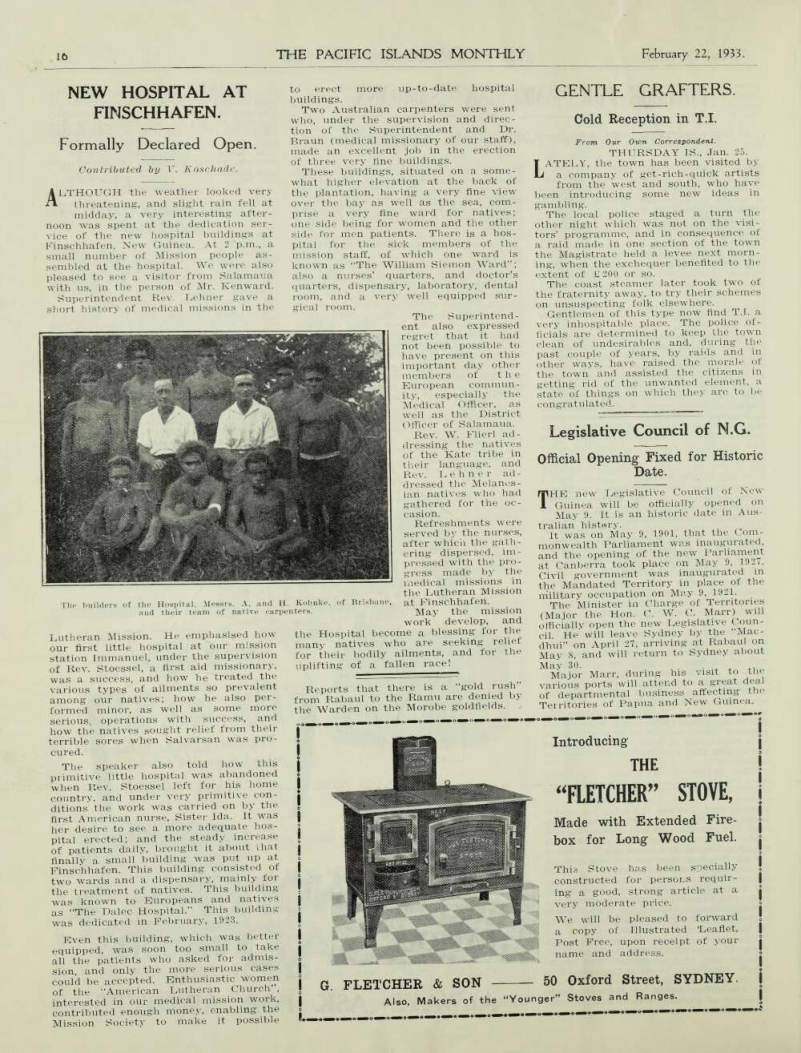
Two Australian carpenters were sent who, under the supervision and direc tion of the Superintendent and Dr.
Braun (medical missionary of our staff), made an excellent job in the erection of three very fine buildings.
These buildings, situated on a some what higher elevation at the back of the plantation, having a very fine view over the bay as well as the sea, com prise a very fine ward for natives; one side being for women and the other side for men patients. There is a hos pital for the sick members of the mission staff, of which one ward is known as “The William Siemon Ward”; also a nurses’ quarters, and doctor’s quarters, dispensary, laboratory, dental room, and a very well equipped sur gical room.
The Superintend ent also expressed regret that it had not been possible to have present on this important day other members of the European commun ity, especially the Medical Officer, as well as the District Officer of Salamaua.
Rev. W. Flierl ad dressing the natives of the Kate tribe in their language, and Rev. Lehner ad dressed the Melanes ian natives who had gathered for the oc casion.
Refreshments were served by the nurses, after which the gath ering dispersed, im pressed with the pro gress made by the medical missions in the Lutheran Mission at Finschhafen.
May the mission work develop, and
the Hospital become a blessing for the many natives who are seeking relief for their bodily ailments, and for the uplifting of a fallen race!
Reports that there is a “gold rush” from Rabaul to the Ramu are denied by the Warden on the Morobe goldfields.
The builders of the Hospital. Messrs. A. and H. Kohnke, of Brisbane, and their team of native carpenters.