The Condominium.
p. 16 · Read in the full issue
Opportunity to Review an Un
wieldy, Unworkable and Un
economic Arrangement.
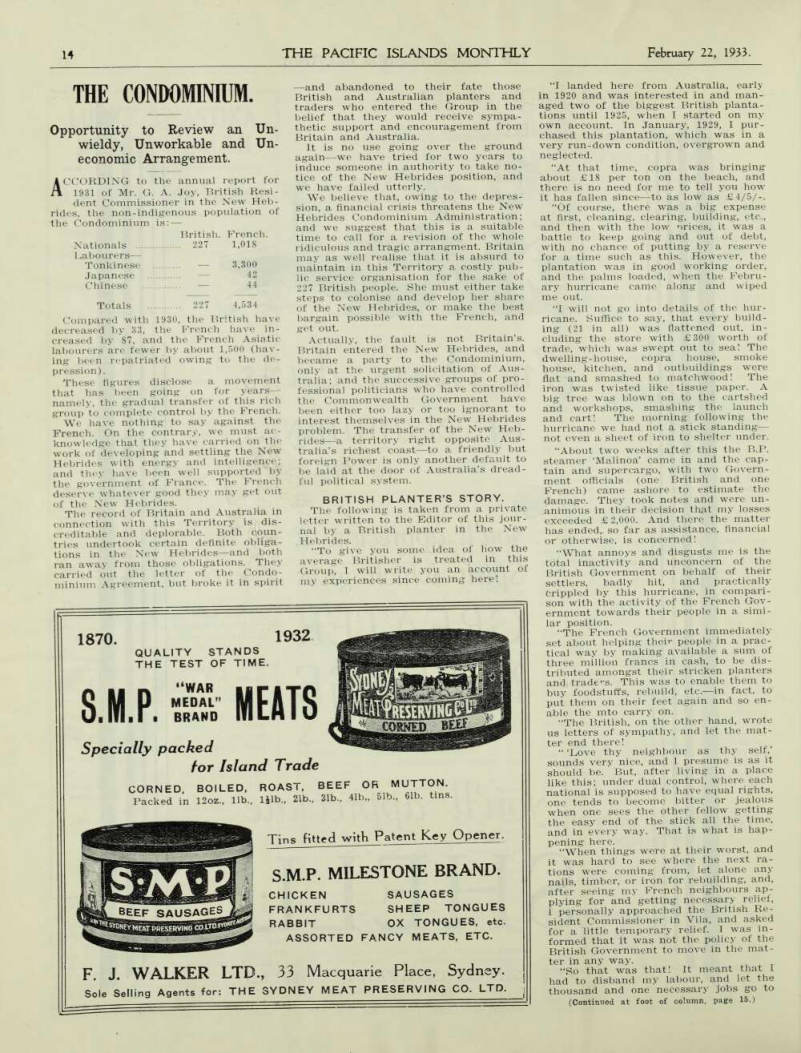
ACCORDING to the annual report for 1931 of Mr. G. A. Joy, British Resi dent Commissioner in the New Heb rides, the non-indigenous population of the Condominium is:
Compared with 1930, the British have decreased by 33, the French have in creased by 87, and the French Asiatic labourers are fewer by about 1,500 (hav ing been repatriated owing to the de pression).
These figures disclose a movement that has been going on for years— namely, the gradual transfer of this rich group to complete control by the French.
We have nothing to say against the French. On the contrary, we must ac knowledge that they have carried on the work of developing and settling the New Hebrides with energy and intelligence; and they have been well supported by the government of France. The French deserve whatever good they may get out of the New Hebrides.
The record of Britain and Australia in connection with this Territory is dis creditable and deplorable. Both coun tries undertook certain definite obliga tions in the New Hebrides—and both ran away from those obligations. They carried out the letter of the Condo minium Agreement, but broke it in spirit
—and abandoned to their fate those British and Australian planters and traders who entered the Group in the belief that they would receive sympa thetic support and encouragement from Britain and Australia.
It is no use going over the ground again—we have tried for two years to induce someone in authority to take no tice of the New Hebrides position, and we have failed utterly.
We believe that, owing to the depres sion, a financial crisis threatens the New Hebrides Condominium Administration; and we suggest that this is a suitable time to call for a revision of the whole ridiculous and tragic arrangment. Britain may as well realise that it is absurd to maintain in this Territory a costly pub lic service organisation for the sake of 227 British people. She must either take steps to colonise and develop her share of the New Hebrides, or make the best bargain possible with the French, and get out.
Actually, the fault is not Britain’s.
Britain entered the New Hebrides, and became a party to the Condominium, only at the urgent solicitation of Aus tralia; and the successive groups of pro fessional politicians who have controlled the Commonwealth Government have been either too lazy or too ignorant to interest themselves in the New Hebrides problem. The transfer of the New Heb rides —a territory right opposite Aus tralia’s richest coast —to a friendly but foreign Power is only another default to be laid at the door of Australia’s dread ful political system.
British Planter’S Story.
The following is taken from a private letter written to the Editor of this jour nal by a British planter in the New Hebrides.
“To give you some idea of how the average Britisher is treated in this Group, I will write you an account of my experiences since coming here!
“I landed here from Australia, early in 1920 and was interested in and man aged two of the biggest British planta tions until 1925, when I started on my own account. In January, 1929, I pur chased this plantation, which was in a very run-down condition, overgrown and neglected.
“At that time, copra was bringing about £18 per ton on the beach, and there is no need for me to tell you how it has fallen since—to as low as £4/5/-.
“Of course, there was a big expense at first, cleaning, clearing, building, etc., and then with the low prices, it was a battle to keep going and out of debt, with no chance of putting by a reserve for a time such as this. However, the plantation was in good working order, and the palms loaded, when the Febru ary hurricane came along and wiped me out.
“I will not go into details of the hur ricane. Suffice to say, that every build ing (21 in all) was flattened out, in cluding the store with £300 worth of trade, which was swept out to sea! The dwelling-house, copra house, smoke house, kitchen, and outbuildings were flat and smashed to matchwood! The iron was twisted like tissue paper. A big tree was blown on to the cartshed and workshops, smashing the launch and cart! The morning following the hurricane we had not a stick standing— not even a sheet of iron to shelter under.
“About two weeks after this the B.P. steamer ‘Malinoa’ came in and the cap tain and supercargo, with two Govern ment officials (one British and one French) came ashore to estimate the damage. They took notes and were un animous in their decision that my losses exceeded £2,000. And there the matter has ended,, so far as assistance, financial or otherwise, is concerned!
“What annoys and disgusts me is the total inactivity and unconcern of the British Government on behalf of their settlers, badly hit, and practically crippled by this hurricane, in compari son with the activity of the French Gov ernment towards their people in a simi lar position.
“The French Government immediately set about helping their people in a prac tical way by making available a sum of three million francs in cash, to be dis tributed amongst their stricken planters and traders. This was to enable them to buy foodstuffs, rebuild, etc. —in fact, to put them on their feet again and so en able the mto carry on.
“The British, on the other hand, wrote us letters of sympathy, and let the mat ter end there!
“ ‘Love thy neighbour as thy self,’ sounds very nice, and I presume is as it should be. But, after living in a place like this; under dual control, where each national is supposed to have equal rights, one tends to become bitter or jealous when one sees the other fellow getting the easy end of the stick all the time, and in every way. That is what is hap pening here.
“When things were at their worst, and it was hard to see where the next ra tions were coming from, let alone any nails, timber, or iron for rebuilding, and, after seeing my French neighbours ap plying for and getting necessary relief, I personally approached the British Re sident Commissioner in Vila, and asked for a little temporary relief. I was in formed that it was not the policy of the British Government to move in the mat ter in any way.
“So that was that! It meant that I had to disband my labour, and let the thousand and one necessary jobs go to (Continued at foot of column, page 15.)
British.
French Nationals 227 1,018 labourers — Tonkinese — 3,300 Japanese — 42 Chinese — 44 Totals 227 4,534