Exchange Rate.
p. 11 · Read in the full issue
Samoa Anxious About Cost of Imports.
From Our Own Correspondent.
Apia, Jan. 20.
THOUGH imports from England make only 17.8 per cent, of the total im ports in 1931, a large portion of the New Zealand and Australian imports are re-exports of British goods. In 1932 the proportion of British-made goods has probably further increased, while imports from Germany, U.S.A., and other gold standard countries are practically negligible at present.
The raising of the exchange, New Zea land on England, to 25 per cent., which simultaneously came into force in Samoa, is bound to affect trading con ditions here adversely and again to raise the cost of living to a considerable ex tent. In this regard it may be of interest to point to the origin of our imports in 1930 and 1931, as given in the Adminis trator’s last report to the League of Nations.
EDITORIAL NOTE. —Our correspondent over looks the fact that, if imports cost more under the new exchange, exports of Samoan products become correspondingly more valuable. As a matter of fact, the advantage is with the Samoan producers. It is only countries like Australia and New Zealand, which have to send a huge interest payment overseas every year, which secure doubtful benefits from a high rate of controlled exchange. We think that non debtor countries like Fiji and Samoa, when ac counts are finally taken, will find that they have benefited enormously from this development of exchange.
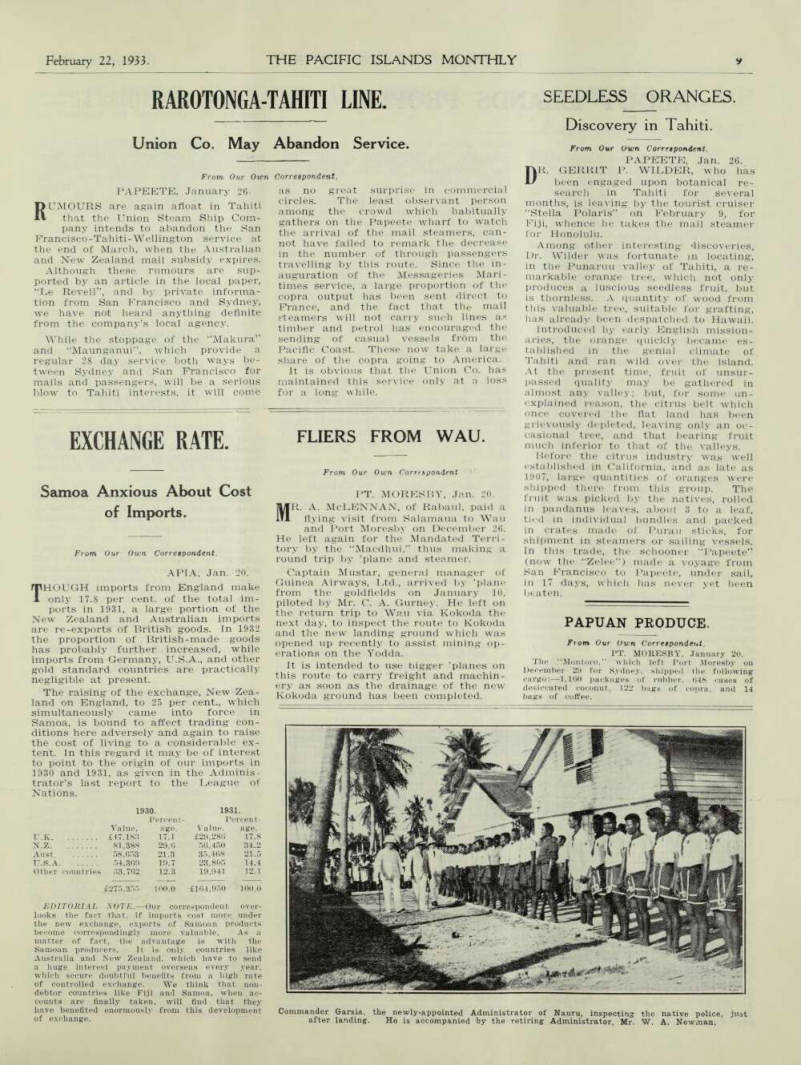
Commander Garsia, the newly-appointed Administrator of Nauru, inspecting the native police, just after landing. He is accompanied by the retiring Administrator, Mr. W. A. Newman.
1930. 1931.
Percentage.
Percentage Value.
Value.
U.K. £47,183 17.1 £29,280 17.8 N.Z. 81,388 29.6 56,450 34.2 Aust. 58,653 21.3 35,468 21.5
U.S.A.
54,369 19.7 23,805 14.4 Other countries 33.762 12.3 19,941 12.1 £275,355 100.0 £164,950 100.0