Trade In Human Flesh.
The Cannibalistic Orgies of Dutch New Guinea.
Written for “The Pacific Islands Monthly" by Dr. G. H. Vernon, of Daru, Papua, Copyright.
IN Malay countries, the British alone are distinguished from other Euro pean races by the title “Orang Puteh,” the “White Men”—and the Malays are no mean judge of character.
A handful of British bird-shooters who made South-west Dutch New Guinea their base for hunting operations during the decade following the war, fully de served the title, for they were a fine set of fellows. Alas, each one was destined to meet with a violent death in the land of his adoption!
You can count the members of this little team on the fingers of one hand — Bell, Penrose, Jackson and Roche; to the quartet add Dressier, a German, but a man of the same intrepid character, and you have the lot.
So far as the writer knows, no other Britons were settled in that unknown land during the years in question (1920- 1930), and, since their death, no one has taken their place. That they were men who could be ill-spared from any com munity is evident to anyone who knows what life in such a savage country en tails. Strength, mental and physical, was needed for such a career. Not only does inanimate Nature place all sorts of ob stacles to their journeyings, but Man, cruel and callous, living in a state of anarchism where might alone is right, is a constant menace to anyone who ventures outside the very circumscribed area that Dutch authorities have tamed.
Truly this quintet of adventurers were men of more than usual courage.
In 1924, a paper in Rotterdam, Hol land, published an account of the expedi tion written by one of the priests sta tioned at Merauke, the capital town of Southern Dutch New Guinea, who ac companied it into the wilds, and there is no doubt that the almost incredible state of cannibalism described is wholly ac curate. If confirmation of this were necessary, Dick Roche gave it many a time when he used to remark, in his im pressive way, “There’s more human meat bartered for and eaten in the jungles over there in a month than beef on Thursday Island.”
George Penrose’s death, details of which may still be unknown to many of his friends over the border in British territory, is graphically described in the Dutch paper by the Belgian priest, and it is from his narrative that this sum mary is made.
The expedition, which was apparently of an exploratory and punitive nature combined, left Merauke in October, 1921, and at a place called Assiba they fell in with Jackson and Roche.
The two bird-hunters were still in great distress on account of the loss of their friend and colleague Penrose, in the previous July. During that month birds had been scarce, and Penrose had decided to penetrate into the Upper Kawo district, notorious for the savag ery of its inhabitants, in search of bet ter luck. The others tried to dissuade him; they had heard from friendly na tives that the “Stone People” (so called because in their district are found the fine black stones so much in demand for axes and clubs) were fierce cannibals who objected to the intrusion of strangers and were habitual dealers in human flesh, which they preferred above
all commodities in exchange for the stones.
But their warnings fell on deaf ears and Penrose left with his boys, intent only on getting more birds.
A few days after, one of his shoot ing Malays cleared out with a gun, and in order to prevent a recurrence, Pen rose gathered all the arms in every night and placed them under his camp bed.
This precaution was undoubtedly the cause of his death.
At about 3 a.m. on the 14th of July, he and his boys were surrounded by a mob of natives. The unarmed boys scat tered in all directions, two being killed as they fled; Penrose himself received seven arrows in his body, one in the abdomen eventually proving fatal. He was a very strong man, fearless and re solute, and he fought his way out, only to collapse in the darkness of the bush, where one of his boys found him and, placing him on his back, carried him into a safer spot. Here he remained in hid ing through the rest of the night, weak from loss of blood and the increasing pain of his wounds, while his assailants could be heard preparing with shouts and chanting for their ghastly feast of victory.
Jackson was camped about six hours’ walk away and, on hearing from one of the fugitive Malays what had happened, set out with a rescue party and arrived at the spot before dark. The hideous orgy was at its height when he came on the scene, the murderers being then en gaged in eating the bodies of the Malays they had killed.
Jackson, with signal bravery, drove them off and, later, came across his friend lying under a tree in a dying con dition. Penrose recognised him; he looked at him, but could not speak.
Then he closed his eyes for ever.
Setting watch, Jackson prepared to spend the night by the body of his friend, but shortly after midnight he was disturbed; a light was cautiously ap
preaching their camp from the jungle.
Jackson picked up his gun, and would have fired at once, but one of his boys, with a better knowledge of savage cun ning, stopped him until the light came closer, when the spy was put out of ac tion. It was then found that the torch had been fastened at the end of a long pole, and premature firing would have missed the bearer.
According to the narrative, Penrose’s remains were finally brought to Merauke.
The members of the priest’s expedi tion later camped on the very spot where Dressier and Bell had been mur dered in 1920, and here they fell in with a tribe who spoke quite openly about their cannibalistic habits.
All the elderly people who cannot re sist are “Namnan” (eaten), and even some of the women share this fate, so that it is not only strangers who fall victim to the lust of the tribesmen. Some misdeeds, adultery, for instance, are punished by death and the culprits are subsequently eaten.
Human flesh is the greatest delicacy of these people and the chief medium of exchange, a leg having about the value of an axe. Men who go out to kill and who bring supplies of flesh to the mar ket place are held in high repute; they are the honoured citizens of these jungle communities. When asked if it were really any good, their reply was that no meat is so delicious as human flesh. So great becomes the craving for it that their own children, who perish by acci dent or sickness, are subsequently eaten.
A proof of this was forthcoming at this camp. Just as they were ready to move on, some of the carriers asked to be excused, as an accident had occurred in the village, one of the children having fallen from the raised verandah of a house. Next day, they reappeared, one of them bearing the parts of the little victim of this accident. ‘There is never any difficulty in ob taining carriers from these tribes for a punitive expedition; there is always the chance of meat, and they gleefully set out in the hopes of satisfying their sinister tastes.
“Homo homini lupus.” As one reads these tales of modern cannibalism, the old saying, “Man to man is a wolf” be comes startlingly real.
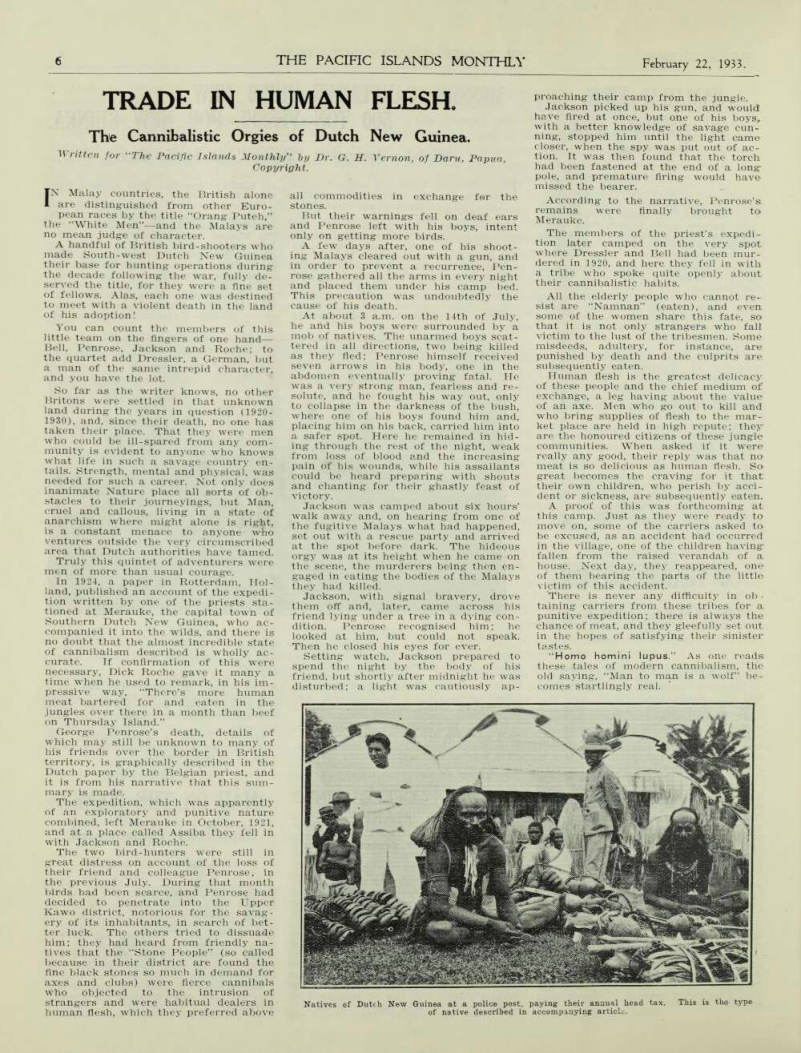
Natives of Dutch New Guinea at a police post, paying their annual head tax. This is the type of native described in accompanying article.