South Seas.
pp. 5-6 · Read in the full issue
How Fools, Liars and Degenerates Libel the South Seas.
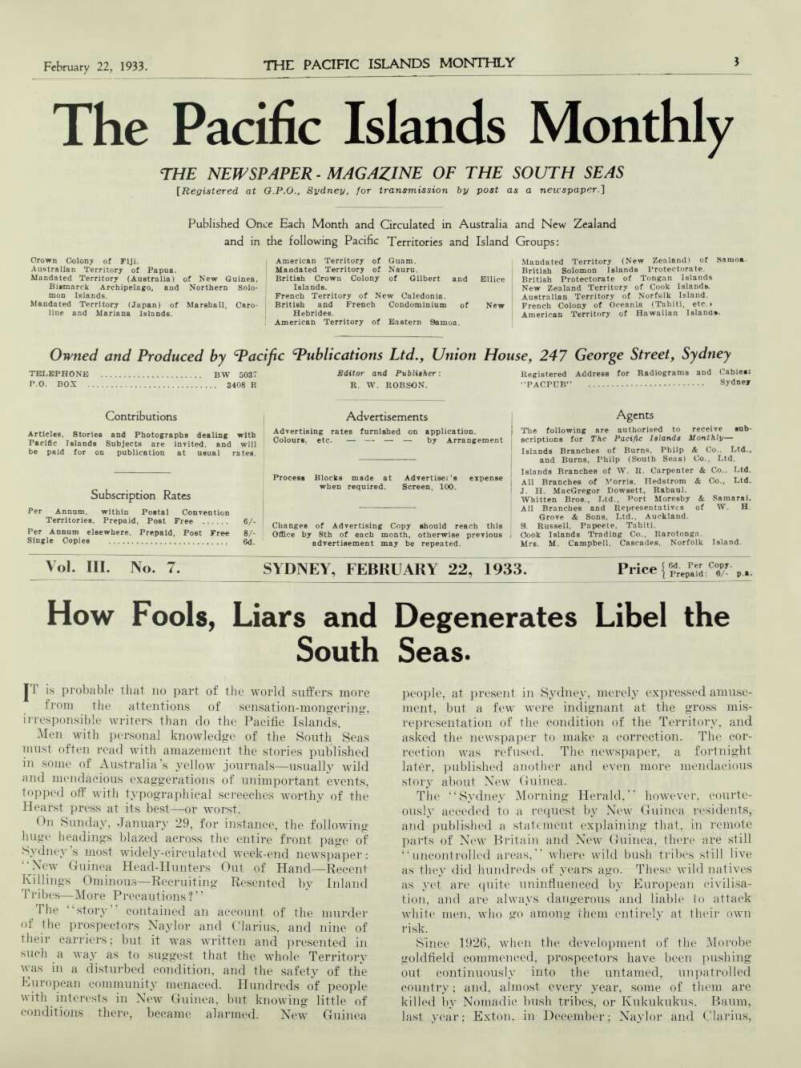
IT is probable that no part of the world suffers more from the attentions of sensation-mongering, irresponsible writers than do the Pacific Islands.
Men with personal knowledge of the South Seas must often read with amazement the stories published in some of Australia’s yellow journals—usually wild and mendacious exaggerations of unimportant events, topped off with typographical screeches worthy of the Hearst press at its best—or worst.
On Sunday, January 29, for instance, the following huge headings blazed across the entire front page of Sydney’s most widely-circulated week-end newspaper: “New Guinea Head-Hunters Out of Hand—Recent Killings Ominous —Recruiting Resented by Inland Tribes—More Precautions?”
The ‘story’ contained an account of the murder of the prospectors Naylor and Clarius, and nine of their carriers; but it was written and presented in such a way as to suggest that the whole Territory was in a disturbed condition, and the safety of the European community menaced. Hundreds of people with interests in New Guinea, but knowing little of conditions there, became alarmed. New Guinea
people, at present in Sydney, merely expressed amuse ment, but a few were indignant at the gross mis representation of the condition of the Territory, and asked the newspaper to make a correction. The cor rection was refused. The newspaper, a fortnight later, published another and even more mendacious story about New Guinea.
The “Sydney Morning Herald,” however, courte ously acceded to a request by New Guinea residents, and published a statement explaining that, in remote parts of New Britain and New Guinea, there are still “uncontrolled areas,” where wild bush tribes still live as they did hundreds of years ago. These wild natives as yet are quite uninfluenced by European civilisa tion, and are always dangerous and liable to attack white men, who go among them entirely at their own risk.
Since 1926, when the development of the Morobe goldfield commenced, prospectors have been pushing out continuously into the untamed, unpatrolled country; and, almost every year, some of them are killed by Nomadic bush tribes, or Kukukukus. Baum, last year; Exton, in December; Naylor and Clarius,
in January—these men went out deliberately into dangerous country, seeking gold, and finding death, as such men have done all through history.
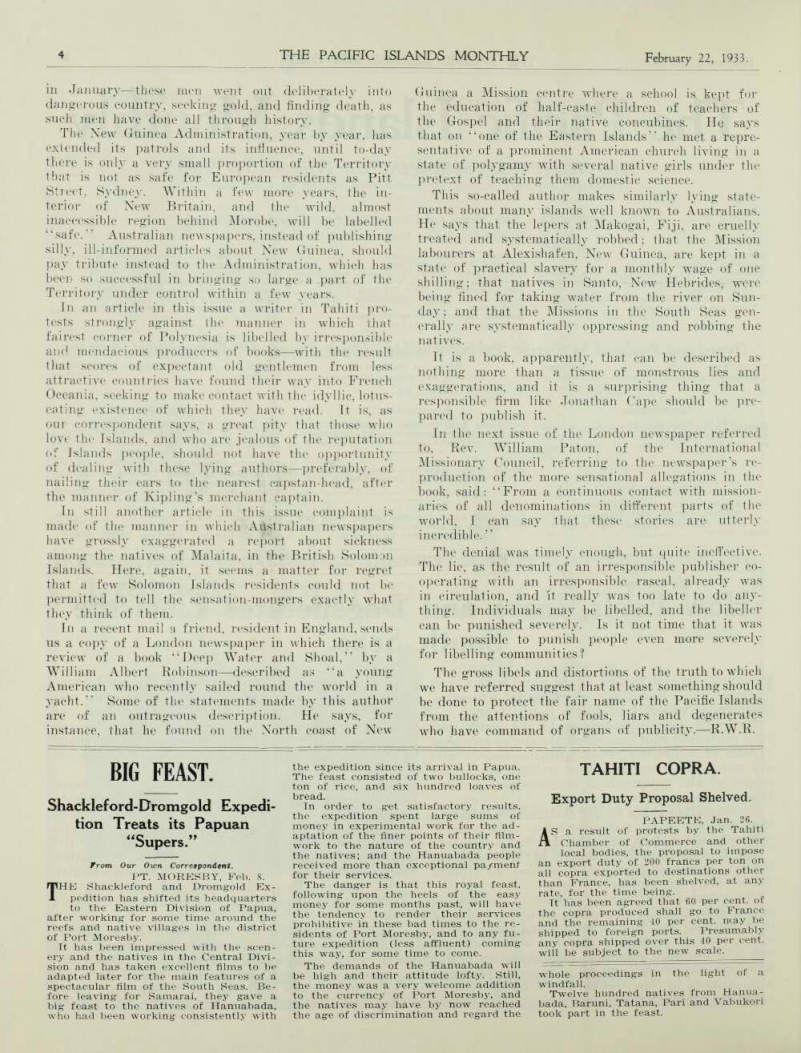
The New Guinea Administration, year by year, has extended its patrols and its influence, until to-day there is only a very small proportion of the Territory that is not as safe for European residents as Pitt Street, Sydney. Within a few more years, the in terior of New Britain, and the wild, almost inaccessible region behind Morobe, will be labelled "safe." Australian newspapers, instead of publishing silly, ill-informed articles about New Guinea, should pay tribute instead to the Administration, which has been so successful in bringing so large a part of the Territory under control within a few years.
In an article in this issue a writer in Tahiti pro tests strongly against the manner in which that fairest corner of Polynesia is libelled by irresponsible and mendacious producers of books —with the result that scores of expectant old gentlemen from less attractive countries have found their way into French Oceania, seeking to make contact with the idyllic, lotus eating existence of which they have read. It is, as our correspondent says, a great pity that those who love the Islands, and who are jealous of the reputation of Islands people, should not have the opportunity of dealing with these lying authors —preferably, of nailing their ears to the nearest capstan-head, after the manner of Kipling’s merchant captain.
In still another article in this issue complaint is made of the manner in which Australian newspapers have grossly exaggerated a report about sickness among the natives of Malaita, in the British Solomon Islands. Here, again, it seems a matter for regret that a few Solomon Islands residents could not be permitted to tell the sensation-mongers exactly what they think of them.
In a recent mail a friend, resident in England, sends us a copy of a London newspaper in which there is a review of a book “Deep Water and Shoal,” by a William Albert Robinson—described as “a young American who recently sailed round the world in a yacht.” Some of the statements made by this author are of an outrageous description. He says, for instance, that he found on the North coast of New
Guinea a Mission centre where a school is kept for the education of half-caste children of teachers of the Gospel and their native concubines. He says that on “one of the Eastern Islands’’ he met a repre sentative of a prominent American church living in a state of polygamy with several native girls under the pretext of teaching them domestic science.
This so-called author makes similarly lying state ments about many islands well known to Australians.
He says that the lepers at Makogai, Fiji, are cruelly treated and systematically robbed; that the Mission labourers at Alexishafen, New Guinea, are kept in a state of practical slavery for a monthly wage of one shilling; that natives in Santo, New Hebrides, were being fined for taking water from the river on Sun day; and that the Missions in the South Seas gen erally are systematically oppressing and robbing the natives.
It is a book, apparently, that can be described as nothing more than a tissue of monstrous lies and exaggerations, and it is a surprising thing that a responsible firm like Jonathan Cape should be pre pared to publish it.
In the next issue of the London newspaper referred to, Rev. William Paton, of the International Missionary Council, referring to the newspaper’s re production of the more sensational allegations in the book, said: "From a continuous contact with mission aries of all denominations in different parts of the world, I can say that these stories are utterly incredible."
The denial was timely enough, but quite ineffective.
The lie, as the result of an irresponsible publisher co operating with an irresponsible rascal, already was in circulation, and it really was too late to do any thing. Individuals may be libelled, and the libeller can be punished severely. Is it not time that it was made possible to punish people even more severely for libelling communities'?
The gross libels and distortions of the truth to which we have referred suggest that at least something should be done to protect the fair name of the Pacific Islands from the attentions of fools, liars and degenerates who have command of organs of publicity. —R.W.R.