Story Of Shipwreck.
p. 32 · Read in the full issue
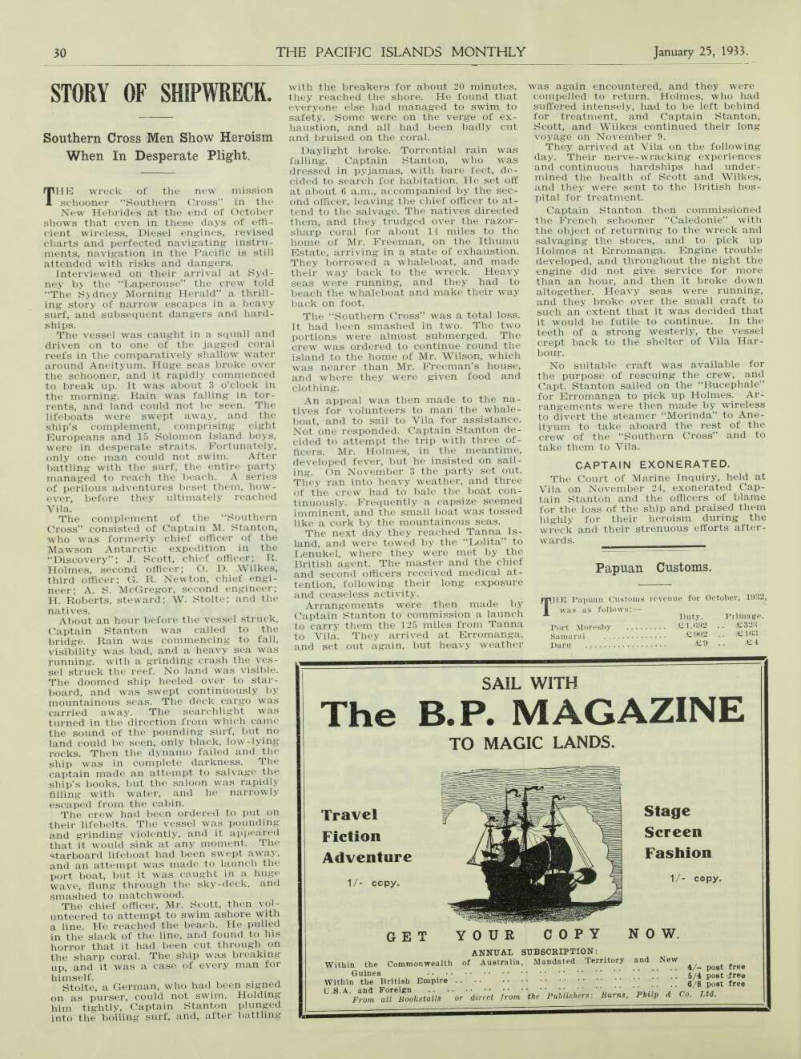
Southern Cross Men Show Heroism When In Desperate Plight.
THE wreck of the new mission schooner “Southern Cross” in the New Hebrides at the end of October shows that even in these days of effi cient wireless, Diesel engines, revised charts and perfected navigating instru ments, navigation in the Pacific is still attended with risks and dangers.
Interviewed on their arrival at Syd ney by the “Laperouse” the crew told “The Sydney Morning Herald” a thrill ing story of narrow escapes in a heavy surf, and subsequent dangers and hard ships.
The vessel was caught in a squall and driven on to one of the jagged coral reefs in the comparatively shallow water around Aneityum. Huge seas broke over the schooner, and it rapidly commenced to break up. It was about 3 o’clock in the morning. Rain was falling in tor rents, and land could not be seen. The lifeboats were swept away, and the ship’s complement, comprising eight Europeans and 15 Solomon Island boys, were in desperate straits. Fortunately, only one man could not swim. After battling with the surf, the entire party managed to reach the beach. A series of perilous adventures beset them, how ever, before they ultimately reached Vila.
The complement of the “Southern Cross” consisted of Captain M. Stanton, who was formerly chief officer of the Mawson Antarctic expedition in the “Discovery”; J. Scott, chief officer; R.
Holmes, second officer; O. D. Wilkes, third officer; G. R. Newton, chief engi neer; A. S. McGregor, second engineer; H. Roberts, steward; W. Stolte; and the natives.
About an hour before the vessel struck, Captain Stanton was called to the bridge. Rain was commencing to fall, visibility was bad, and a heavy sea was running, with a grinding crash the ves sel struck the reef. No land was visible.
The doomed ship heeled over to star board, and was swept continuously by mountainous seas. The deck cargo was carried away. The searchlight was turned in the direction from which came the sound of the pounding surf, but no land could be seen, only black, low-lying rocks. Then the dynamo failed and the ship was in complete darkness. The captain made an attempt to salvage the ship’s books, but the saloon was rapidly filling with water, and he narrowly escaped from the cabin.
The crew had been ordered to put on their lifebelts. The vessel was pounding and grinding violently, and it appeared that it would sink at any moment. The starboard lifeboat had been swept away, and an attempt was made to launch the port boat, but it was caught in a huge wave, flung through the sky-deck, and smashed to matchwood.
The chief officer, Mr. Scott, then vol unteered to attempt to swim ashore with a line. He reached the beach. He pulled in the slack of the line, and found to his horror that it had been cut through on the sharp coral. The ship was breaking up, and it was a case of every man for himself.
Stolte, a German, who had been signed on as purser, could not swim. Holding him tightly, Captain Stanton plunged into the boiling surf, and, after battling
with the breakers for about 20 minutes, they reached the shore. He found that everyone else had managed to swim to safety. Some were on the verge of ex haustion, and all had been badly cut and bruised on the coral.
Daylight broke. Torrential rain was falling. Captain Stanton, who was dressed in pyjamas, with bare feet, de cided to search for habitation. He set off at about 6 a.m., accompanied by the sec ond officer, leaving the chief officer to at tend to the salvage. The natives directed them, and they trudged over the razor sharp coral for about 14 miles to the home of Mr. Freeman, on the Ithumu Estate, arriving in a state of exhaustion.
They borrowed a whaleboat, and made their way back to the wreck. Heavy seas were running, and they had to beach the whaleboat and make their way back on foot.
The “Southern Cross” was a total loss.
It had been smashed in two. The two portions were almost submerged. The crew was ordered to continue round the island to the home of Mr. Wilson, which was nearer than Mr, Freeman’s house, and where they were given food and clothing.
An appeal was then made to the na tives for volunteers to man the whale boat, and to sail to Vila for assistance.
Not one responded. Captain Stanton de cided to attempt the trip with three of ficers. Mr. Holmes, in the meantime, developed fever, but he insisted on sail ing. On November 3 the party set out.
They ran into heavy weather, and three of the crew had to bale the boat con tinuously. Frequently a capsize seemed imminent, and the small boat was tossed like a cork by the mountainous seas.
The next day they reached Tanna Is land, and were towed by the “Lolita” to Lenukel, where they were met by the British agent. The master and the chief and second officers received medical at tention, following their long exposure and ceaseless activity.
Arrangements were then made by Captain Stanton to commission a launch to carry them the 125 miles from Tanna to Vila. They arrived at Erromanga, and set out again, but heavy weather
was again encountered, and they were compelled to return. Holmes, who had suffered intensely, had to be left behind for treatment, and Captain Stanton, Scott, and Wilkes continued their long voyage on November 9.
They arrived at Vila on the following day. Their nerve-wracking experiences and continuous hardships had under mined the health of Scott and Wilkes, and they were sent to the British hos pital for treatment.
Captain Stanton then commissioned the French schooner “Caledonie” with the object of returning to the wreck and salvaging the stores, and to pick up Holmes at Erromanga. Engine trouble developed, and throughout the night the engine did not give service for more than an hour, and then it broke down altogether. Heavy seas were running, and they broke over the small craft to such an extent that it was decided that it would be futile to continue. In the teeth of a strong westerly, the vessel crept back to the shelter of Vila Har bour.
No suitable craft was available for the purpose of rescuing the crew, and Capt. Stanton sailed on the “Bucephale” for Erromanga to pick up Holmes. Ar rangements were then made by wireless to divert the steamer “Morinda” to Ane ityum to take aboard the rest of the crew of the “Southern Cross” and to take them to Vila.
Captain Exonerated.
The Court of Marine Inquiry, held at Vila on November 24, exonerated Cap tain Stanton and the officers of blame for the loss of the ship and praised them highly for their heroism during the wreck and their strenuous efforts after wards.