“Whisky-Ruled Mentality.”
p. 28 · Read in the full issue
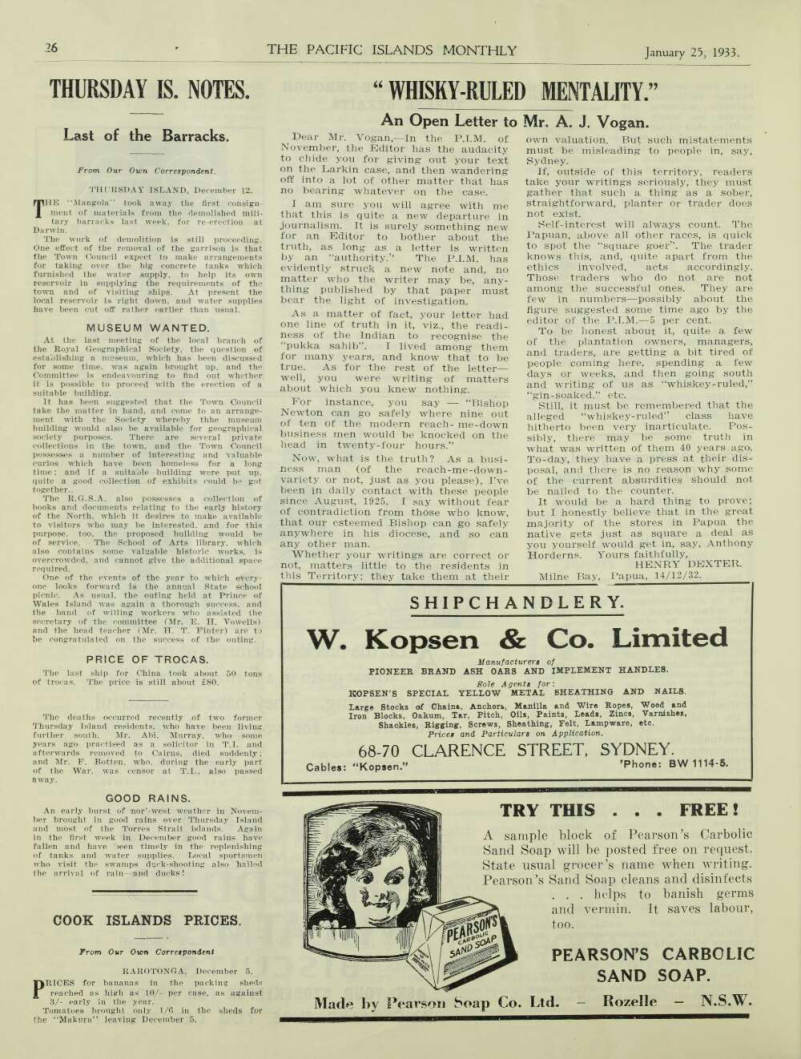
An Open Letter to Mr, A. J. Vogan.
Dear Mr. Vogan,—In the P.I.M. of November, the Editor has the audacity to chide you for giving out your text on the Larkin case, and then wandering off into a lot of other matter that has no bearing whatever on the case.
I am sure you will agree with me that this is quite a new departure in journalism. It is surely something new for an Editor to bother about the truth, as long as a letter is written by an “authority.’’ The P.I.M. has evidently struck a new note and, no matter who the writer may be, any thing published by that paper must bear the light of investigation.
As a matter of fact, your letter had one line of truth in it, viz., the readi ness of the Indian to recognise the “pukka sahib”. I lived among them for many years, and know that to be true. As for the rest of the letter — well, you were writing of matters about which you knew nothing.
For instance, you say “Bishop Newton can go safely where nine out of ten of the modern reach-me-down business men would be knocked on the head in twenty-four hours.”
Now, what is the truth? As a busi ness man (of the reach-me-down variety or not, just as you please), I’ve been in daily contact with these people since August, 1925. I say without fear of contradiction from those who know, that our esteemed Bishop can go safely anywhere in his diocese, and so can any other man.
Whether your writings are correct or not, matters little to the residents in this Territory; they take them at their
own valuation. But such mistatements must be misleading to people in, say, Sydney.
If, outside of this territory, readers take your writings seriously, they must gather that such a thing as a sober, straightforward, planter or trader does not exist.
Self-interest will always count. The Papuan, above all other races, is quick to spot the “square goer”. The trader knows this, and, quite apart from the ethics involved, acts accordingly.
Those traders who do not are not among the successful ones. They are few in numbers—possibly about the figure suggested some time ago by the editor of the P.I.M.—5 per cent.
To be honest about it, quite a few of the plantation owners, managers, and traders, are getting a bit tired of people coming here, spending a few days or weeks, and then going south and writing of us as “whiskey-ruled,”
“gin-soaked.” etc.
Still, it must be remembered that the alleged “whiskey-ruled” class have hitherto been very inarticulate. Pos sibly, there may be some truth in what was written of them 40 years ago.
To-day, they have a press at their dis posal, and there is no reason why some of the current absurdities should not be nailed to the counter.
It would be a hard thing to prove; but I honestly believe that in the great majority of the stores in Papua the native gets just as square a deal as you yourself would get in, say, Anthony Horderns. Yours faithfully,
Henry Dexter.
Milne Bay, Papua, 14/12/32.