Extraordinary Currency Muddle in Fiji
pp. 5-6 · Read in the full issue
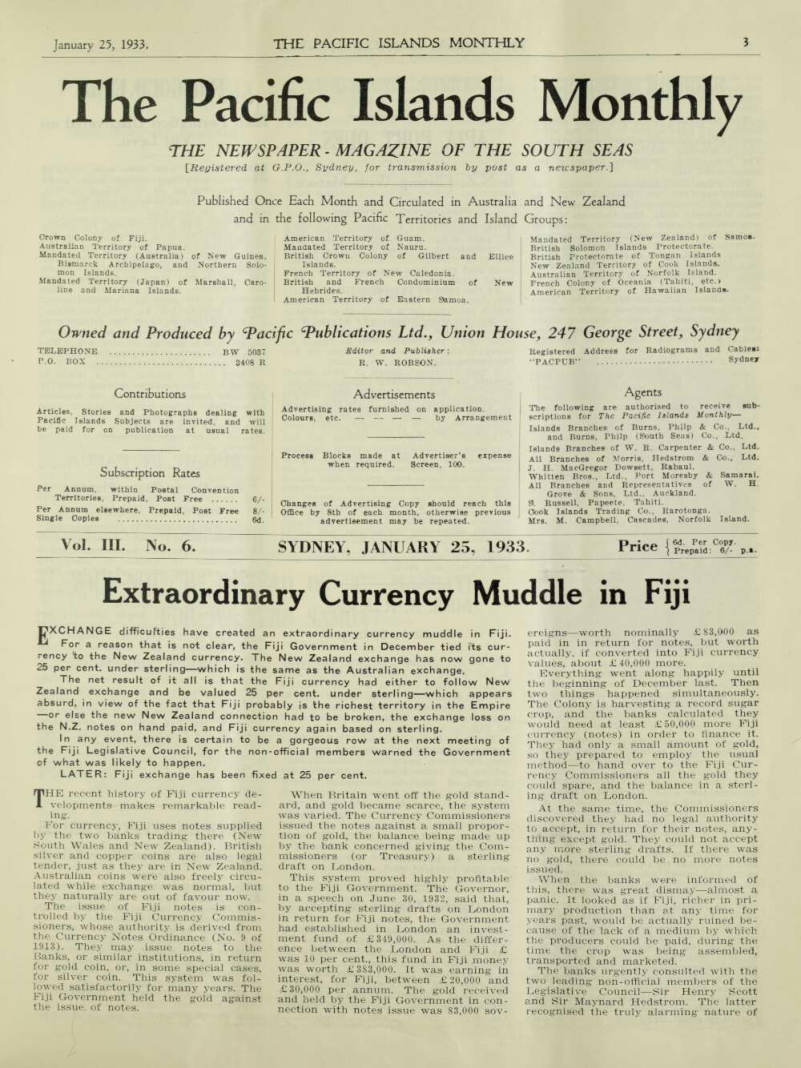
F'XCHANGE difficulties have created an extraordinary currency muddle in Fiji.
For a reason that is not clear, the Fiji Government in December tied its cur rency to the New Zealand currency. The New Zealand exchange has now gone to 25 per cent, under sterling—which is the same as the Australian exchange.
The net result of it all is that the Fiji currency had either to follow New Zealand exchange and be valued 25 per cent, under sterling—which appears absurd, in view of the fact that Fiji probably is the richest territory in the Empire or else the new New Zealand connection had to be broken, the exchange loss on the N.Z. notes on hand paid, and Fiji currency again based on sterling.
In any event, there is certain to be a gorgeous row at the next meeting of the Fiji Legislative Council, for the non-official members warned the Government of what was likely to happen.
LATER: Fiji exchange has been fixed at 25 per cent.
THE recent history of Fiji currency de velopments makes remarkable read ing.
For currency, Fiji uses notes supplied by the two banks trading there (New South Wales and New Zealand). British silver and copper coins are also legal tender, just as they are in New Zealand.
Australian coins were also freely circu lated while exchange was normal, but they naturally are out of favour now.
The issue of Fiji notes is con trolled by the Fiji Currency Commis sioners, whose authority is derived from the Currency Notes Ordinance (No. 9 of 1913). They may issue notes to the Banks, or similar institutions, in return for gold coin, or, in some special cases, for silver coin. This system was fol lowed satisfactorily for many years. The Fiji Government held the gold against the issue, of notes.
When Britain went off the gold stand ard, and gold became scarce, the system was varied. The Currency Commissioners issued the notes against a small propor tion of gold, the balance being made up by the bank concerned giving the Com missioners (or Treasury) a sterling draft on London.
This system proved highly profitable to the Fiji Government. The Governor, in a speech on June 30, 1932, said that, by accepting sterling drafts on London in return for Fiji notes, the Government had established in London an invest ment fund of £349,000. As the differ ence between the London and Fiji £ was 10 per cent., this fund in Fiji money was worth £383,000. It was earning in interest, for Fiji, between £20,000 and £ 30,000 per annum. The gold received and held by the Fiji Government in con nection with notes issue was 83,000 sov
ereigns—worth nominally £ 83,000 as paid in in return for notes, but worth actually, if converted into Fiji currency values, about £ 40,000 more.
Everything went along happily until the beginning of December last. Then two things happened simultaneously.
The Colony is harvesting a record sugar crop, and the banks calculated they would need at least £50,000 more Fiji currency (notes) in order to finance it.
They had only a small amount of gold, so they prepared to employ the usual method —to hand over to the Fiji Cur rency Commissioners all the gold they could spare, and the balance in a sterl ing draft on London.
At the same time, the Commissioners discovered they had no legal authority to accept, in return for their notes, any thing except gold. They could not accept any more sterling drafts. If there was no gold, there could be no more notes issued.
When the banks were informed of this, there was great dismay—almost a panic. It looked as if Fiji, richer in pri mary production than at any time for years past, would be actually ruined be cause of the lack of a medium by which the producers could be paid, during the time the crop was being assembled, transported and marketed.
The banks urgently consulted with the two leading non-official members of the Legislative Council —Sir Henry Scott and Sir Maynard Hedstrom. The latter recognised the truly alarming nature of
the development. There was a series of conferences with the Government, and a long cablegram was sent to the Colonial Office.
The procedure needed seemed simple enough—to pass a law to give the Cur rency Commissioners legal authority to accept sterling drafts instead of gold.
The non-official members urgently re commended this.
But when the Legislative Council was called together on December 13, to amend the Currency Notes Ordinance, it was disclosed that the Colonial Office was not in favour of such a procedure.
References were made by the Acting- Governor to a mysterious message, of a highly confidential character; and all that could be said was that the accept ance of sterling drafts was not desir able.
The alternative presented to the Coun cil was that, for a period of six months from December 13, the Currency Com missioners be allowed to accept New Zealand currency notes, or bankers’ drafts on New Zealand, instead of gold, in return for Fiji Treasury notes.
The Council finally agreed to this alteration of the law, but only under strong protest from non-official mem bers Sir Maynard Hedstrom, Sir Henry Scott and Mr. Alport Barker. These three men could not see why Fiji should tie itself up to New Zealand currency, instead of to sterling. It was true that the New Zealand exchange, in relation to sterling was exactly the same as that of Fiji, but New Zealand might decide, at any time, to inflate its exchange, and then Fiji finance would be in a deplor able position.
The Ordinance was also amended to clear the Currency Commissioners from any blame due to the fact that, for some time, they had been accepting sterling drafts on London instead of gold.
The new law operated immediately: and it may be assumed that Fiji is now holding about £50,000 worth of New Zealand currency.
On Friday, January 20, it was an nounced that the New Zealand banks, under pressure from the N.Z. Govern ment, had inflated the New Zealand ex change on sterling from about 10 per cent, to 25 per cent, which is equal to the Australian rate. Fiji must now either bring its own exchange rate on sterling into line with New Zealand, or else face the loss of 15 per cent, on approximately £50,000 worth of N.Z. currency.
It will be most interesting to see what Fiji does. It is a country which exports primary produce, and imports all neces sary manufactured goods, and much of its food. It sells mostly to countries on or near the gold standard (sugar to Canada and copra to U.S.A. and Europe) so that adherence to N.Z. ex change must greatly benefit its pro ducers. It has considerable London in vestments, and the inflated exchange would increase the income from that source. It has no oversea debts; and it could buy most of its imports from Australia and New Zealand, where it would pay no exchange penalty.
It does seem absurd that the Fiji £ should be 25 per cent, under sterling, and about 45 per cent, under gold; be cause, as we have repeatedly pointed out, both the internal and external fin ance of this Crown Colony is so strong that its currency should be on gold. But if, by a curious combination of circum stances, Fiji were allowed to remain in the New Zealand-Australian exchange bloc, it may be a good thing for the Fiji primary producer.
Incidentally, it will provide the oppor tunity of the century for the investor in command of sterling or gold.—R.W.R.