The Sepik.
pp. 29-30 · Read in the full issue
Details of An Untamed Part of New Guinea.
By R. J. Beckett.
THE north-west corner of that section of New Guinea that is included in the Mandated Territory remains stll in its primitive condition, though it is steadily being brought under Gov ernment influence. Through the middle of this vast region runs the mighty Sepik River, 600 miles long, and navi gable by small vessels for at least 300 miles.
Some 40 miles up-stream from the mouth of the Sepik River one passes Marienberg Government Station. Then there is the tedious monotony of 240 miles of steaming, through low country, before one reaches Ambunti, headquar ters of the administrative district.
It is a really wearisome voyage. Vil lage after village is passed, where the now familiar scenes of native women washing sago, and men chewing betel nut, are constant, until the ranges sur rounding Ambunti are reached.
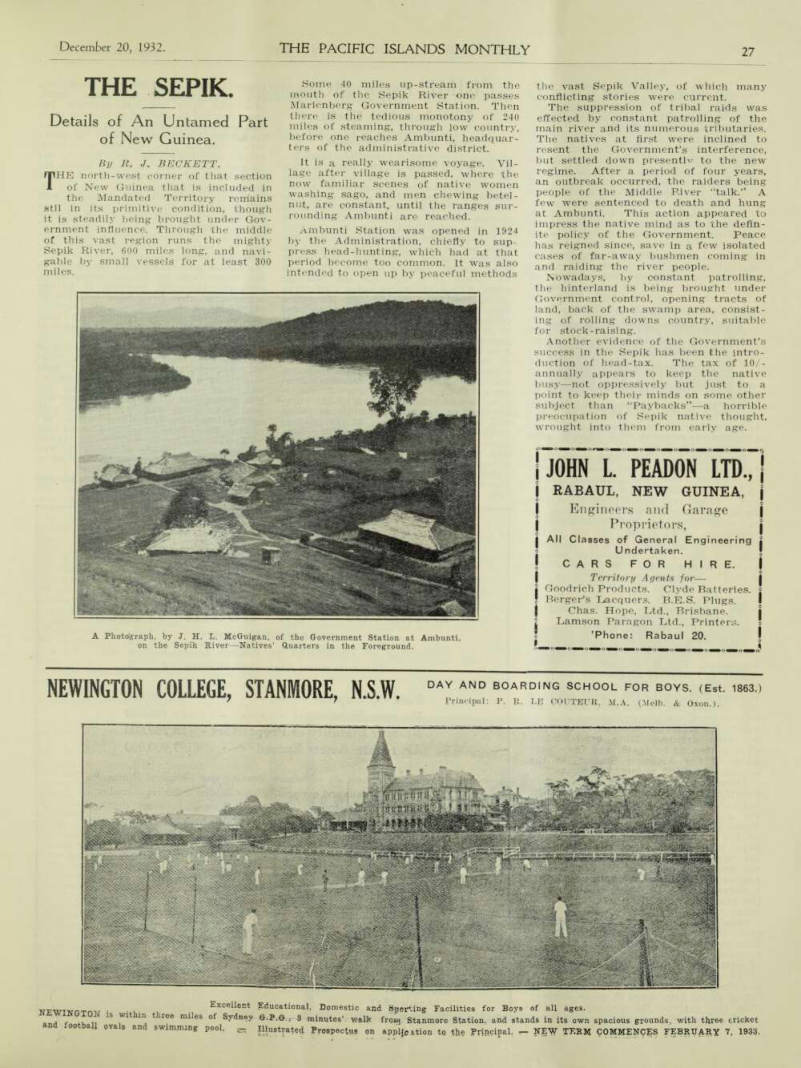
Ambunti Station was opened in 1924 by the Administration, chiefly to sup press head-hunting, which had at that period become too common. It was also intended to open up by peaceful methods
the vast Sepik Valley, of which many conflicting stories were current.
The suppression of tribal raids was effected by constant patrolling of the main river and its numerous tributaries.
The natives at first were inclined to resent the Government’s interference, but settled down to the new regime. After a period of four years, an outbreak occurred, the raiders being people of the Middle River “talk.” A few were sentenced to death and hung at Ambunti. This action appeared to impress the native mind as to the defin ite policy of the Government. Peace has reigned since, save in a few isolated cases of far-away bushmen coming in and raiding the river people.
Nowadays, by constant patrolling, the hinterland is being brought under Government control, opening tracts of land, back of the swamp area, consist ing of rolling downs country, suitable for stock-raising.
Another evidence of the Government’s success in the Sepik has been the intro duction of head-tax. The tax of 10/annually appears to keep the native busy—not oppressively but just to a point to keep their minds on some other subject than “Paybacks”—a horrible preoccupation of Sepik native thought, wrought into them from early age.
A Photograph, by J. H. L. McGuigan, of the Government Station at Ambunti, on the Sepik River —Natives’ Quarters in the Foreground.
Although they acclaim themselves to be mighty warriors, I have never heard a single instance of a stand-up fight.
The early-morning pounce and kill is the invariable procedure.
Sorcery plays a big part in their lives.
A native supposed to be a sorcerer is generally some old man not worth his weight in salt, or a man who perhaps has had the misfortune to lose an eye, or been born deformed, and who lives apart from the social group.
One man, to my knowledge, owing to the constant bickering of his women, es tablished a new camp some miles away from his village. Years later, he was acclaimed a sorcerer. People from far and wide came to him, with native pay, bribing him to desist from killing off the remainder of his or her family.
They were all sure that he had “worked poison” against a lately deceased. Even tually, the matter came before the Dis trict Officer. The accused sorcerer stoutly denied any knowledge of sorcery, but enlightened the Court with infor mation. The reputation had been placed upon his shoulders, and people came to him with pay, and this was too much for his honesty, so he carried on, letting the people think he had magical powers. The episode closed with a fine of several pounds, including return of all native pay, which took many months to effect.
In village life, the Sepik native is a handy agriculturist, and a good hunter on land or water; but he excels himself in a ceremonial house, chewing betel nut. Homicidal decorations in various forms are used. The chief forms, on the main Sepik, are the skin of a flying fox, worn as an apron; the bill of the horn-bill, worn on the back of the head; and the lime-stick, with many tassels, each denoting a kill, used in connection with the chewing of betel-nut, as the method of passing lime from the pot to the mouth. One native, to my know ledge, has 28 tassels on his lime-stick.
Editorial Note.
This article, by Mr. Beckett, was written several months ago. Early in November, by a curious coincidence, Mr. L. J. Perichon, of Madang (now in Australia on leave), called at this office.
He was formerly in the Public Service; and he was one of the four white men who carried out the executions at Am bunti in 1928, as described in Mr.
Beckett’s article. Nine head-hunters were sentenced to death, and they were hung at the Ambunti Station, in the presence of 7,000 untamed natives.
According to Mr. Perichon, it was a ghastly experience. The assembled natives were threatening and sulky, and the gallows were primitive. In four cases, when the murderers were thrown off the execution platform by the police boys, the ropes did not run clear, and the jerk which is supposed to dislocate the criminal’s neck did not occur. Con sequently, the kicking, squirming head hunters had to be hauled back on to the platform, and thrown off a second time.
Finally, all nine were duly executed, and their dead bodies, with ropes attached, were handed over to their tribesmen, as a warning and example of white men’s justice. The Sepiks hung about the station for a couple of days, and the four white men and their hand ful of police boys were in some danger; then the natives disappeared into the jungle.