Missions And Trade-Spirited
pp. 19-20 · Read in the full issue
Answer By Catholic Missionary.
(We gladly give space to this interesting and spirited contribution, by a well-known New Guinea missionary, to the controversy about the alleged trading activities of missionaries.)
[To The Editor.] THE October issue of “The Pacific Is lands Monthly,” which has just now reached us here, contains a letter from a New Ireland planter and trader, endeavouring to show that the Catholic Mission, in violation of the Canon Law of the Catholic Church, is engaged in trading with the natives to the detri ment of the planter.
The writer, who signs himself “Mort gaged,” in the course of his narrative, gives us his ideas of the nature and ex tent of missionary activity in the Is lands, represents the Missions as the
spoilt children of the Administration, and attempts to clarify his case by quoting examples in support of his al legations.
Read by one unacquainted with the Mandated Territory and unable accu rately to grasp the policy followed by the Catholic Mission, your correspondent may appear to have presented a plaus ible case; but, studied in the light of actual facts, the contribution is bristling with inaccuracies and entirely mislead ing, as I propose to show.
In the first place, His Lordship. Dr.
Vesters, the Catholic Bishop, did not state, as alleged, to the President of the Planters and Traders’ Association that trading is opposed to the Canon Law of the Church—even though such hap pens to be precisely the case.
The Canon Law of the Catholic Church states that clerics (and mission
aries, of course, are clerics) are forbid den to engage in trade or commerce, either personally or through the agency of others, either for themselves or for the benefit of others. The reason of this wise ordinance is that clerics should be free from the distractions associated with trade or commerce, in order to de vote themselves exclusively to their duties.
Canon Law, however, like Civil Law, has its code of interpretation and “trad ing,” as understood in the Canon Law, means purely gainful merchandising— that is, buying an article or object at a
lower price in order to sell it unchanged at a higher price, or buying an article or object to sell it at a profit after it has been changed by hired labour.
Hence it will be observed that four elements enter into the definition of trading: (1) Pur chase of an article or object; (2) in tention of reselling it; (3) the article or object must be unchanged; (4) the article or object must be sold at a higher price than was paid for it.
It will be readily understood that Canon Law, and, I believe, Civil Law also, does not label as trading the cen turies - old custom of disposing of the products of mission
properties, and devoting the entire revenues thus obtained to religious, edu cational and charitable purposes, By this time it is fairly well known and understood that the Catholic Mission obtains a certain income from the pro ducts of its plantations and the sale of timber. The whole of this revenue, combined with the contributions and gifts of benefactors in other countries, are devoted exclusively to the benefit of the native races, and no impartial critic
will deny that a very useful work is be ing done for the natives, while the Ad ministration is being assisted in its dif ficult task and taxation is being light ened for the planter.
Neither Canon Law nor Civil Law hinders or restrains a missionary faced with the necessity of protecting his people from exploitation, from devising means (not bartering for gain, of course) of placing commodities at a reasonable rate within the reach of his people who otherwise could not obtain them and this has, to my knowledge, been the expedient a few Catholic missionaries have reluctantly been driven to.
The planters, as a body, are friendly to the Catholic Mission, and many Catholics are members of the Planters’
Association. But no one would expect to find the entire body of planters im mune from temptation to overcharge, especially in places remote from any kind of competition. In the Australian States, governments have frequently found it necessary to appoint price fixing tribunals and appoint a body of inspectors to see that the ordinances of those tribunals are observed. A higher standard of integrity could not be looked for here than that obtaining in Australia.
The correspondent quotes cases which, to my mind, clearly point in one direc tion—namely, a genuine wish on the part of a missionary to obtain justice for his people. The prices charged are merely the same as those obtaining in Rabaul
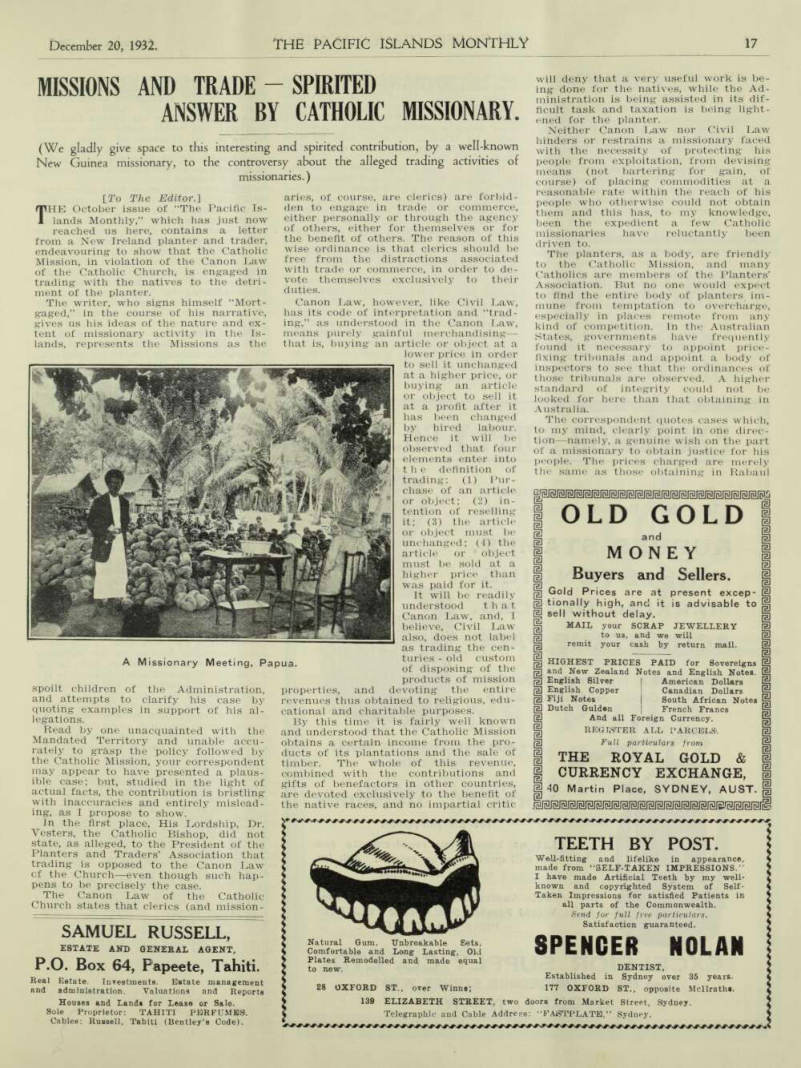
A Missionary Meeting, Papua.
and which are daily availed of by hun dreds of natives. Conditions at Kavieng are the same as at Rabaul.
Would anyone expect a missionary in a village, devoting his life to the uplift ing of hundreds of natives, to look on while his people are being exploited by one or two unscrupulous planters or traders? Of course, this statement will be denied. “Reasonable prices” is a very elastic term to certain minds, and it is notorious that exorbitant prices are not only charged to the natives but even the assistance of the missionary is not rarely asked to make the native a more pliable creature in the hands of the trader.
A visiting New Ireland planter came to my station, situated only a short dis tance from Rabaul and, in the course of a conversation, quite boastfully told me about his methods of enriching himself.
Lengths of laplap for which he paid 7½d. were sold for 3/6; knives for which 9d. was paid were disposed of for 2/9. In reply to my query as to whether he con sidered such conduct proper, he replied: “They are all doing it —the native does not value money.” Yet this person had one idea, and that was to become rich
quick, dispose of his holding to an is land company and return to Australia.
One actually asked me to persuade the natives to part with their produce for less than 50 per cent, of what they were already obtaining for it. Another made no attempt to deny that he sold bicycles for more than four times what they cost.
It may be urged that these cases—and the number could be easily multiplied are rare. No one would impute improper trading to the planters as a body; but the examples quoted serve to show the necessity of protecting the natives, and I am fully convinced that what was complained of was fully justified and nothing has so far come to light to prove the mission or an individual mis sionary engages in trade.
One other observation of the writer would like to throw a little light on is his statement that the missions are here for the purpose of ministering to the spiritual and mental requirements of the kanaka and, in consideration of this, the Government allows them cer tain concessions. Are missionaries to ac cept direction as to the scope of their activity from planters —many of whom,
uninfluenced by any form of religious belief, have an ingrained aversion for the native and a sneering contempt for what is being done to uplift him? The League of Nations has stated that the material and moral well-being, as well as the social progress of those living under the Mandate must be promoted.
Year by year questions are being asked at Geneva as to the manner this precept is being carried out.
Official records show that more than 38,000 native children are being educated in the Mandated Territory to-day. Ap proximately seventy are in the Govern ment school and their education and maintenance absorbs between £ 8,000 and £10,000 annually. The remainder, that is, 38,000 are educated solely by the missions, who purchase pieces of land, erect schools, train teachers and pay them afterwards, thus providing free education to the native without a penny of expense to Administration or tax payer.
The maintenance and education of half-castes, which would cost thousands of pounds annually, is left entirely to the Missions. In Rabaul, alone, approxi mately 200 children —Chinese, Malays and half-castes —are educated entirely by the Missions, thus saving at least five teachers and a large school.
Again, it is admitted that 50 per cent, of native infants die. Year by year, Catholic Mission sisters, many of whom are trained nurses, have worked suc cessfully to reduce this high mortality, without any cost to taxpayer. A Gov ernment institute costing thousands of pounds was erected at Malabunga, in the Toma district, for child welfare; yet only two young expectant native mothers entered there in fourteen months. The mission orphanages are the only places orphan children can go to.
The medical work done by the Catho lic mission is extensive and a great benefit to natives, as well as great help to the Administration.
An accurate reading of these facts will readily dissipate the erroneous view that missions are the spoilt pets of the Administration, receiving concessions that others do not enjoy. I submit that the missions are, according to the Man date, powerful factors in the uplifting of the natives, the greatest help to the Administration, and a decided aid to the taxpayer—although the latter may be slow to admit it.
In Australia, Governments have wisely drawn a sharp line of distinction be tween institutions not worked for profit and those that are. All realise that vol untary effort of every kind should be fostered and encouraged and few will quarrel with the contention that taxa tion should fall lightly on those who, without personal gain, are spending their lives for the benefit of others.
In conclusion, I would state that the Catholic Mission has never, during the half century of its existence, engaged in trading. The Catholic mission can gain neither pleasure nor profit from inter fering with the legitimate rights of others.
Most of the stupid and empty talk about missions and trading is found on investigation to be without the least foundation in fact. A small but malig nant clique may seek to discredit mis sions and missionaries, but cannot suc ceed in destroying their work in the de velopment of the Territory and the up lifting of the native races.
I am, etc.,
A Catholic Missionary.
Rabaul, Nov. 2, 1932.