Bourke Verdict And Sentence In
p. 16 · Read in the full issue
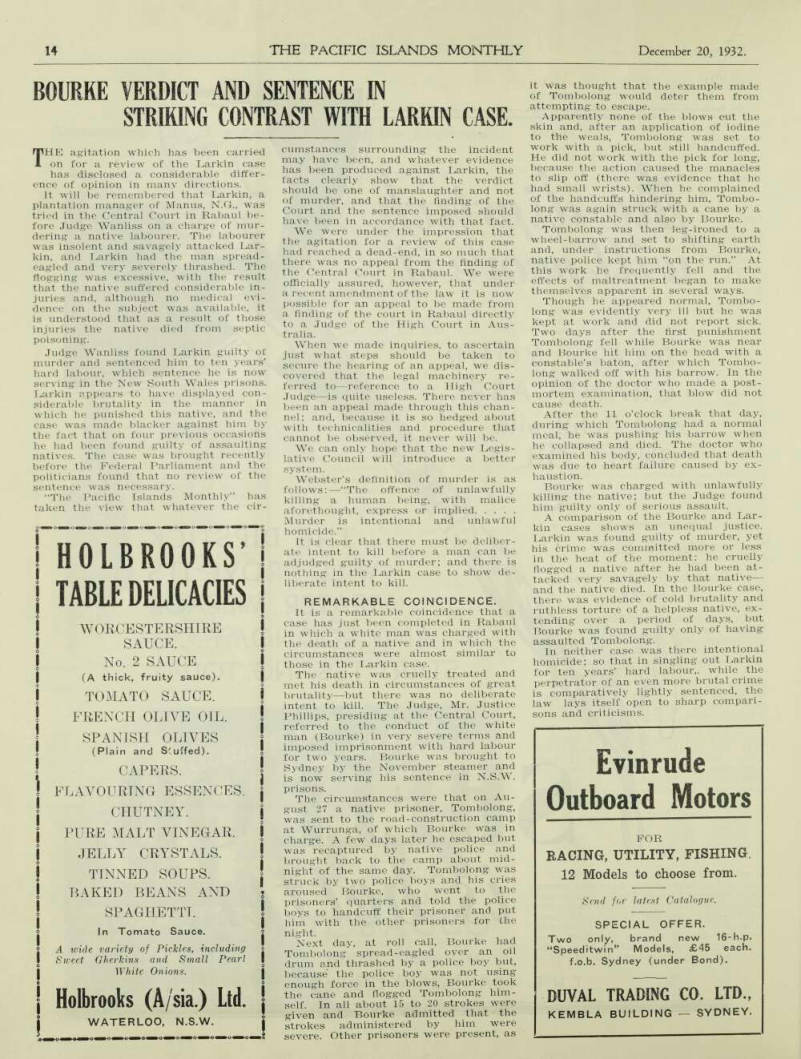
Striking Contrast With Larkin Case.
THE agitation which has been carried on for a review of the Larkin case has disclosed a considerable differ ence of opinion in many directions.
It will be remembered that Larkin, a plantation manager of Manus, N.G., was tried in the Central Court in Rabaul be fore Judge Wanliss on a charge of mur dering a native labourer. The labourer was insolent and savagely attacked Lar kin, and Larkin had the man spread eagled and very severely thrashed. The flogging was excessive, with the result that the native suffered considerable in juries and, although no medical evi dence on the subject was available, it is understood that as a result of those injuries the native died from septic poisoning.
Judge Wanliss found Larkin guilty of murder and sentenced him to ten years’ hard labour, which sentence he is now serving in the New South Wales prisons.
Larkin appears to have displayed con siderable brutality in the manner in which he punished this native, and the case was made blacker against him by the fact that on four previous occasions he had been found guilty of assaulting natives. The case was brought recently before the Federal Parliament and the politicians found that no review of the sentence was necessary.
“The Pacific Islands Monthly” has taken the view that whatever the cir
cumstances surrounding the incident may have been, and whatever evidence has been produced against Larkin, the facts clearly show that the verdict should be one of manslaughter and not of murder, and that the finding of the Court and the sentence imposed should have been in accordance with that fact.
We were under the impression that the agitation for a review of this case had reached a dead-end, in so much that there was no appeal from the finding of the Central Court in Rabaul. We were officially assured, however, that under a recent amendment of the law it is now possible for an appeal to be made from a finding of the court in Rabaul directly to a Judge of the High Court in Aus tralia.
When we made inquiries, to ascertain just what steps should be taken to secure the hearing of an appeal, we dis covered that the legal machinery re ferred to —reference to a High Court Judge—is quite useless. There never has been an appeal made through this chan nel; and, because it is so hedged about with technicalities and procedure that cannot be observed, it never will be.
We can only hope that the new Legis lative Council will introduce a better system.
Webster’s definition of murder is as follows: —“The offence of unlawfully killing a human being, with malice aforethought, express or implied Murder is intentional and unlawful homicide.”
It is clear that there must be deliber ate intent to kill before a man can be adjudged guilty of murder; and there is nothing in the Larkin case to show de liberate intent to kill.
Remarkable Coincidence.
It is a remarkable coincidence that a case has just been completed in Rabaul in which a white man was charged with the death of a native and in which the circumstances were almost similar to those in the Larkin case.
The native was cruelly treated and met his death in circumstances of great brutality—but there was no deliberate intent to kill. The Judge, Mr. Justice Phillips, presiding at the Central Court, referred to the conduct of the white man (Bourke) in very severe terms and imposed imprisonment with hard labour for two years. Bourke was brought to Sydney by the November steamer and is now serving his sentence in N.S.W. prisons.
The circumstances were that on Au gust 27 a native prisoner, Tombolong, was sent to the road-construction camp at Wurrunga, of which Bourke was in charge. A few days later he escaped but was recaptured by native police and brought back to the camp about mid night of the same day. Tombolong was struck by two police boys and his cries aroused Bourke, who went to the prisoners’ quarters and told the police boys to handcuff their prisoner and put him with the other prisoners for the night.
Next day, at roll call, Bourke had Tombolong spread-eagled over an oil drum and thrashed by a police boy but, because the police boy was not using enough force in the blows, Bourke took the cane and flogged Tombolong him self. In all about 15 to 20 strokes were given and Bourke admitted that the strokes administered by him were severe. Other prisoners were present, as
it was thought that the example made of Tombolong would deter them from attempting to escape.
Apparently none of the blows cut the skin and, after an application of iodine to the weals, Tombolong was set to work with a pick, but still handcuffed.
He did not work with the pick for long, because the action caused the manacles to slip off (there was evidence that he had small wrists). When he complained of the handcuffs hindering him, Tombo long was again struck with a cane by a native constable and also by Bourke.
Tombolong was then leg-ironed to a wheel-barrow and set to shifting earth and, under instructions from Bourke, native police kept him “on the run.” At this work he frequently fell and the effects of maltreatment began to make themselves apparent in several ways.
Though he appeared normal, Tombo long was evidently very ill but he was kept at work and did not report sick.
Two days after the first punishment Tombolong fell while Bourke was near and Bourke hit him on the head with a constable’s baton, after which Tombo long walked off with his barrow. In the opinion of the doctor who made a post mortem examination, that blow did not cause death.
After the 11 o’clock break that day, during which Tombolong had a normal meal, he was pushing his barrow when he collapsed and died. The doctor who examined his body, concluded that death was due to heart failure caused by ex haustion.
Bourke was charged with unlawfully killing the native; but the Judge found him guilty only of serious assault.
A comparison of the Bourke and Lar kin cases shows an unequal justice.
Larkin was found guilty of murder, yet his crime was committed more or less in the heat of the moment: he cruelly flogged a native after he had been at tacked very savagely by that native — and the native died. In the Bourke case, there was evidence of cold brutality and ruthless torture of a helpless native, ex tending over a period of days, but Bourke was found guilty only of having assaulted Tombolong.
In neither case was there intentional homicide; so that in singling out Larkin for ten years’ hard labour,, while the perpetrator of an even more brutal crime is comparatively lightly sentenced, the law lays itself open to sharp compari sons and criticisms.