Chinese Problem in the South Seas
pp. 5-6 · Read in the full issue
ONE of the most difficult problems in the Pacific, and one which the European races must soon at tack, is that of the Chinese. Partly by slow immigration, partly by natural increase, they are steadily penetrating all the Islands Groups and Territories, and are taking con trol of small trading and distribu tion. Already, in New Guinea, the Solomons, Fiji, Samoa and French Oceania, they are a thorn in the side of the European merchant and a source of anxiety to the respective administrations.
The problem is not peculiar to the Islands—it is racial. The Chinese is not a pioneer. He has no capacity for colonisation—he tames no wilderness, imposes no adminis trative order, has no ability for community organisation. But, once a new country has been opened up and rendered safe, he enters readily and eagerly, and displays genius as a barterer, and much industry and
technical skill as an artisan. Many Chinese merchants become rich and influential.
His standard of living definitely is below that of the European: con sequently, when European and Chi nese compete in trade, the Euro pean inevitably is starved out. That naturally creates bad feeling. The Europeans quite properly resent the fact that the Chinese deprive them of the fruits of their work and sac rifices in opening up new countries and developing them.
The trouble, in some of the Pa cific Territories, threatens to be come acute. New Guinea is a case in point. When Australia took over New Guinea from Germany, in 1914, there were between 1200 and 1500 Chinese men and women there, who had been brought in mostly as plantation labourers. The bulk of them were marked by the Germans for repatriation, and they should have been sent home. But, under
the exigencies of war, they were al lowed to remain; and when Aus tralia was given the Mandate in 1921, they already were “dug in.”
Australia imposed two important laws—no more Chinese immigra tion, and no Chinese to hold trad ing licenses—and left it at that.
To-day, in the Territory, there must be 2000 Chinese, and their numbers are steadily increasing.
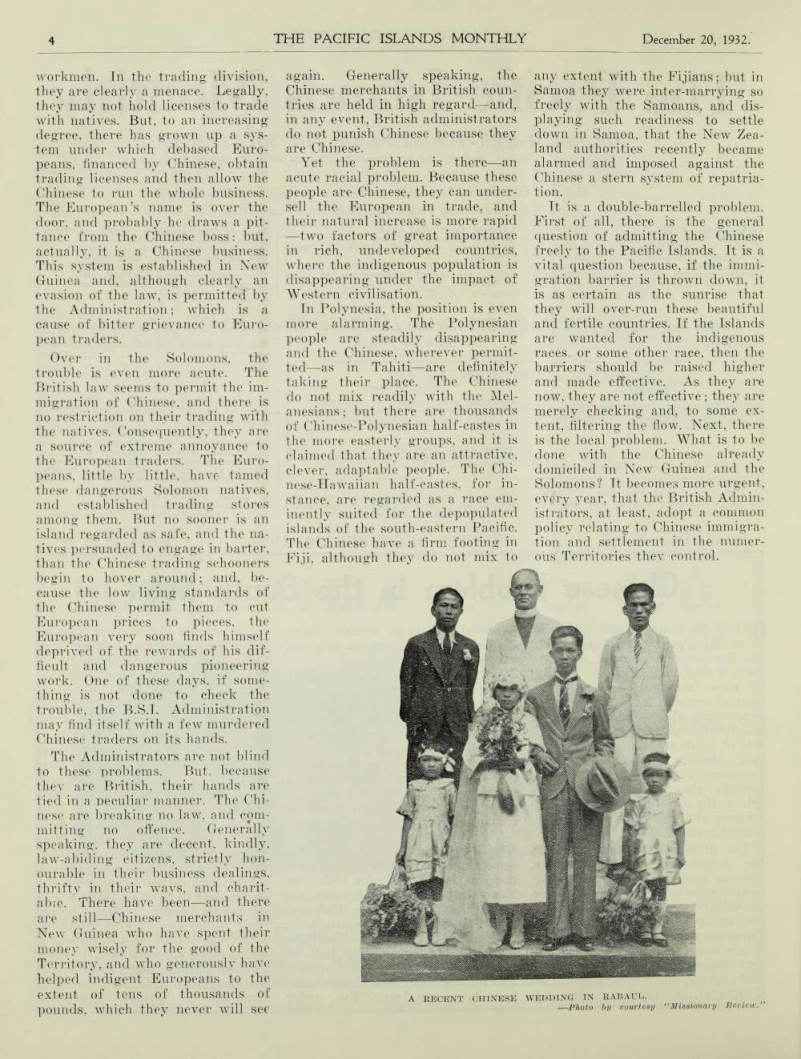
They are the artisans, small shop keepers and small traders of New Guinea. The large Chinese com munity in Rabaul provides engi neers, carpenters, car drivers, schooner captains, tailors, bakers, contractors, restaurant-keepers, etc.
In the artisan division, they are of no special benefit to New Guinea: their wages are little, if anything, below the wages of a European— which simply means that, if there were no Chinese there, there would be jobs in New Guinea for some hundreds of skilled Australian
workmen. In the trading division, they are clearly a menace. Legally, they may not hold licenses to trade with natives. But, to an increasing degree, there has grown up a sys tem under which debased Euro peans, financed by Chinese, obtain trading licenses and then allow the Chinese to run the whole business.
The European’s name is over the door, and probably he draws a pit tance from the Chinese boss: but, actually, it is a Chinese business.
This system is established in New Guinea and, although clearly an evasion of the law, is permitted by the Administration; which is a cause of bitter grievance to Euro pean traders.
Over in the Solomons, the trouble is even more acute. The British law seems to permit the im migration of Chinese, and there is no restriction on their trading with the natives. Consequently, they are a source of extreme annoyance to the European traders. The Euro peans, little by little, have tamed these dangerous Solomon natives, and established trading stores among them. But no sooner is an island regarded as safe, and the na tives persuaded to engage in barter, than the Chinese trading schooners begin to hover around; and, be cause the low living standards of the Chinese permit them to cut European prices to pieces, the European very soon finds himself deprived of the rewards of his dif ficult and dangerous pioneering work. One of these days, if some thing is not done to check the trouble, the B.S.I. Administration may find itself with a few murdered Chinese traders on its hands.
The Administrators are not blind to these problems. But because they are British, their hands are tied in a peculiar manner. The Chi nese are breaking no law, and com mitting no offence. Generally speaking, they are decent, kindly, law-abiding citizens, strictly hon ourable in their business dealings, thrifty in their ways, and charit able. There have been —and there are still—Chinese merchants in New Guinea who have spent their money wisely for the good of the Territory, and who generously have helped indigent Europeans to the extent of tens of thousands of pounds, which they never will see
again. Generally speaking, the Chinese merchants in British coun tries are held in high regard—and, in any event, British administrators do not punish Chinese because they are Chinese.
Yet the problem is there—an acute racial problem. Because these people are Chinese, they can under sell the European in trade, and their natural increase is more rapid —two factors of great importance in rich, undeveloped countries, where the indigenous population is disappearing under the impact of Western civilisation.
In Polynesia, the position is even more alarming. The Polynesian people are steadily disappearing and the Chinese, wherever permit ted —as in Tahiti—are definitely taking their place. The Chinese do not mix readily with the Mel anesians ; but there are thousands of Chinese-Polynesian half-castes in the more easterly groups, and it is claimed that they are an attractive, clever, adaptable people. The Chi nese-Hawaiian half-castes, for in stance, are regarded as a race em inently suited for the depopulated islands of the south-eastern Pacific.
The Chinese have a firm footing in Fiji, although they do not mix to
any extent with the Fijians; but in Samoa they were inter-marrying so freely with the Samoans, and dis playing such readiness to settle down in Samoa, that the New Zea land authorities recently became alarmed and imposed against the Chinese a stern system of repatria tion.
It is a double-barrelled problem.
First of all, there is the general question of admitting the Chinese freely to the Pacific Islands. It is a vital question because, if the immi gration barrier is thrown down, it is as certain as the sunrise that they will over-run these beautiful and fertile countries. If the Islands are wanted for the indigenous races, or some other race, then the barriers should be raised higher and made effective. As they are now, they are not effective ; they are merely checking and, to some ex tent, filtering the flow. Next, there is the local problem. What is to be done with the Chinese already domiciled in New Guinea and the Solomons? It becomes more urgent, every year, that the British Admin istrators, at least, adopt a common policy relating to Chinese immigra tion and settlement in the numer ous Territories they control.
A Recent Chinese Wedding In Rabaul.
—Photo by courtesy “Missionary Review.