Cook Is. Notes
p. 36 · Read in the full issue
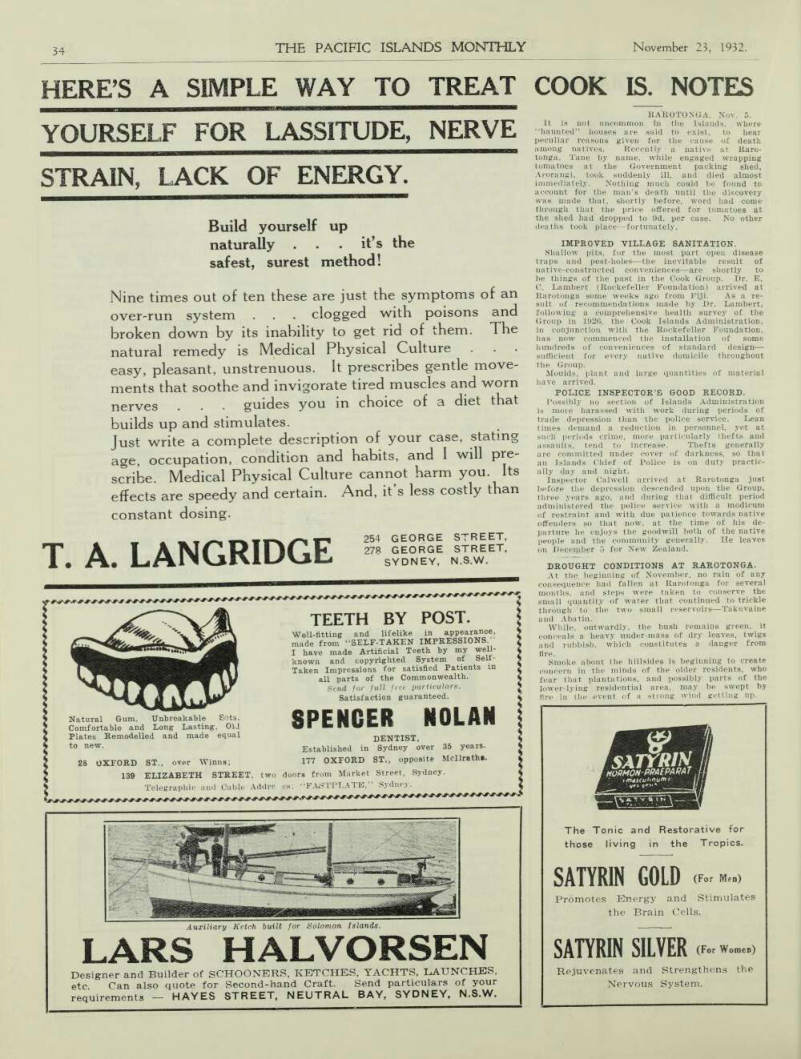
Rarotonga. Nov. 5.
It is not uncommon in the Islands, where “haunted” houses are said to exist, to hear peculiar reasons given for the cause of death among natives. Recently a native at Raro tonga, Tane by name, while engaged wrapping tomatoes at the Government packing shed, Arorangi, took suddenly ill, and died almost immediately. Nothing much could be found to account for the man’s death until the discovery was made that, shortly before, word had come through that the price offered for tomatoes at the shed had dropped to 9d. per case. No other deaths took place—fortunately.
Improved Village Sanitation,
Shallow pits, for the most part open disease traps and pest-holes—the inevitable result of native-constructed conveniences—are shortly to be things of the past in the Cook Group. Dr. E.
C. Lambert (Rockefeller Foundation) arrived at Rarotonga some weeks ago from Fiji. As a re sult of recommendations made by Dr. Lambert, following a comprehensive health survey of the Group in 1926, the Cook Islands Administration, in conjunction with the Rockefeller Foundation, has now commenced the installation of some hundreds of conveniences of standard design— sufficient for every native domicile throughout the Group.
Moulds, plant and large quantities of material have arrived.
Police Inspector’S Good Record.
Possibly no section of Islands Administration is more harassed with work during periods of trade depression than the police service. Lean times demand a reduction in personnel, yet at suctf periods crime, more particularly thefts and assaults, tend to increase. Thefts generally are committed under cover of darkness, so that an Islands Chief of Police is on duty practic ally day and night.
Inspector Calwell arrived at Rarotonga just before the depression descended upon the Group, three years ago, and during that difficult period administered the police service with a modicum of restraint and with due patience towards native offenders so that now, at the time of his de parture he enjoys the goodwill both of the native people and the community generally. He leaves on December 5 for New Zealand.
Drought Conditions At Rarotonga.
At the beginning of November, no rain of any consequence had fallen at Rarotonga for several months, and steps were taken to conserve the small quantity of water that continued to trickle through to the two small reservoirs—Takuvaine and Abatiu.
While, outwardly, the bush remains green, it conceals a heavy under-mass of dry leaves, twigs and rubbish, which constitutes a danger from fire.
Smoke about the hillsides is beginning to create concern in the minds of the older residents, who fear that plantations, and possibly parts of the lower-lying residential area, may be swept by fire in the event of a strong wind getting up.