How Christmas Is Celebrated
pp. 28-29 · Read in the full issue
At An Islands Mission Station.
By Fred R. Isom, of the Melanesian Mission Press, Guadalcanal, Solomon Islands
CHRISTMAS usually begins, for the Island Missionary, three or four months beforehand, when considera tion has to be given to the amount of stores to be ordered, and the sum avail able for presents, sports prizes, etc.
Then things go on more or less as usual until the week before Christmas.
When this week arrives everyone is im bued with the “cleaning” spirit. Gardens are spruced up, lawns and grass cut and trimmed, paths and roads are cleaned, and houses of whites and natives and the church are subjected to a thorough overhaul.
For the purposes of this article we will remember that the Mission Station here mentioned is a fairly large one, comprising a school of about 100 native boys, ages 9 to 15, two white priests, a native deacon, four other white staff, three native teachers, and some 25 work-boys from the plantation and estate.
The morning of Christmas Eve, and a busy day. Quite early, two bullocks are slain for to-morrow’s feast. These are cut up, wrapped in large leaves and, with large supplies of native root crops and puddings already prepared, are cooked in large native ground ovens.
The cooking is very gradual, the ovens are covered over and left, and next morning the food will be done to a turn.
While some have been acting as butchers and cooks, others have been decorating the church and the houses ready for the great festival.
In the afternoon, a baptism is to be held. Six boys, carefully prepared for several months, are to be made mem bers of the Church of God in Melan esia. The ceremony is to be performed in the river.
At 4.30 clergy and staff robe in the vestry, while the congregation gathers in church. From the steps of the altar the officiating priest begins with a short prayer. Then, “Let us go forth in peace,” and the procession, led by the Thurifer, commences its way to the riverside. Crucifer, banners, acolytes, staff, follow, then the priest, who has prepared them, leads his catechumens.
The officiant follows, and then the whole school, four by four. The Litany is intoned on the way down.
At the river-bank, the procession stands on either side, and the boys are questioned, one by one, by the priest.
Priest and boys go down into the river, and there each one is signed with the Sign of the Cross and baptised to be a Christ’s man unto his life’s end.
Coming out of the water, the newly baptized put on their new white cali coes, surely a very practical sign of the inner washing. Now their recital of the Apostles’ Creed, and the follow ing prayers, and the procession reforms and makes its way with hymns of thanksgiving back to the church. Here, the newly-baptized are put into their new places, and a final prayer ends the service. Sung Evensong for Christmas Eve follows, and then the evening meal. At 7 p.m. comes the service of Preparation for the Christmas Communion, with address. This over, everyone goes to bed at once, and strict silence is kept.
Half-an-hour before midnight, the whole station is awakened by the loud beating of the native drum, warning for the midnight Eucharist.
On the stroke of 12, the procession leads in from the vestry, and forms be fore the altar. After the Invocation the Thurifer leads the way down the aisle to the west end of the church and back up the nave. Cross and banners are put in place and the Celebrant exchanges Cope for Chasuble, and then commences the Christ- Mass.
People from two nearby villages have arrived, and altogether there are over 120 communicants. The singing is to Merbecke, and the hymns go with a swing.
A collection is taken and usually quite a substantial sum is offered.
The service ended, the whole congregation is re galed with tea and biscuits, and after this a few may
be fortunate to secure an hour or two’s sleep. But the refreshments over, the
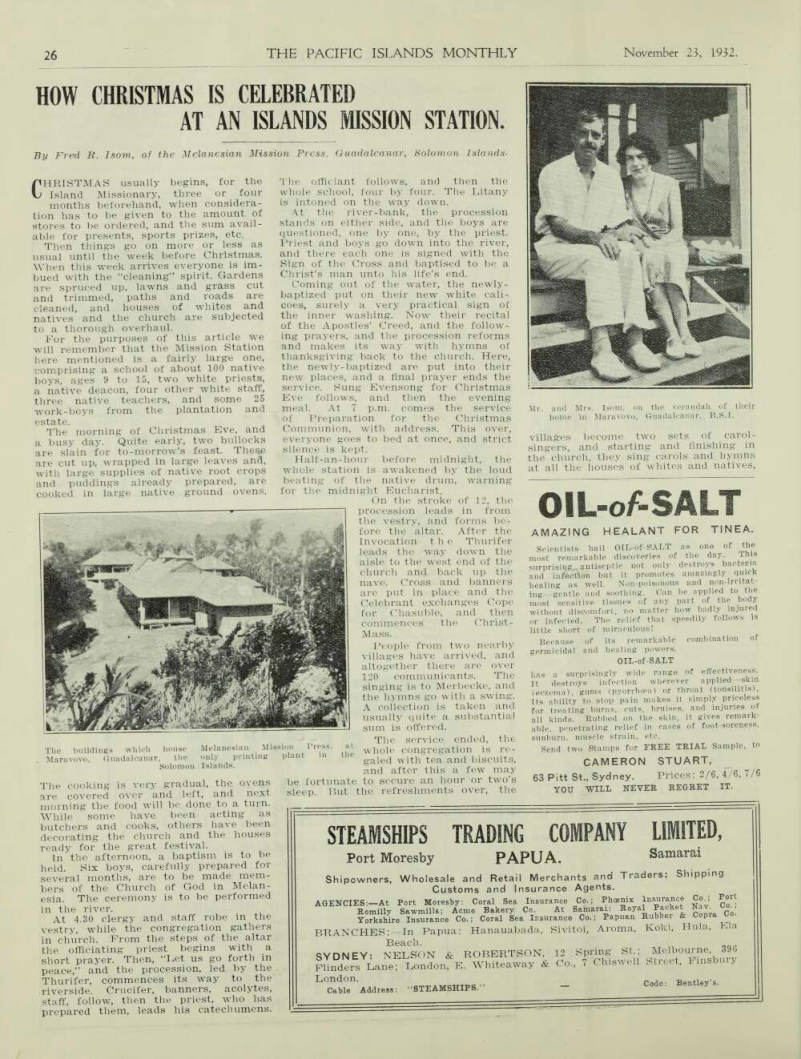
The buildings which house Melanesian Mission Press, at Maravovo, Guadalcanal, the only printing plant in the Solomon Islands.
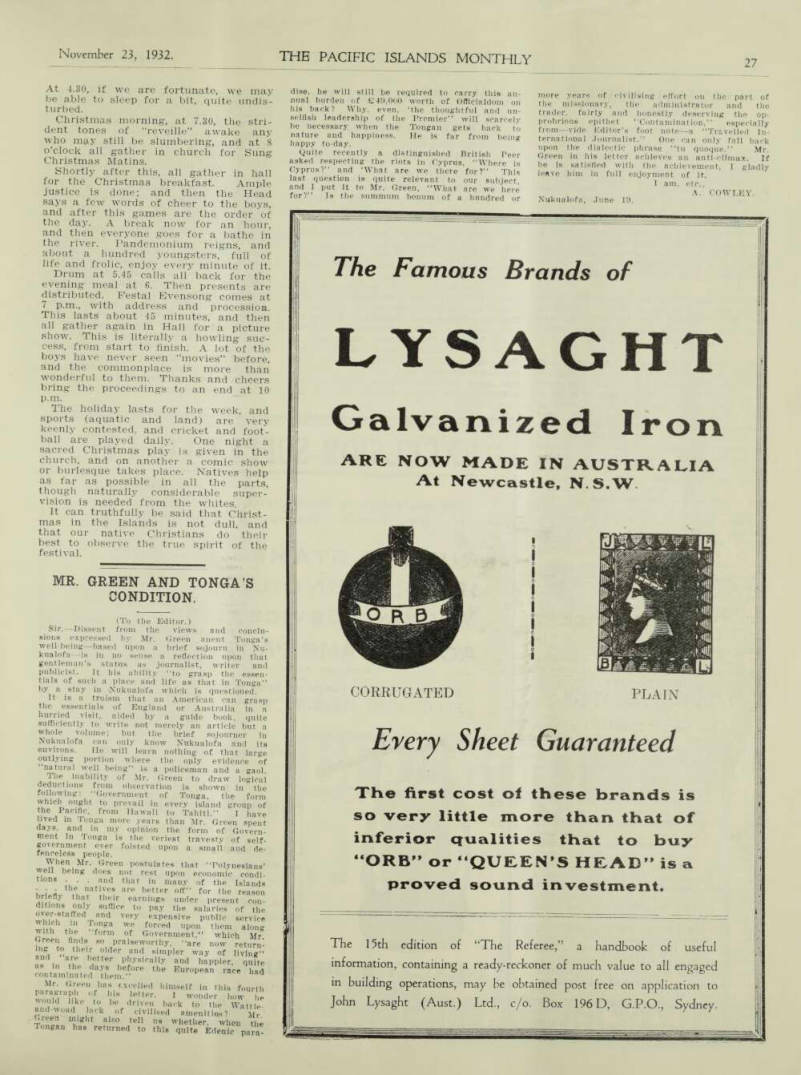
Mr. and Mrs. Isom, on the verandah of their home in Maravovo, Guadalcanar, B.S.I. villages become two sets of carol singers, and starting and finishing in the church, they sing carols and hymns at all the houses of whites and natives,
At 4.30, if we are fortunate, we may be able to sleep for a bit, quite undis turbed.
Christmas morning, at 7.30, the stri dent tones of “reveille” awake any who may still be slumbering, and at 8 o’clock all gather in church for Sung Christmas Matins.
Shortly after this, all gather in hall for the Christmas breakfast. Ample justice is done; and then the Head says a few words of cheer to the boys, and after this games are the order of the day. A break now for an hour, and then everyone goes for a bathe in the river. Pandemonium reigns, and about a hundred youngsters, full of life and frolic, enjoy every minute of it.
Drum at 5.45 calls all back for the evening meal at 6. Then presents are distributed. Festal Evensong comes at 7 p.m., with address and procession.
This lasts about 45 minutes, and then all gather again in Hall for a picture show. This is literally a howling suc cess, from start to finish. A lot of the boys have never seen “movies” before, and the commonplace is more than wonderful to them. Thanks and cheers bring the proceedings to an end at 10 p.m.
The holiday lasts for the week, and sports (aquatic and land) are very keenly contested, and cricket and foot ball are played daily. One night a sacred Christmas play is given in the church, and on another a comic show or burlesque takes place. Natives help as far as possible in all the parts, though naturally considerable super vision is needed from the whites.
It can truthfully be said that Christ mas in the Islands is not dull, and that our native Christians do their best to observe the true spirit of the festival.