“Uncle Cornish,” Of Norfolk Island.
p. 10 · Read in the full issue
Specially written for “The Pacific Islands Monthly ” by Mildred Campbell.
ONE of the outstanding personalities of Norfolk is old Mr. Cornelius Quintal —"Pa,” to his handsome middle-aged family, "Uncle Cornish” to the rest of the world.
Grandson on both sides of his family to two of the famous Bounty Mutineers, he is the eldest of the four remaining Islanders who were actually born on Pitcairn; and as he was 15 years old when that romantic little community was transferred in 1856 to Norfolk Island —then recently abandoned as a penal settlement —that makes him now a hale and hearty 91 on his last birth day.
His memory covering the years of his childhood is as keen as ever it was and, to favoured visitors, he tells tales of the days when the world was young that are as vivid as though he were talking of yesterday. There was sharp-tongued neighbour woman on Pitcairn who used to drive him, as little fellow, up into coconut palms that seemed to reach into the sky; and on Norfolk, when the wide-eyed children of the Garden of Eden arrived here, there still remained a dozen convicts in charge of cattle and growing crops.
To the innocent Pitcairn boy, knowing nothing of evil beyond the simple sins of omission or commission of his island brotherhood, these men told stories of wrong and horror and cruelty that drove the blood from his heart, blackened the beauty around him and dimmed the rose and gold of the sky.
When Cornish grew up he became deeply devout and in the train of Bishop Patteson —afterwards murdered in the islands —he wandered the Pacific, helping to bear the torch of religion and civilization among the darker races. Later, he became an expert whaler, with headquarters on his own island; and his children remember playing with a box of golden sovereigns, which meant no more to them than beads or buttons to youngsters else where.
On one occasion a whale boat was overturned twelve miles from shore and, with a man who could not swim clinging to him, accompanied by a couple of sharks as a menacing escort and guided by flares ashore, he finally staggered exhaustedly through the shallow waters of the stony little beach of Cascade Landing—which is still littered with the bones of Leviathan.
A quarter of a century ago Uncle Cornish made his first visit to Sydney on serious business; and the manner of it was this.
Years and years before, when the Pitcairners first landed on Norfolk, they were granted short-sighted per mission to demolish the prison ruins —which should have existed to this day as a perfect example of penal or ganization and system a hundred years ago—and to take the stone to build new homesteads "up country” where their fifty-acre blocks of land were situated.
To Uncle Cornish’s mind—fifty years later —that permission had never been rescinded, nor was it possible for an” later authority to do so, seeing that the Island —lock, stock, and barrel—
had been deeded to the Pitcairn Is landers upon their first taking posses sion. He wanted stone in quantity, and he took it, calmly disregarding the warning of Colonel Spalding, the first Administrator appointed from oversea.
He was haled before the Court and fined.
That might have been enough for many men; but not for Cornish, then a young and determined sixty-five. He took passage to Sydney by the little “Tamba,” and laid his grievance before Admiral Sir Harry Rawson, the then Governor of New South Wales —by which State, in those days, Norfolk Island was administered.
Sir Harry listened sympathetically, as one sea-dog to another, and, after due consideration, not only remitted the fine but saw to Mr. Cornelius Quintal’s entertainment in Sydney, and granted him a free passage back to the island by H.M.S. ‘‘Powerful,” shortly en route for Fiji, but instructed to deviate from her course and land her picturesque passenger. He was great success aboard, from the Com modore down, and on their Sunday at sea he was invited to address the lower deck in the evening, in his capacity as minister of the Methodist Brotherhood on Norfolk Island. This he did with high enjoyment and the utmost aplomb, taking the opportunity to re count the story of the Mutiny of the Bounty and solemnly warning his con gregation not to attempt such "goings on” in these days, when the Pacific Ocean is an open book to all seafaring men and such an enterprise could only end in "hanging from the yardarm.”
In addition to being a fine sailor and an expert farmer, Uncle Cornish, until very recently, was a notable horseman; and when this writer arrived
upon the island, less than five years ago, and used to explore the highways and byways with a trap and a vener able nag, it was nothing uncommon, in the furthest recesses of the island, to suddenly hear the thunder of and be overtaken by Uncle Cornish, on a skittish young horse; galloping in chivralous pursuit, in case the lady met up with one of the lorries that, five years ago, were an unpleasant novelty to the horseflesh of Norfolk.
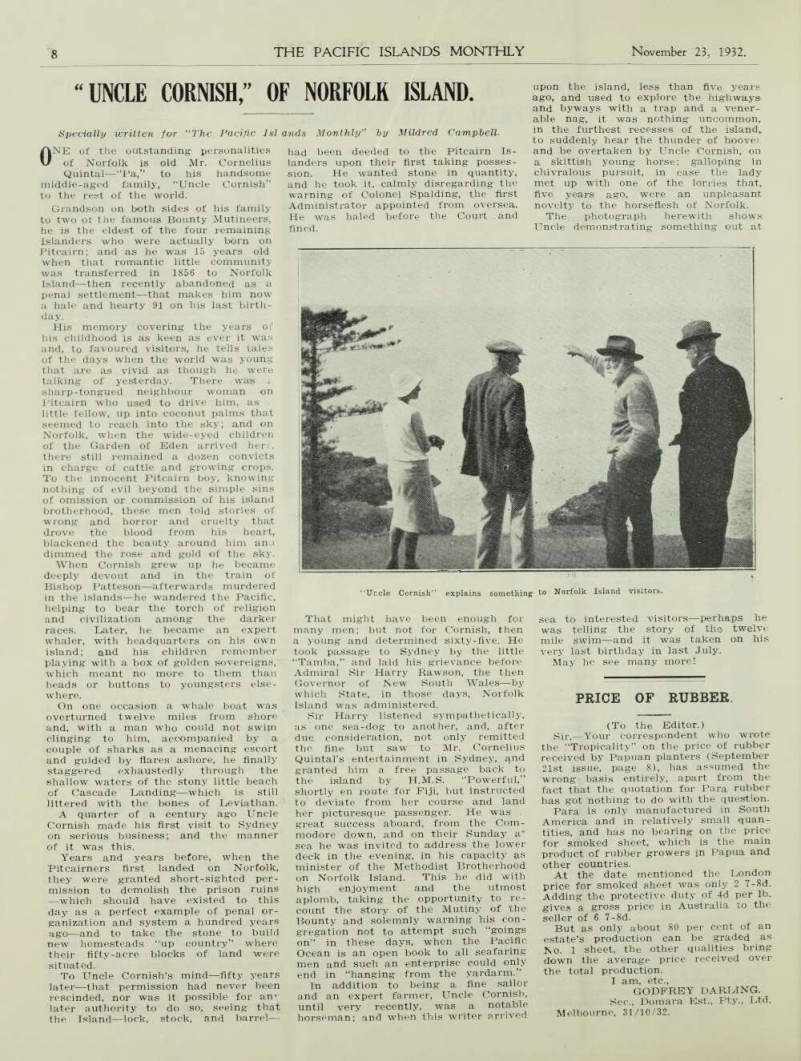
The photograph herewith shows Uncle demonstrating something out at
sea to interested visitors—perhaps he was telling the story of the twelve mile swim—and it was taken on his very last birthday in last July.
May he see many more!
“Uncle Cornish” explains something to Norfolk Island visitors.