Gold Find.
pp. 6-37 · Read in the full issue
Rich Prospects on Guadalcanal,
B.S.I.
IT was reported during the month that an important gold discovery had been made in the Solomon Islands.
The find is in the island of Guadal canar, at the back of Berande, on the north coast. It is 50 or 60 miles nearly due south of Tulagi (the chief adminis trative centre) which is on an island off the coast of Florida Island.
The discovery was made many months ago, but was not advertised. Following careful investigations, a powerful Syd ney group has secured mining rights over 15,000 acres. Testing plant was sent to the field by the October “Mataram,” and an expert staff leaves by the “Ma taram” on November 30.
The find was made by a young Queensland botanist, Mr. Kajewski. He is about 30 years old, and of a bold and adventurous disposition. He was in Bou gainville (Northern Solomons) in 1931, collecting botanical specimens for one of the American universities. Later, he worked his way southwards through the group, eventually reaching Guadalcanal and, wherever he went, he prospected for gold.
Early in 1932, seeking rare plants, Mr.
Kajewski, penetrated into country where white man never before had been seen — the broken, mountainous region lying southwards a little east of Berande, on the north coast of Guadalcanal Only a very strong and courageous man would go where he went.
At a point about 14 miles inland, at a height of 1200 feet (Guadalcanar at this part, is about 25 miles across), Mr.
Kajewski found rich gold. He returned to the Berande plantation of the Solo mon Islands Development Co., and told Mr. Robinson, the manager, of his dis covery. The find was further investi gated; and then a local syndicate was formed to exploit the discovery. It com prised.
Mr. Kajewski.
Mr. Robinson.
Mr. Alan Campbell, a plantation in spector for the S.I.D. Co.
Mr. J. C. M. Scott, manager at Ma kambo for Messrs. Burns, Philp (S.S.) Co., Ltd.
Mr. Whiddy, plantation inspector for Messrs. Levers’ Pacific Plantations, Ltd.
Mr. Johnstone, owner of ice-works, etc., at Tulagi.
Two members of the syndicate came to Sydney, and succeeded in interesting the well known Pratten group, who made several fortunes out of Malayan tin. As a result, Mr. E. P. Penman, a well known mining engineer, was sent to the Solomons by the Pratten group.
Mr. Jenman is a cautious, non-excit able type of man; but it is said that even he was startled by the richness of some of the ore found in Mr. Kajewski’s new field. We have been told, on good authority, that one specimen assayed 1½ ounces to the yard; some others went one ounce to the yard.
(Continued on page 35.)
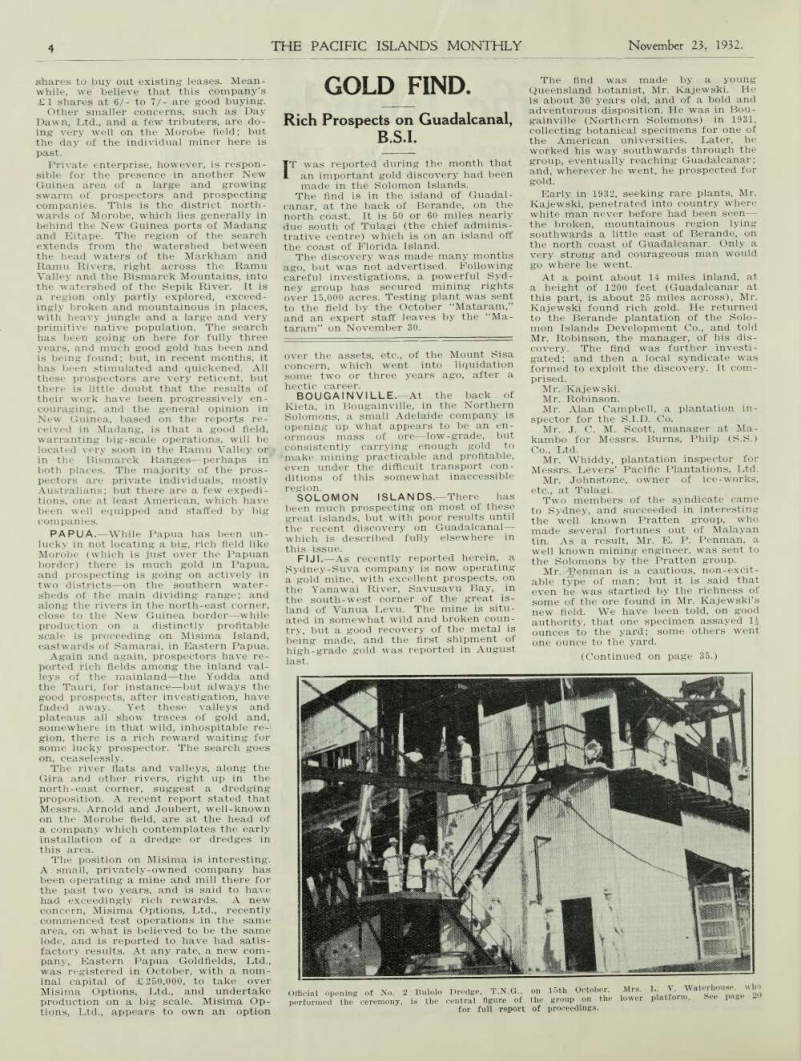
Official opening of No. 2 Bulolo Dredge, T.N.G.. on 15th October. Mrs. L V. Waterhouse, who performed the ceremony, is the central figure of the group on the lower platform. See page 20 for full report of proceedings.
The people interested agreed to keep strict silence concerning their gold dis covery, and they succeeded in giving the impression that it was a “wash-out.” Mr.
Penman returned to Sydney, made his report, and immediately was despatched to Suva to secure some form of tenure over the land.
The Solomon Islands Protectorate is governed by the British Colonial Office, through a Resident Commissioner at Tulagi, who is responsible to the High Commissioner for the Western Pacific.
The latter is also the Governor of Fiji, and is resident at Suva. Any important decisions affecting Solomon Is. adminis tration are made at Suva. The Solomon Islands mining laws are sufficient, so long as there is little mining, but quite insufficient if there is to be a “rush” and an urgent demand for mining rights.
Mr. Penman was able to get a definite protection, so far as mining rights are concerned, over 15,000 acres. A new com pany, Guadalcanal, Ltd., with a nominal capital of £ 30,000, was forthwith regis tered in Suva —not in Australia.
Penman returned to Sydney, and 120,000 shares, of 5/- each, were issued. £10,000 worth of these shares were handed to the members of the original syndicate to purchase their interests.
Mr. F. G. Pratten is chairman of the new board.
Within a week or two, Sydney buzzed with rumours about the “rich Solomons find.” It was reported that some of those 5/- shares changed hands at a consid erable premium.
The directors of the new company re
fused to give any information for publi cation. There were two reasons for this.
One is that a “rush” is not desired by the company, to the district concerned; the other is that the Solomons Islands administration is definitely not equipped to deal with a gold rush. It has, for in stance, only one surveyor, and an as sistant surveyor.
Mr. Penman very courteously gave to “The Pacific Islands Monthly” the first authentic information to be published about this possible new field.
“As a result of what I saw there,” he said, “I put in a favourable report. The present company has been formed to prospect and develop the area. The pro position is in two parts—sluicing in the high country, where rich specimens were obtained, and dredging on the river flats, lower down, which are quite unexplored.
We worked down the Sorvohio River, and found traces of gold all the way.
“We have taken up all the coastal flats, to test for alluvial gold. If the tests come up to reasonable expectations, this may be one of the most important allu vial propositions yet found.
“But there is nothing found there yet to get excited about,” added Mr. Penman, cautiously. “It all has to be tested.”
He admitted that ground taken from a particular place in the river bank, high up in the hills, had proved phenomen ally rich and that Mr. Kajewski, up there, had produced some remarkable specimens.
The area which has been taken up by the company, about five miles from Ber ande, covers five rivers. The testing plant will be operating there very shortly.
Guadalcanal is the largest island of the Solomons group. It is very rugged, with numerous razorback mountains,
some rising- to 8000 feet. Only the north eastern portion has been settled by coco nut planters to any extent, and Aola, the administrative centre, is situated there.
The natives are primitive and, to some extent, dangerous; but do not appear to be numerous. Eleven members of an Austrian scientific expedition were mur dered by the natives there about 1886, and the monument erected to their memory may be seen on the beach, near the scene of the new gold discovery. Mr.
Kajewski and Mr. Penman, who pene trated into this very wild country, saw few natives and were not interfered with.
It is reported that the various interests concerned —administrative, shipping and mining—will cooperate to discourage any rush to the new field. The Adminis tration will not readily issue miners’ rights, or anything of that kind, mainly because it is without facilities for con trolling a mining development: and it will insist on every person entering the Territory making a deposit of £50 on landing, to ensure his maintenance and return. There is a Mining Board in Tu lagi, consisting of Mr. F. E. Johnson (Treasurer), Mr. S. G. C. Knibbs (Chief Surveyor) and one other officer.
Machinery for controlling mining opera tions was created only in 1927.
Mr. Penman, as a keen geologist, was much interested in the formations he found on Guadalcanal. There were many indications of extreme age, leading him to form the opinion that the older Solo mon Islands are part of that ancient continental belt which gave a land con nection between south-eastern Asia and Antarctica or South America. Such con ditions were favourable to the presence of gold.