Growing Use Of Radio Receivers In
pp. 42-43 · Read in the full issue
The Pacific Islands.
A PROBLEM which is increasingly exercising the minds of residents in the various Pacific Territories is that of securing for themselves an adequate and reliable supply of news.
It may be solved by the use of better and bigger wireless receiving sets.
These are now being built.
In past decades, the Pacific Islands resident reconciled himself to the fact that he was definitely far out of range of telegraphs and newspapers, and he was content to receive and consume his news in large lumps whenever the steamers called with his mail.
But with the development of radio, the whole position in that regard has altered.
Almost all Pacific Islands communi tics of anv size now have a radio station, and a radio official settled among them. The air is full of news services, broadcast in short-wave Morse from the surrounding continents. It is possible for men living in very remote is lands to know nowadays about great events within a few hours of their oc currence. But, up-to-date, no regular system of supplying news to the Pacific Islands communities has been devised.
The reason is that the preparation, broadcasting, transmission, copying and circulation of news by Morse de finitely represents a considerable cost; and when the amount is passed on to Pacific Islands residents, per medium of the local radio station, the sum rep
resents a too heavy tax on individuals.
Yet, in the South Seas there are thousands of planters and traders who recognise the possibilities of radio; and who now insist that it shall be used to provide them with a regular news ser vice, and a means of obtaining special messages from the mainland. This may yet be done by picking up broadcasts on individual receiving sets, instead of depending on messages copied through the Morse station.
Up to recently, radio receiving sets installed in the Pacific Islands, to keep their owners in touch with Aus tralian and New Zealand broadcasts. have not been satisfactory. Sets with six and seven valves can pick up the stations from almost any of the Is lands; but they also pick up static, and these older sets have been practically useless in the stormy season, for months at a time.
But, month by month, new and bet ter receiving sets are being produced; and the far more delicate adjustments that are now possible are very rapidly extending the radius of reliable broad cast reception. As a result, more and more Islands groups are becoming wirelessly workable, so that it, is now possible to bring Norfolk Island, New Caledonia. New Hebrides, Solomon Is lands, and some parts of Papua within effective range of Australian stations; and Fiji, Samoa, Tonga and Cook Is lands within range of Australian and
New Zealand stations, during practic ally the whole of the year.
We are much interested in these de velopments, because we believe they are going to solve one of the chief dis advantages of life in the Islands — namely, inability to keep in touch with the world’s current affairs. It is only a question of a short time before one or more of the big broadcasting sta tions in Australia and New Zealand will devote at least one regular session to Pacific Islands listeners-in, during which a special news service, and spe cial messages for Islands residents, will be broadcast. Under these conditions, a resident of New Ireland, or Malaita, or Santo, or Norfolk Island, who now re ceives a mail perhaps once a month, will listen in every evening to a news broadcast, and perhaps to special mes sages directed to him personally.
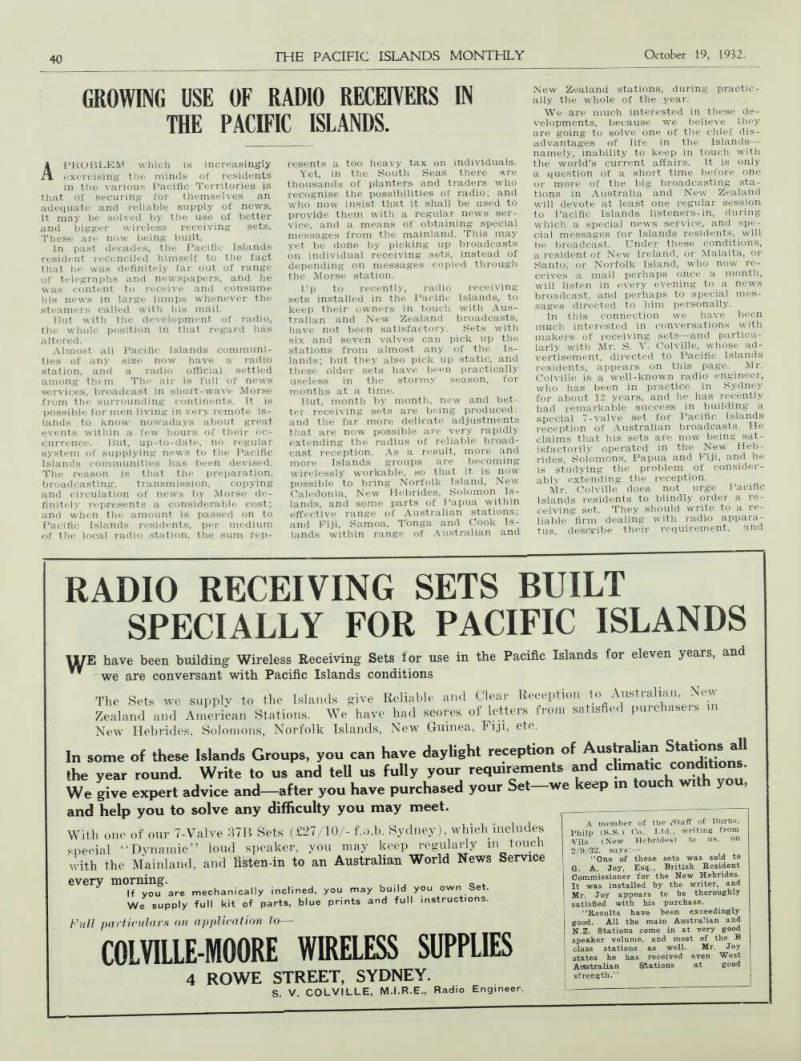
In this connection we have been much interested in conversations with makers of receiving sets—and particu larly with Mr. S. V. Colville, whose ad vertisement, directed to Pacific Islands residents, appears on this page. Mr.
Colville is a well-known radio engineer, who has been in practice in Sydney for about 12 years, and he has recently had remarkable success in building a special 7-valve set for Pacific Islands reception of Australian broadcasts. He claims that his sets are now being sat isfactorily operated in the New Heb rides, Solomons, Papua and Fiji, and he is studying the problem of consider ably extending the reception.
Mr. Colville does not urge Pacific Islands residents to blindly order a re ceiving set. They should write to a re liable firm dealing with radio appara tus, describe their requirement, and
place on the firm the option of stating: whether satisfactory service may be given, cost of same, etc.
One of the biggest problems con nected with radio for the Islands is that of supplying power. A big set is needed, and a big set places a con siderable strain on the storage bat teries. If the Islands resident can “plug in” to an electric power system he has an advantage over those who must use batteries; but there are vari ous Australian and New Zealand firms which now make storage batteries specially for big wireless sets.
“The Pacific Islands Monthly” will be glad to supply information to any Is lands resident interested in the instal lation or maintenance of a receiving set. Persons seeking information should state clearly whether there is an elec tric power supply available, to which they can plug in; and, if so, what is its voltage, and whether the current is alternating or direct. If there is no electric power available —which means that storage batteries must be depended on—correspondents should give the name of the nearest town or station where there is apparatus for re-charg ing the wet batteries.