Tung Oil.
p. 11 · Read in the full issue
Possible Lucrative Industry.
IN an article published in “The Times Trade Supplement,” Mr. T. Hedley Barry, after describing the valuable properties of China wood or tung oil in varnish manufacture, refers to efforts made in recent years to encour age the growth of the tung oil tree in suitable parts of the British Empire.
In 1929 about 700lb. of selected seeds from American plantations were distri
buted in those parts of the Empire where there appeared to be a reason able chance of successful cultivation.
It is, of course, too early to pronounce a definite opinion as to the final results of this excellent work, but it has been proved, he says, that an oil of the first grade can be obtained under proper conditions in certain parts of the Empire.
After describing results in Africa and India, Mr. Barry writes: “Recently con siderable interest has been exhibited in the subject both in New Zealand and Australia, and in New Zealand a cor poration has been founded for the com mercial development of tung oil plan tations. In Australia work so far ap peal’s to have been confined to the cul tivation of small experimental planta tions, and the writer has received small samples of oil from Mr. Penfold, of the Technological Museum, Sydney, N.S.W.. which were certainly of the highest possible grade.
“It is most desirable that these ex cellent beginnings should be continued, for the use of China wood oil will con tinue to increase, and, quite apart from the disadvantages, especially under the present conditions, of being entirely In the hands of the Chinese, it is most
important that the British Empire should be self-supporting in an essen tial raw material, the more so as the successful application of this particular oil in industry depends upon a rigid adherence to specification.
“The information already accumu lated in the United States indicates that the successful cultivation of this tree would be a lucrative industry.
Whereas only about 250lb. of linseed oil can be obtained from an acre of land, the yield of tung oil varies from 400lb. per acre in the fourth or fifth year to 1800lb. in the ninth year, and as the oil commands a higher price than linseed it is evident that its cul tivation is worthy of serious considera tion by all who have the necessary facilities.
“Admittedly the extraction of the oil from the nuts presents certain techni cal difficulties, but these have now been overcome, and there seems to be no reason why within a comparatively short time the British Empire should not be able to make a substantial con tribution to the supply of this valuable oil.”
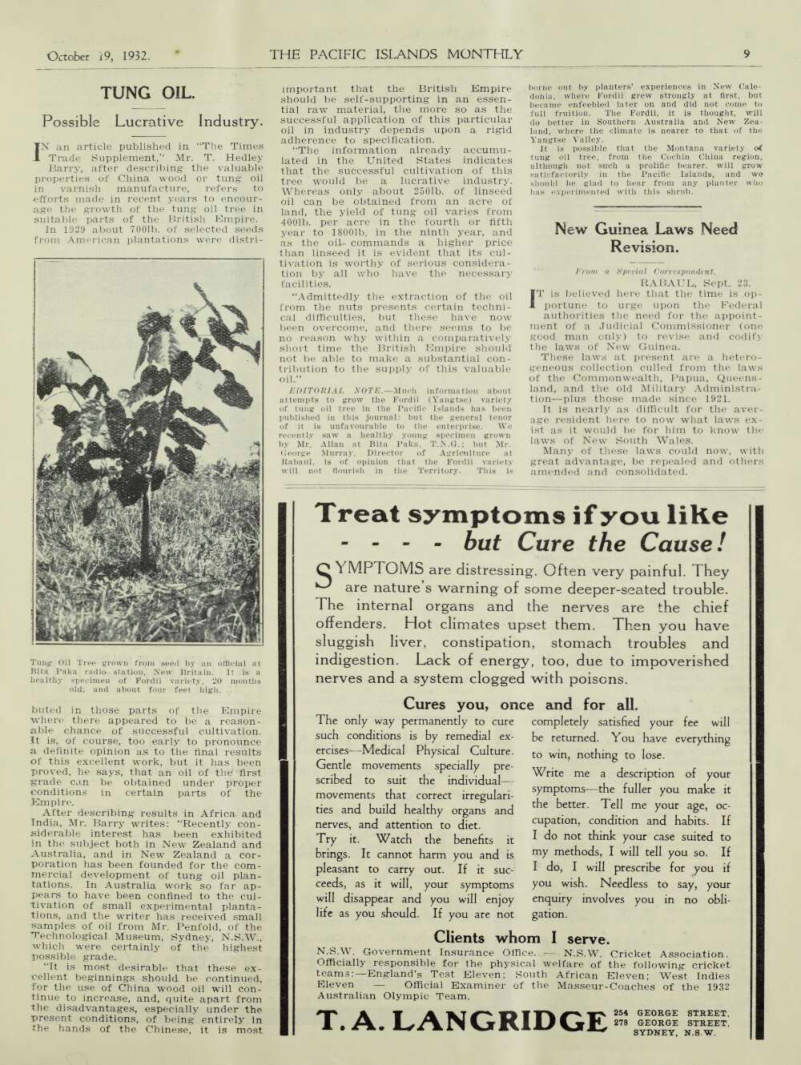
EDITORIAL NOTE. —Much information about attempts to grow the Fordii (Yangtse) variety of tung oil tree in the Pacific Islands has been published in this journal: but the general tenor of it is unfavourable to the enterprise. We recently saw a healthy young specimen grown by Mr. Allan at Bita Paka, T.N.G.; but Mr.
George Murray, Director of Agriculture at Rabaul, is of opinion that the Fordii variety will not flourish in the Territory. This is
borne out by planters’ experiences in New Cale donia, where Fordii grew strongly at first, but became enfeebled later on and did not come to full fruition. The Fordii, it is thought, will do better in Southern Australia and New Zea land, where the climate is nearer to that of the Yangtse Valley.
It is possible that the Montana variety of tung oil tree, from the Cochin China region, although not such a prolific bearer, will grow satisfactorily in the Pacific Islands, and we should be glad to hear from any planter who has experimented with this shrub.
Tung Oil Tree grown from seed by an official at Bita Paka radio station, New Britain. It is a healthy specimen of Fordii variety, 20 months old, and about four feet high.