King Cakobau’S Club.
Returned to Fiji as Council Mace After 30 Years in Windsor Castle.
SUVA, October 7.
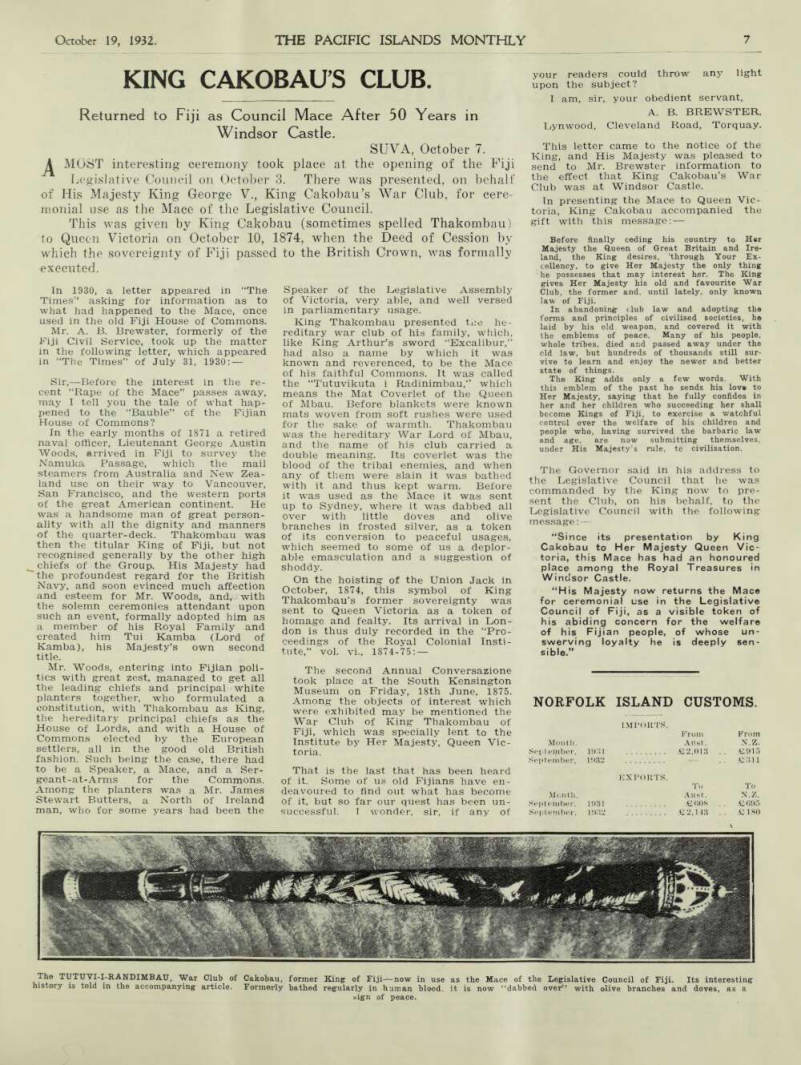
MOST interesting ceremony took place at the opening of the Fiji Legislative Council on October 3. There was presented, on behalf of His Majesty King George V., King Cakobau’s War Club, for cere monial use as the Mace of the Legislative Council.
This was given by King Cakobau (sometimes spelled Thakombau) to Queen Victoria on October 10, 1874, when the Deed of Cession by which the sovereignty of Fiji passed to the British Crown, was formally executed.
In 1930, a letter appeared in “The Times” asking for information as to what had happened to the Mace, once used in the old Fiji House of Commons.
Mr. A. B. Brewster, formerly of the Fiji Civil Service, took up the matter in the following letter, which appeared in “The Times” of July 31, 1930: Sir, —Before the interest in the re cent “Rape of the Mace” passes away, may I tell you the tale of what hap pened to the “Bauble” of the Fijian House of Commons?
In the early months of 1871 a retired naval officer, Lieutenant George Austin Woods, arrived in Fiji to survey the Namuka Passage, which the mail steamers from Australia and New Zea land use on their way to Vancouver, San Francisco, and the western ports of the great American continent. He was a handsome man of great person ality with all the dignity and manners of the quarter-deck. Thakombau was then the titular King of Fiji, but not recognised generally by the other high chiefs of the Group. His Majesty had the profoundest regard for the British Navy, and soon evinced much affection and esteem for Mr. Woods, and, with the solemn ceremonies attendant upon such an event, formally adopted him as a member of his Royal Family and created him Tui Kamba (Lord of Kamba), his Majesty’s own second title.
Mr. Woods, entering into Fijian poli tics with great zest, managed to get all the leading chiefs and principal white planters together, who formulated a constitution, with Thakombau as King, the hereditary principal chiefs as the House of Lords, and with a House of Commons elected by the European settlers, all in the good old British fashion. Such being the case, there had to be a Speaker, a Mace, and a Ser geant-at-Arms for the Commons.
Among 1 the planters was a Mr. James Stewart Butters, a North of Ireland man, who for some years had been the
Speaker of the Legislative Assembly of Victoria, very able, and well versed in parliamentary usage.
King Thakombau presented the he reditary war club of his family, which, like King Arthur’s sword “Excalibur,” had also a name by which it was known and reverenced, to be the Mace of his faithful Commons. It was called the “T'utuvikuta i Radinimbau,” which means the Mat Coverlet of the Queen of Mbau. Before blankets were known mats woven from soft rushes were used for the sake of warmth. Thakombau was the hereditary War Lord of Mbau, and the name of his club carried a double meaning. Its coverlet was the blood of the tribal enemies, and when any of them were slain it was bathed with it and thus kept warm. Before it was used as the Mace it was sent up to Sydney, where it was dabbed all over with little doves and olive branches in frosted silver, as a token of its conversion to peaceful usages, which seemed to some of us a deplor able emasculation and a suggestion of shoddy.
On the hoisting of the Union Jack in October, 1874, this symbol of King Thakombau’s former sovereignty was sent to Queen Victoria as a token of homage and fealty. Its arrival in Lon don is thus duly recorded in the “Pro ceedings of the Royal Colonial Insti tute,” vol. vi., 1874-75; The second Annual Conversazione took place at the South Kensington Museum on Friday, 18th June, 1875.
Among the objects of interest which were exhibited may be mentioned the War Club of King Thakombau of Fiji, which was specially lent to the Institute by Her Majesty, Queen Vic toria.
That is the last that has been heard of it. Some of us old Fijians have en deavoured to find out what has become of it, but so far our quest has been un successful. I wonder, sir, if any of
your readers could throw any light upon the subject?
I am, sir, your obedient servant.
A. B. Brewster.
Lynwood, Cleveland Road, Torquay.
This letter came to the notice of the King, and His Majesty was pleased to send to Mr. Brewster information to the effect that King Cakobau’s War Club was at Windsor Castle.
In presenting the Mace to Queen Vic toria, King Cakobau accompanied the gift with this message: Before finally ceding his country to Her Majesty the Queen of Great Britain and Ire land, the King desires, 'through Your Ex cellency, to give Her Majesty the only thing he possesses that may interest her. The King gives Her Majesty his old and favourite War Club, the former and, until lately, only known law of Fiji.
In abandoning: club law and adopting the forms and principles of civilised societies, he laid by his old weapon, and covered it with the emblems of peace. Many of his people, whole tribes, died and passed away under the old law, but hundreds of thousands still sur vive to learn and enjoy the newer and better state of things.
The King adds only a few words. With this emblem of the past he sends his love to Her Majesty, saying that he fully confides in her and her children who succeeding her shall become Kings of Fiji, to exercise a watchful control over the welfare of his children and people who, having survived the barbaric law and age. are now submitting themselves, under His Majesty's rule, to civilisation.
The Governor said in his address to the Legislative Council that he was commanded by the King now to pre sent the Club, on his behalf, to the Legislative Council with the following message: “Since its presentation by King Cakobau to Her Majesty Queen Vic toria, this Mace has had an honoured place among the Royal Treasures in Windsor Castle.
“His Majesty now returns the Mace for ceremonial use in the Legislative Council of Fiji, as a visible token of his abiding concern for the welfare of his Fijian people, of whose un
swerving loyalty he is deeply sen
sible.”