Plea For Crown Colony Of New Guinea,
pp. 30-32 · Read in the full issue
To Include Papua And Solomons.
(Written for “The Pacific Islands Monthly” by Henry K. Eekhoff .)
(A homogeneous self-governing Crown colony formed by the amalgama tion of the rich, half-developed Territories of Papua, New Guinea and British Solomon Islands, with the administrative centre at Samarai —that is the attractive, broad vision of the writer of the following article. He is a well-known trader in New Guinea.)
THE most ill-used dominions in the British Empire to-day are in the Pacific. It is the old tale of “too many cooks spoiling the broth.”
The League of Nations, the British Colonial Office, Australia, New Zealand, Foreign Mission Societies, and the itinerant free press politician, all wield a spoon in the soup.
Only in the Condominion of the New Hebrides can Britishers be found bar tering their birthright for foreign naturalisation. Only in New Guinea can be heard war veterans expressing the view that the Mandated Territory should be returned to Gemany with a note of apology. Only in Samoa can be found a handful of indigenous natives so incensed as to resort to boycott.
Only in the Solomon Islands do they moot the importation of Asiatic coolies to reinforce the depleted native popu lation, while there is a source of supply in both Papua and New Guinea under the same flag next door.
Only in Papua can be instanced a fertile island with prolific sources of labour, lacking a solvent industry.
Like stars in a murky firmament stand New Zealand, Fiji, and Tonga, for
New Zealand has succeeded in pre serving her Maori population and raising it to respectability. In Fiji, the native is recovering from the first shock of contact with European civil isation, and showing signs of the re covery being permanent. Tonga, with a native Government under intellectual European advice, is both happy and solvent.
Both New Zealand and Fiji instance the beneficial effect of the comprehen sion displayed by local administration.
Certainly, New Zealand has been estab lished for a long time —but she owes her success to local Colonial Govern ment in early days. Yet New Zealand, herself successful, is a conspicuous failure in the endeavour to govern the distant Samoans.
All this proves conclusively that the only successful spots in the British Pacific are those who administer their own affairs. As the attitude of Aus tralia and Britain to-day has changed, they no longer credit their pioneers with intelligence or humanity. It be comes necessary, therefore, to bring such issues home to them for the pur pose of emphasising that the pioneers are, on direct evidence, better adapted
to control these places than those who prefer to misgovern them from com paratively remote distances.
One great cause of the Pacific chaos is that well meaning, but uninformed, people in the Homeland, in the League of Nations, in Australia, New Zealand and the world in general, regard the interests of Europeans in the Pacific as being diametrically opposed to the best interests of the indigenous races.
No greater fallacy was ever pro pounded.
Because of this stupid misconception, the British people of the Pacific are distrusted, and steps are specially taken to frustrate the slightest initiative.
The wild and poisonous romances of Pacific fiction have done much to cloud the view of the outside world. The imaginary combination of beach comber, trader, and buccaneer, with the inevitable bottle of “squareface”, rises like a ghost to confuse common sense To such people, the Pacific is peopled with Bully Hayeses, hell ships, and Captain Kidds, instead of prosaic indus trious planters and traders, under going the inevitable honest struggle to make ends meet.
For centuries past, the Pacific races have been upon the decline. Long be fore Captain Cook visited the Pacific, the early Dutch and Spanish naviga tors found it so, and perhaps contri buted something to the causes.
The remoter natives have not re sponded generally to mission influences, and remain as decadent and insanitary as ever, after over fifty years of mis sion effort. The only native com munities showing increased vitality and productivity are those which are most in contact with Europeans.
The reason for this is self evident.
No settler would tolerate disease amongst the natives for whom he is responsible. Balanced rations, sanita tion, medical attention, and industrial incentive excited by precept —all go to rescue the native from misery, disease, and decline. Tourists along the beaten track observe these healthy contact people, and fail to discover the factors which stand as a reproach to the present system.
Could they proceed with one of these sleek Melanesians on a visit to his village brother, born of the same parents, in his native village, they would find the brother to be two stone lighter, filthy and disease ridden, and the parents in rapid decline at the age of forty. There in the village are no white mentors and, save for the annual tax collection, they are seldom visited by the casual official, enervated by travel in a humid climate. Other oc casional visitors are missionaries in pursuit of baptismal aspirants, and re cruiters.
The only meat is the tuberculous pig, which functions in life as the com munal septic tank. Malaria, elephan tiasis, skin diseases, hookworm, tuber culosis, and framboesia, with its hor rible disfigurations, sap the population —so much so, that most recruiters spend time and money in cleaning up their volunteer labourers before pre senting them to the local magistrate and the certifying medical officers.
The settler is vitally interested in the elimination of these evils from the source of his labour supply. To others.
it is a mere onerous duty, more con spicuous in neglect than observance.
Unfortunately, these village people are the mainspring of the race, and mor tality is high among old and young of both sexes. It is desirable to influence these people at a fairly early age, during the period of mental expan sion, but, unfortunately, they are not suitable for employment at this period.
Natives beyond contact are a suspicious and timid people, but they do eventu ally become wholesomely responsive on close contact. Thus, it is only when the native community brushes the skirts of good-class European settle ment that the benefit is duly reflected.
The foregoing suggests that the native is ultimately dependent upon European settlement for his eventual survival, and such settlement is only promoted by attractive conditions. The European looks and thinks ahead, but the Melanesian neither dwells on yes terday nor plans for to-morrow. He has been largely weaned from his ancient method of obtaining susten ance, and has become increasingly de pendent upon white men’s tools and in dustrialisation to obtain his actual food supply. With Europeans suffering from “slump”, the native suffers in propor tion from hunger and disease.
Those whose high ideals and altruism suggest that the Pacific Melanesians be developed at the ex pense of British and Australian tax payers to the stage of self government, do not realise that the process of evolu tion is a slow one, and that hundreds of years must elapse before these stone-age peoples can overtake the modern world. The history of gov ernment in Haiti and Liberia proves that.
There is little doubt that the British and Australian areas can be locally administered; but a haze hangs over the national title in respect of Samoa and New Guinea. These so-called “Mandated Territories” were con quered from a nation which has since added default to her other crimes against civilisation, and are just pay ment in part for the debt which Britain incurred on behalf of the civil ised world. Apart from conquest, they have been paid for a thousand times over in blood and specie by British races.
Before the League of Nations was born, they were relinquished by Ger
many at Versailles, in a Treaty to which America was a witness. At a later stage, political jobbers, fearing jingoistic accusations of territorial acquisition, conceived the cowardly subterfuge of “dummying” these areas through the creation of a Mandates Commission, incorporated in the League of Nations. They were sublimely in different to the possibility that the League of Nations might eventually include inimical forces —at is does at present. Fortunately, America, as a witness to the original treaty, never endorsed the League, and she may, or may not, have commercial, and perhaps sentimental, interests in seeing these countries developed by a race of common origin and speech.
Turning to the Tanganyika Mandate, we obtain some comfort. In this Ter ritory, the inhabitants, both European and native, resented the implied insecurity of title in the Mandatory tenure. The British Commissioner found a reassurance necessary, and, after negotiations with the British Government, made a statement to the following effect: “I am here with the authority of the King and by the consent of Parliament to assure the inhabitants of Tanganyika that this Territory is no less an in tegral portion of the British Empire than any of the older colonies, and no provision has been made in the Man date for the rescission of the Mandate.” (Vide “Current History Magazine” for March and April, 1927.) [It is my recollection that there has been a later development, at Germany’s instigation, which makes the East African position some what different from that suggested by Mr.
Eekhoff.— EDITOR.] The League of Nations seems to re serve all its reproaches for the deferential and courteous representa tives of British Mandates rather than for the French in Syria, or for Japan in her independent attitude in regard to her so-called Mandates. But even if the title allegedly enjoyed by the Mandates Commission were unclouded, sweet reason should not demand the present crucifixion of both brown and white in the Pacific.
There are two natural focii of ad ministration in the British Pacific.
The first is Fiji, upon the main Pacific mail-route, with a government already experienced in native administration, and with a striking victory to its credit
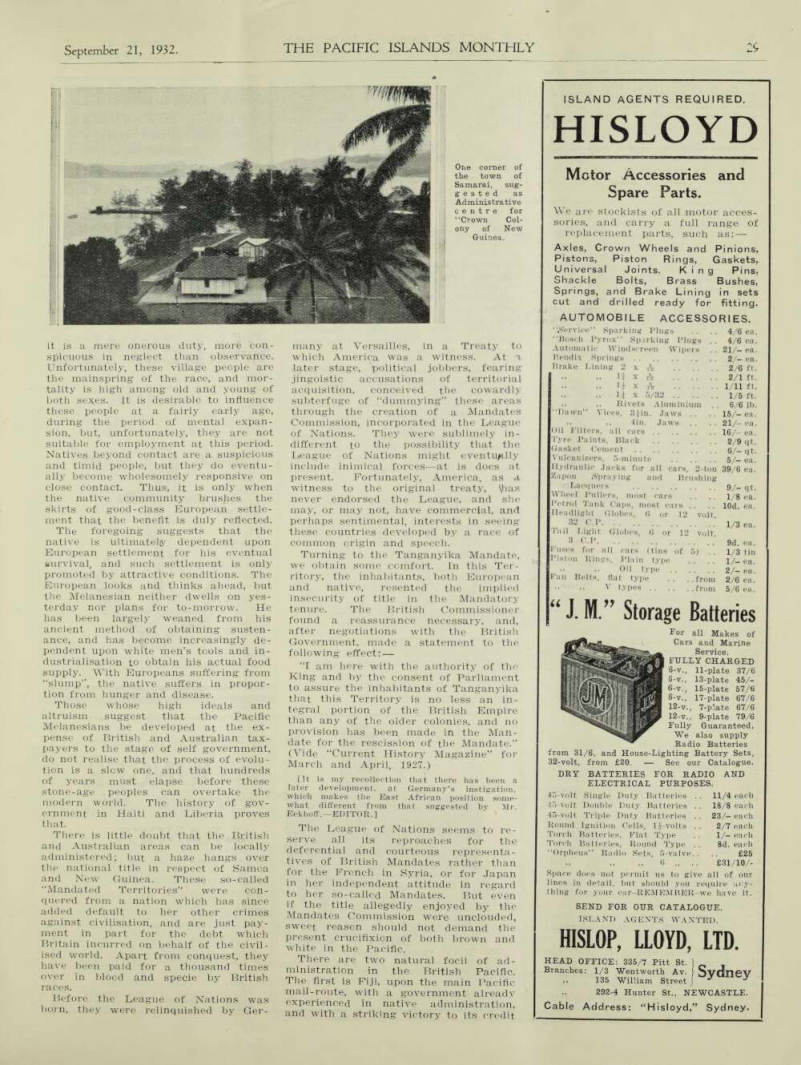
One corner of the town of Samarai, sug gested as Administrative centre for “Crown Col ony of New Guinea.
in the modern recovery of its indi genous peoples, and its successful European colonisation and establish ment of industries. Bravely has Fiji fought her pioneer battle against loaded tariffs and Australian prejudices.
This centre is surely worthy to control her Pacific environs, and it may be con fidently assumed that Samoa would be more happily circumstanced if governed from Suva than in association with New Zealand.
The second centre is Samarai, situated upon the China Straits, the direct route from Australia to China and the East, and the logical focus for Papua, the British Solomons, and New Guinea, as it can reach any of these centres with a radius of 600 miles.
There is a useful nucleus of popula tion, quite competent to control its own destiny, grouped in these areas, pos sibly five thousand whites in all.
There are, at present, three wholly heterogeneous and futile administrations in these areas.
The British Solomon Islands Protec torate, with a seriously depleted labour supply, is struggling along. After all these years, the interior of the islands is unsafe for European life, though an aeroplane could hop from one side to the other of the largest under an hour.
The Rabaul strike of New Guinea natives, though officially minimised, had a prophetic element of danger. Such rumblings are suggestive of the horrors of the Jamaican affair of the 1860’s, and the New Caledonian rising of half a century ago.
The use of the Papuan Government’s yacht to convey reprieved criminals away from curious eyes has contributed to the Papuans’ sense of security in the commission of crime, and also con tributed to the insecurity of European life generally—especially with sex offences on the increase. It may not be out of place to refer to the eleva tion of discharged murderers to the village constabulary in Papua, or to the case of O’Brien on the Yodda, a European committed for trial, put to work felling scrub with a line of native criminals. O’Brien eventually escaped, to perish in the bush. Though those days are past, the attitude is not ex tinct, officially.
The areas around Samarai are merely held through fear for Aus tralia’s unprotected coastline. The Solomons are an embarrassment to Britain; and Papua and New Guinea are white elephants to Australia.
It may surprise some people to know that no native or white British subject may travel between the Solomons, Papua, and New Guinea without special permission. No schooner may trade across the imaginary boundary line without £100 per capita guarantee upon her crew. There is no homogenity in the laws of these adjoining places, and each government represents an inde pendent experiment in native adminis tration.
New Guinea is afraid to put her Native Labour Ordinance into public print. New Guinea has, moreover, eventually succeeded in dissipating the heritage of German colonial prosperity, and her goldfields, which provide tem
porary rescue, are suffering under un sympathetic legislation, high tariffs (even on machinery), and the extra ordinary labour regulations which prescribe such items as “marmite ’ on the menu.
In Papua, a striking example of Aus tralian success is the introduction of electric light into the “native village’’ of Hanuabada, the residents of which prosper owing to the tourist traffic in “curios”.
The fact is that two of these ex pensive administrations must go, for many reasons, of which economy is not the least. With fertile country galore and ample labour, there is no reason why this area should not prosper under the direction of a sympathetic local ad ministration, familiar with local con ditions and requirements. With a home source of gold supply, and free dom from trade restrictions, financial stability in New Guinea could be made as certain as the sunrise.
The advantages of an incorporation of Papua, New Guinea, and the Solomons under free colonial con ditions would be enormous. Australia would have a buffer State in the Pacific, without having to support it by taxation upon her own citizens.
Britain would get rid of the reproach of the Solomons, and the Empire would benefit by the addition of a loyal colony.
Freedom has ever been a bond where restriction has been a failure, and the Empire of the past was built up of such colonial systems. The loyalty of the French Canadians, and the Boer races of Africa are proof of these things.
Certainly a Pacific Amalgamation is the best prophylactic against the arrival of a foreign power in Aus tralia’s unprotected north; and such in vasion is a certainty unless some sane policy is adopted in the Pacific.
Development of the Pacific Islands Association probably would be the best method of inaugurating a movement for better conditions of government in the New Guinea-Solomons section of the Pacific.