Doubtful Value Of Indian
pp. 28-29 · Read in the full issue
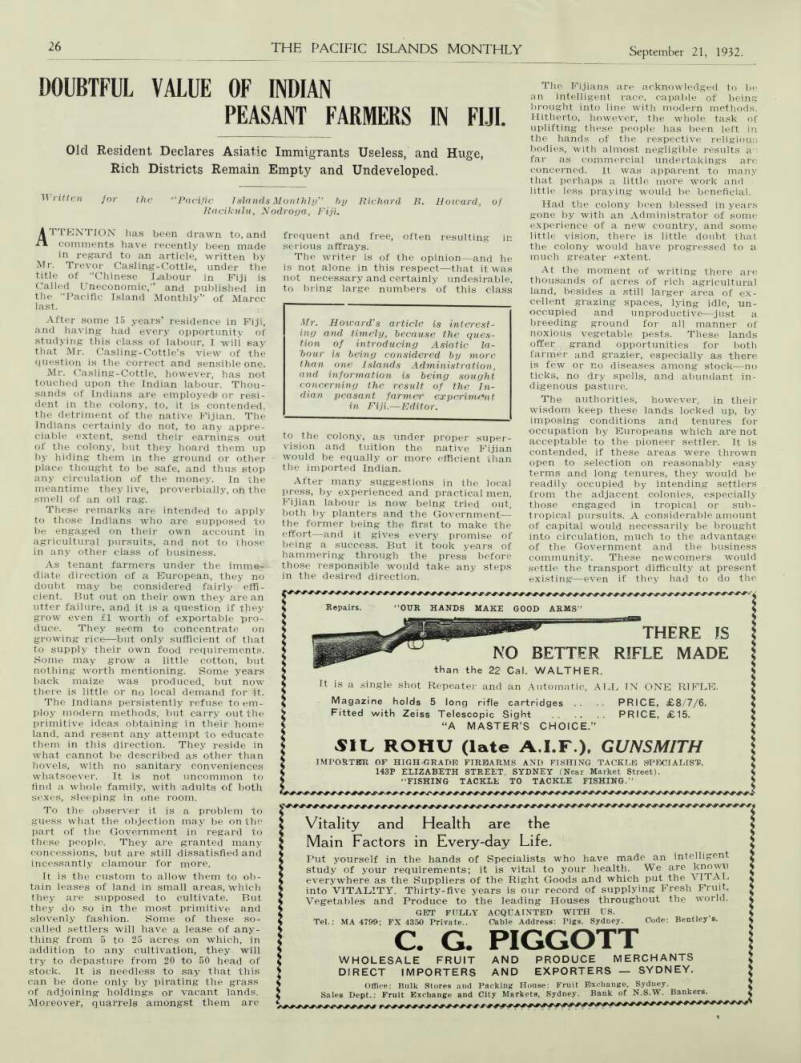

Peasant Farmers In Fiji.
Old Resident Declares Asiatic Immigrants Useless, and Huge, Rich Districts Remain Empty and Undeveloped.
Written for the “Pacific Islands Monthly" by Richard B. Howard, of Racikulu, Nodroga, Fiji.
ATTENTION has been drawn to, and comments have recently been made in regard to an article, written by Mr. Trevor Casling-Cottle, under the title of “Chinese Labour in Fiji is Called Uneconomic,” and published in the “Pacific Island Monthly” of March last.
After some 15 years’ residence in Fiji, and having had every opportunity of studying this class of labour, I will say that Mr. Casling-Cottle’s view of the question is the correct and sensible one.
Mr. Casling-Cottle, however, has not touched upon the Indian labour. Thou sands of Indians are employed or resi dent in the colony, to, it is contended, the detriment of the native Fijian. The Indians certainly do not, to any appre ciable extent, send their earnings out of the colony, but they hoard them up by hiding them in the ground or other place thought to be safe, and thus stop any circulation of the money. In the meantime they live, proverbially, on the smell of an oil rag.
These remarks are intended to apply to those Indians who are supposed to be engaged on their own account in agricultural pursuits, and not to those in any other class of business.
As tenant farmers under the imme diate direction of a European, they no doubt may be considered fairly effi cient. But out on their own they are an utter failure, and it is a question if they grow even £1 worth of exportable pro duce. They seem to concentrate on growing rice—but only sufficient of that to supply their own food requirements.
Some may grow a little cotton, but nothing worth mentioning. Some years back maize was produced, but now there is little or no local demand for it.
The Indians persistently refuse to em ploy modern methods, but carry out the primitive ideas obtaining in their home land, and resent any attempt to educate them in this direction. They reside in what cannot be described as other than hovels, with no sanitary conveniences whatsoever. It is not uncommon to find a whole family, with adults of both sexes, sleeping in one room.
To the observer it is a problem to guess what the objection may be on the part of the Government in regard to these people. They are granted many concessions, but are still dissatisfied and incessantly clamour for more.
It is the custom to allow them to ob tain leases of land in small areas, which they are supposed to cultivate. But they do so in the most primitive and slovenly fashion. Some of these so called settlers will have a lease of any thing from 5 to 25 acres on which, in addition to any cultivation, they will try to depasture from 20 to 50 head of stock. It is needless to say that this can be done only by pirating the grass of adjoining holdings or vacant lands.
Moreover, quarrels amongst them are
frequent and free, often resulting in serious affrays.
The writer is of the opinion—and he is not alone in this respect—that it was not necessary and certainly undesirable, to bring large numbers of this class
Mr. Howard's article is interest ing and timely, because the ques tion of introducing Asiatic la bour is being considered by more than one Islands Administration, and information is being sought concerning the result of the In dian peasant farmer experiment in Fiji. — Editor.
to the colony, as under proper super vision and tuition the native Fijian would be equally or more efficient than the imported Indian.
After many suggestions in the local press, by experienced and practical men, Fijian labour is now being tried out, both by planters and the Government — the former being the first to make the effort—and it gives every promise of being a success. But it took years of hammering through the press before those responsible would take any steps in the desired direction.
The Fijians are acknowledged to be an intelligent race, capable of being brought into line with modern methods.
Hitherto, however, the whole task of uplifting these people has been left in the hands of the respective religious bodies, with almost negligible results as far as commercial undertakings are concerned. It was apparent to many that perhaps a little more work and little less praying would be beneficial.
Had the colony been blessed in years gone by with an Administrator of some experience of a new country, and some little vision, there is little doubt that the colony would have progressed to a much greater extent.
At the moment of writing there are thousands of acres of rich agricultural land, besides a still larger area of ex cellent grazing spaces, lying idle, un occupied and unproductive—just a breeding ground for all manner of noxious vegetable pests. These lands offer grand opportunities for both farmer and grazier, especially as there is few or no diseases among stock—no ticks, no dry spells, and abundant in digenous pasture.
The authorities, however, in their wisdom keep these lands locked up, by imposing conditions and tenures for occupation by Europeans which are not acceptable to the pioneer settler. It is contended, if these areas were thrown open to selection on reasonably easy terms and long tenures, they would be readily occupied by intending settlers from the adjacent colonies, especially those engaged in tropical or sub tropical pursuits. A considerable amount of capital would necessarily be brought into circulation, much to the advantage of the Government and the business community. These newcomers would settle the transport difficulty at present existing—even if they had to do the
work themselves —as was the case in many parts of Australia in the early pioneering days.
The writer was, in the early sixties, pioneering in the outer beyond of Aus tralia, particularly in the tropical and sub-tropical parts, and has had a fairly large experience of native races, not only Australian aboriginals, but also South Sea Islanders.
In the opinion of several it is evident that some steps in the direction indi cated will have to be taken by the authorities of Fiji, if the colony is to be lifted from its present state of unpro gressiveness and stagnation. The sug gestions of our elected members to the Legislative Council are ignored; and, as they are always in a minority, anything brought before the Council, no matter how practical or commensense it may be, if not in accordance with official views, is bludgeoned out by the nominee (or official) members. The great ma jority of these responsible officers are selected and appointed by the Home authorities to serve a given period in one or other of the Crown colonies.
Naturally, they have no interest in the future development of the place, and just perform their allotted duties with as little trouble as possible to them selves, awaiting the expiry of their term of office, then to be transferred to a pension.
So long as this state of affairs con tinues, just so long will the colony of Fiji remain in the doldrums.