The End Of Historic Bita Paka,
pp. 20-21 · Read in the full issue
Spot Where First Australians Killed To Be Abandoned Because Advance of Science Makes Radio Station at Rabaul Possible.
By R. W. Robson.
ONE of these days soon they are going to move Bita Paka radio station from Bita Paka into Ra baul. Some 30 miles of expensive land line will be cut out —and the tropical jungle will quickly resume dominion over the historic place where Aus tralian fighting men were first engaged in the Great War, and where the first Australian lives were sacrificed.
In July last, I drove out from Ra baul with Mr. Twycross, the A.W.A. officer in charge of the radio network which serves New Guinea, and of which Bita Paka is the centre. He is a keen, practical chap, and I learned with much interest of the way in which wireless traffic in and cut of Rabaul, Salamaua, Kavieng, Kieta, Madang, Manus and Eitape is organised and concentrated at Bita Paka, and thence distributed south to Port Moresby and Australia, east to Suva, Noumea, Nauru and Ocean Island, and north to Truk. It was a fascinating experience to stand beside an operator there in a jungle clearing, on a hilltop in the in terior of New Britain and, through his Morse, chat with a friend at 47 York Street, Sydney.
But I confess I was even more in terested in examining the ground over which those Australian sailors travelled on September 11, 1914. It was so easy to reconstruct the scene of 18 years ago. Eighteen years! It seems only yesterday that we read the brief news paper accounts of how Australians and Germans first met in war.
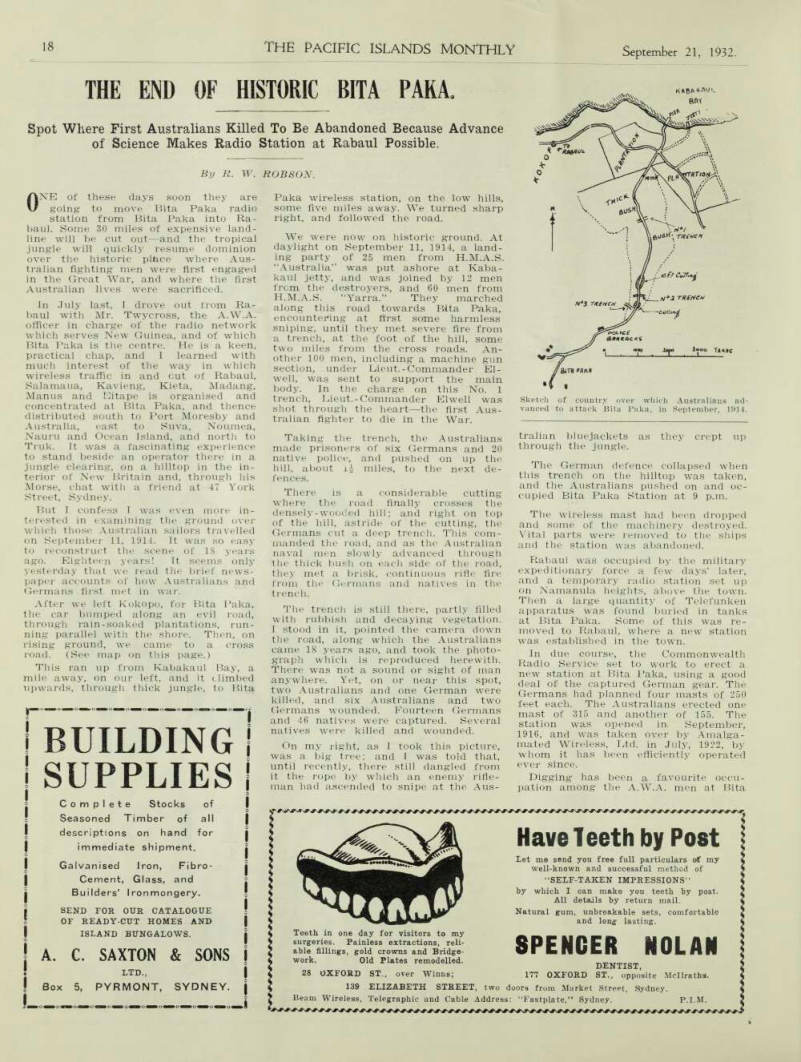
After we left Kokopo, for Bita Paka, the car bumped along an evil road, through rain-soaked plantations, run ning parallel with the shore. Then, on rising ground, we came to a cross road. (See map on this page.) This ran up from Kabakaul Bay, a mile away, on our left, and it climbed upwards, through thick jungle, to Bita
Paka wireless station, on the low hills, some five miles away. We turned sharp right, and followed the road.
We were now on historic ground. At daylight on September 11, 1914, a land ing party of 25 men from H.M.A.S.
“Australia” was put ashore at Kaba kaul jetty, and was joined by 12 men from the destroyers, and 60 men from H.M.A.S. “Yarra.” They marched along this road towards Bita Paka, encountering at first some harmless sniping, until they met severe fire from a trench, at the foot of the hill, some two miles from the cross roads. An other 100 men, including a machine gun section, under Lieut.-Commander El well, was sent to support the main body. In the charge on this No. 1 trench, Lieut.-Commander Elwell was shot through the heart—the first Aus tralian fighter to die in the War.
Taking the trench, the Australians made prisoners of six Germans and 20 native police, and pushed on up the hill, about miles, to the next de fences.
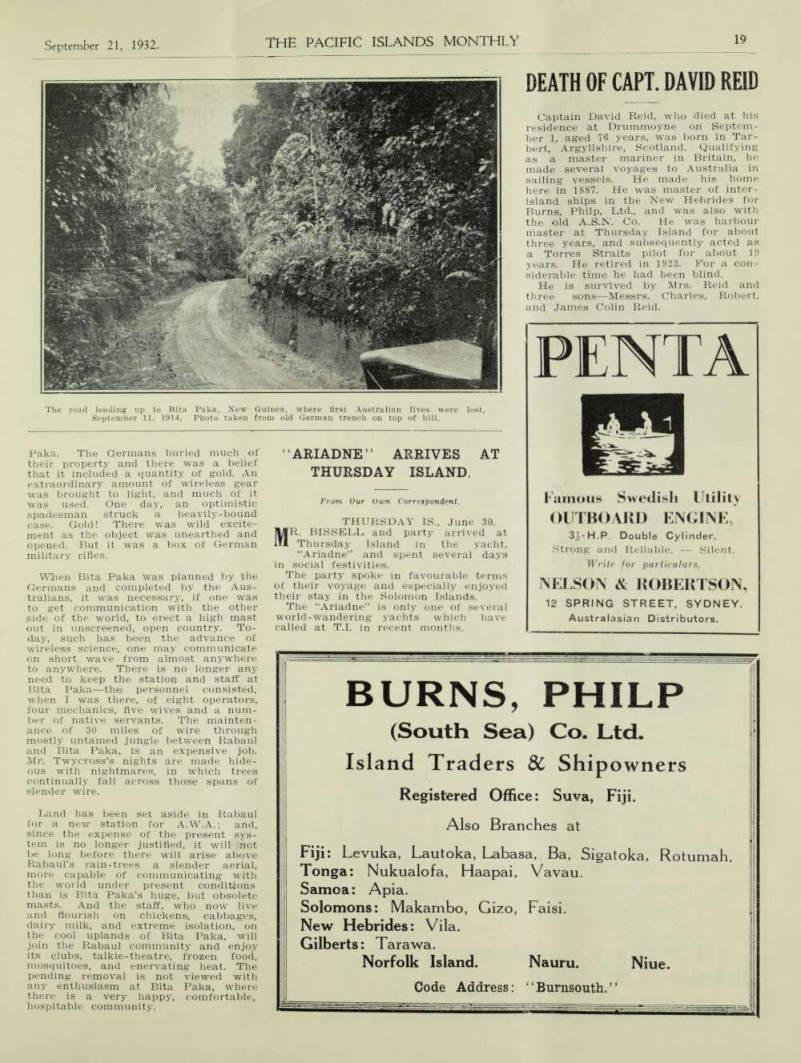
There is a considerable cutting where the road finally crosses the densely-wooded hill; and right on top of the hill, astride of the cutting, the Germans cut a deep trench. This com manded the road, and as the Australian naval men slowly advanced through the thick bush on each side of the road, they met a brisk, continuous rifle fire from the Germans and natives in the trench.
The trench is still there, partly filled with rubbish and decaying vegetation.
I stood in it, pointed the camera down the road, along which the Australians came 18 years ago, and took the photo graph which is reproduced herewith.
There was not a sound or sight of man anywhere. Yet, on or near this spot, two Australians and one German were killed, and six Australians and two Germans wounded. Fourteen Germans and 46 natives were captured. Several natives were killed and wounded.
On my right, as I took this picture, was a big tree; and I was told that, until recently, there still dangled from it the rope by which an enemy rifle man had ascended to snipe at the Aus
tralian bluejackets as they crept up through the jungle.
The German defence collapsed when this trench on the hilltop was taken, and the Australians pushed on and oc cupied Bita Paka Station at 9 p.m.
The wireless mast had been dropped and some of the machinery destroyed.
Vital parts were removed to the ships and the station was abandoned.
Rabaul was occupied by the military expeditionary force a few days’ later, and a temporary radio station set up on Namanula heights, above the town.
Then a large quantity of Telefunken apparatus was found buried in tanks at Bita Paka. Some of this was re moved to Rabaul, where a new station was established in the town.
In due course, the Commonwealth Radio Service set to work to erect a new station at Bita Paka, using a good deal of the captured German gear. The Germans had planned four masts of 250 feet each. The Australians erected one mast of 315 and another of 155. The station was opened in September, 1916, and was taken over by Amalga mated Wireless, Ltd. in July, 1922, by whom it has been efficiently operated ever since.
Digging has been a favourite occu pation among the A.W.A. men at Bita
Sketch of country over which Australians ad vanced to attack Bita Paka, in September, 1914.
Paka. The Germans buried much of their property and there was a belief that it included a quantity of gold. An extraordinary amount of wireless gear was brought to light, and much of it was used. One day, an optimistic spadesman struck a heavily-bound case. Gold! There was wild excite ment as the object was unearthed and opened. But it was a box of German military rifles.
Wiien Bita Paka was planned by the Germans and completed by the Aus tralians, it was necessary, if one was to get communication with the other side of the world, to erect a high mast out in unscreened, open country. To day, such has been the advance of wireless science, one may communicate on short wave from almost anywhere to anywhere. There is no longer any need to keep the station and staff at Bita Paka —the personnel consisted, when I was there, of eight operators, four mechanics, five wives and a num ber of native servants. The mainten ance of 30 miles of wire through mostly untamed jungle between Rabaul and Bita Paka, is an expensive job.
Mr. Twycross’s nights are made hide ous with nightmares, in which trees continually fall across those spans of slender wire.
Land has been set aside in Rabaul for a new station for A.W.A.; and, since the expense of the present sys tem is no longer justified, it will not be long before there will arise above Rabaul’s rain-trees a slender aerial, more capable of communicating with the world under present conditions than is Bita Paka’s huge, but obsolete masts. And the staff, who now live and flourish on chickens, cabbages, dairy milk, and extreme isolation, on the cool uplands of Bita Paka, will join the Rabaul community and enjoy its clubs, talkie-theatre, frozen food, mosquitoes, and enervating heat. The pending removal is not viewed with any enthusiasm at Bita Paka, where there is a very happy, comfortable, hospitable community.
The road leading up to Bita Paka, New Guinea, where first Australian lives were lost, September 11, 1914. Photo taken from old German trench on top of hill.