How The White Man “Goes Native ”
p. 34 · Read in the full issue
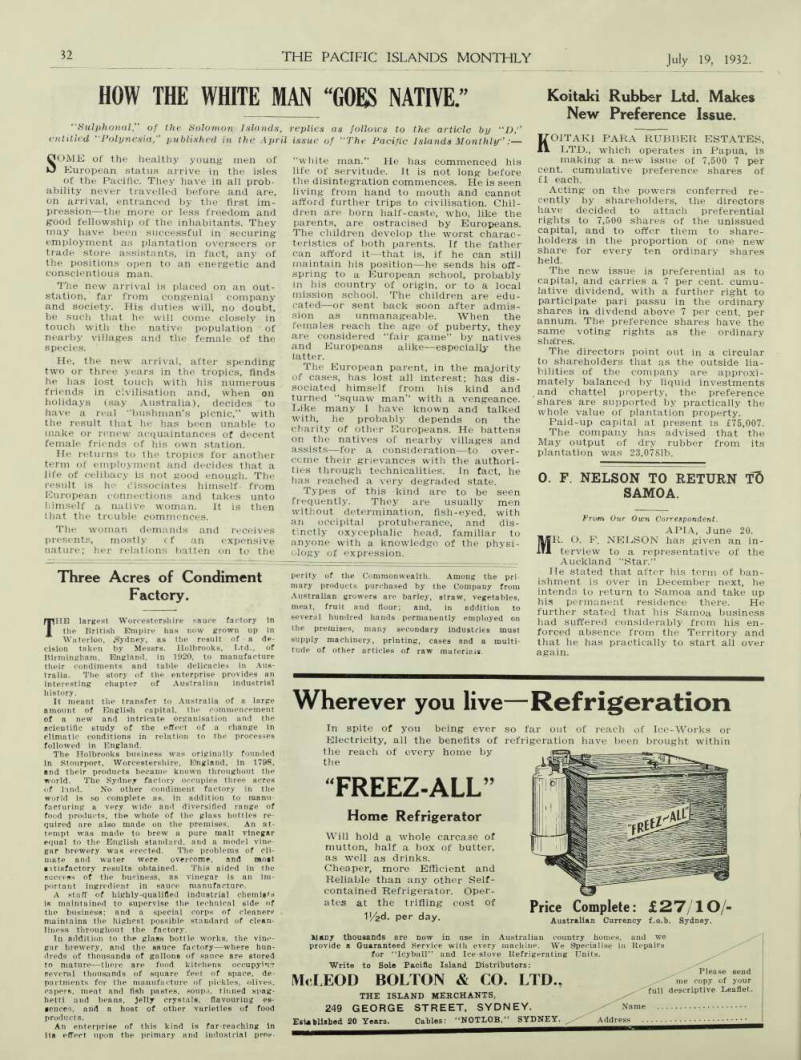
“Sulphonal” of the Solomon Islands, replies as follows to the article by "B," entitled "Polynesia," published in the April issue of “The Pacific Islands Monthly" :—
SOME of the healthy young men of European status arrive in the isles of the Pacific. They have in all prob ability never travelled before and are, on arrival, entranced by the first im pression—the more or less freedom and good fellowship of the inhabitants. They may have been successful in securing employment as plantation overseers or trade store assistants, in fact, any of the positions open to an energetic and conscientious man.
The new arrival is placed on an out station, far from congenial company and society. His duties will, no doubt, be such that he will come closely in touch with the native population of nearby villages and the female of the species.
He, the new arrival, after spending two or three years in the tropics, finds he has lost touch with his numerous friends in civilisation and, when on holidays (say Australia), decides to have a real “bushman’s picnic,” with the result that he has been unable to make or renew acquaintances of decent female friends of his own station.
He returns to the tropics for another term of employment and decides that a life of celibacy is not good enough. The result is he dissociates himself from European connections and takes unto himself a native woman. It is then that the trouble commences.
The woman demands and receives presents, mostly of an expensive nature; her relations batten on to the
“white man.” He has commenced his life of servitude. It is not long before the disintegration commences. He is seen living from hand to mouth and cannot afford further trips to civilisation. Chil dren are born half-caste, who, like the parents, are ostracised by Europeans.
The children develop the worst charac teristics of both parents. If the father can afford it —that is, if he can still maintain his position—he sends his off spring to a European school, probably in his country of origin, or to a local mission school. The children are edu cated —or sent back soon after admis sion as unmanageable. When the females reach the age of puberty, they are considered “fair game” by natives and Europeans alike—especially the latter.
The European parent, in the majority of cases, has lost all interest; has dis sociated himself from his kind and turned “squaw man’’ with a vengeance.
Like many I have known and talked with, he probably depends on the charity of other Europeans. He battens on the natives of nearby villages and assists—for a consideration —to over come their grievances with the authori ties through technicalities. In fact, he has reached a very degraded state.
Types of this kind are to be seen frequently. They are usually men without determination, fish-eyed, with an occipital protuberance, and dis tinctly oxycephalic head, familiar to anyone with a knowledge of the physi ology of expression.