A Day On The Fulakora River, B.S.I.
p. 30 · Read in the full issue
(Written for “The Pacific Islands Monthly ” by Margaret Bignell, of Ysabel, British Solomon Islands —aged 16 .)
BEING entirely free for a whole day, my mother and I decided to have a day off and investigate the upper part of our river, which runs through the plantation and into the sea about 2½ miles from the house.
We had often been up about two miles, to a delightful swimming pool, which can be reached by both boat and road. Often, in the afternoon, we would canter our ponies along the bush track which leads there, and have a
splash in the sunlit water, and then home again. Beyond that, however, was undiscovered territory to us, though local "boys” had often told us that small canoes could travel on for “two nights and two days.” This seemed hard to believe, so we decided to investigate.
We left the house at 7 a.m. for the river mouth, having sent two boys round by sea with our five-man canoe, the tucker-basket well stacked with bread and butter, hard-boiled eggs, sardines and spaghetti (a wonderful combination for lunch and tea) and bathing costumes. We ourselves were dressed in shorts and shirts, and canvas shoes.
It was a lovely day of sunshine and shadow, with a light breeze from the nor’-west —one of those perfect days so often found in these lovely isles.
Our canoe was ready and waiting for us, and we all fitted in. Our party consisted of my mother, myself, our full-grown Alsatian, a fox terrier, and the two “boys” who, having been promised a stick of tobacco each and a tin of salmon, were prepared to take us anywhere.
Heather, the Alsatian, was a bit of a problem in the wobbly canoe, but, being full of adventure and devoid of any feeling of responsibility, we started off happily.
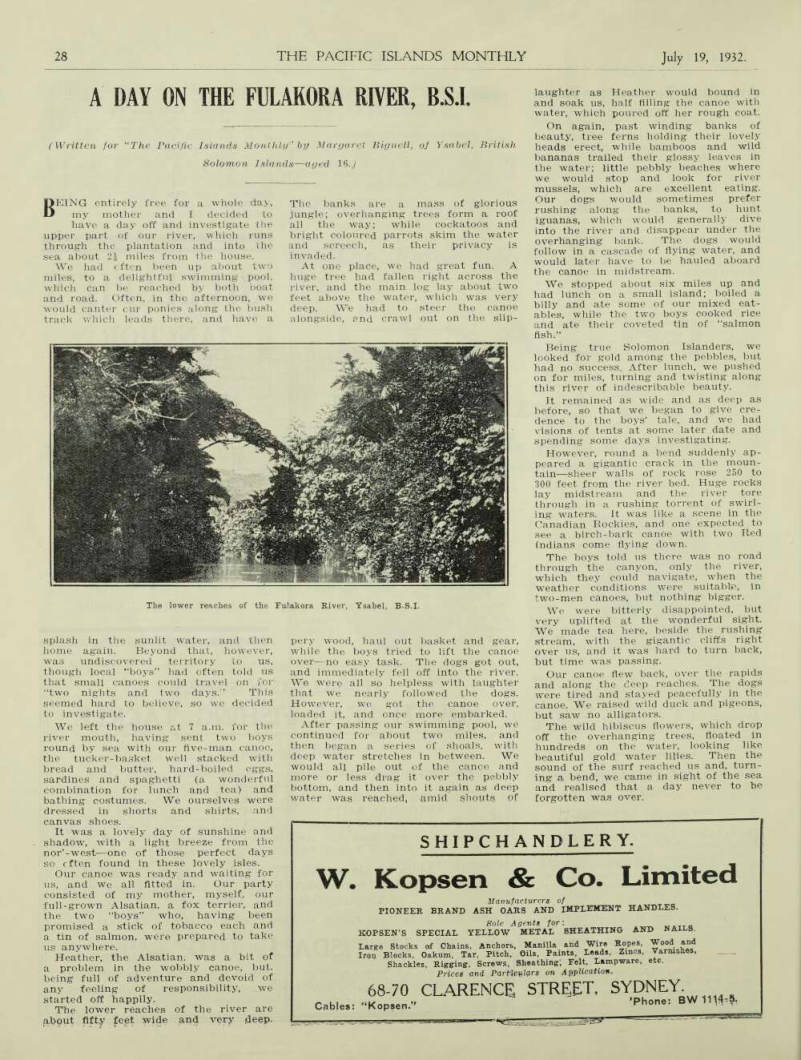
The lower reaches of the river are about fifty feet wide and very deep.
The banks are a mass of glorious jungle; overhanging trees form a roof all the way; while cockatoos and bright coloured parrots skim the water and screech, as their privacy is invaded.
At one place, we had great fun. A huge tree had fallen right across the river, and the main log lay about two feet above the water, which was very deep. We had to steer the canoe alongside, end crawl out on the slip
pery wood, haul out basket and gear, while the boys tried to lift the canoe over—no easy task. The dogs got out, and immediately fell off into the river, We were all so helpless with laughter that we nearly followed the dogs, However, we got the canoe over, loaded it, and once more embarked.
After passing our swimming pool, we continued for about two miles, and then began a series of shoals, with deep water stretches in between. We would all pile out of the canoe and more or less drag it over the pebbly bottom, and then into it again as deep water was reached, amid shouts of
laughter as Heather would bound in and soak us, half filling the canoe with water, which poured off her rough coat.
On again, past winding banks of beauty, tree ferns holding their lovely heads erect, while bamboos and wild bananas trailed their glossy leaves in the water; little pebbly beaches where we would stop and look for river mussels, which are excellent eating.
Our dogs would sometimes prefer rushing along the banks, to hunt iguanas, which would generally dive into the river and disappear under the overhanging bank. The dogs would follow in a cascade of flying water, and would later have to be hauled aboard the canoe in midstream.
We stopped about six miles up and had lunch on a small island; boiled a billy and ate some of our mixed eat ables, while the two boys cooked rice and ate their coveted tin of “salmon fish.”
Being true Solomon Islanders, we looked for gold among the pebbles, but had no success. After lunch, we pushed on for miles, turning and twisting along this river of indescribable beauty.
It remained as wide and as deep as before, so that we began to give cre dence to the boys’ tale, and we had visions of tents at some later date and spending some days investigating.
However, round a bend suddenly ap peared a gigantic crack in the moun tain —sheer walls of rock rose 250 to 300 feet from the river bed. Huge rocks lay midstream and the river tore through in a rushing torrent of swirl ing waters. It was like a scene in the Canadian Rockies, and one expected to see a birch-bark canoe with two Red Indians come flying down.
The boys told us there was no road through the canyon, only the river, which they could navigate, when the weather conditions were suitably, in two-men canoes, but nothing bigger.
We were bitterly disappointed, but very uplifted at the wonderful sight.
We made tea here, beside the rushing stream, with the gigantic cliffs right over us, and it was hard to turn back, but time was passing.
Our canoe flew back, over the rapids and along the deep reaches. The dogs were tired and stayed peacefully in the canoe. We raised wild duck and pigeons, but saw no alligators.
The wild hibiscus flowers, which drop off the overhanging trees, floated in hundreds on the water, looking like beautiful gold water lilies. Then the sound of the surf reached us and, turn ing a bend, we came in sight of the sea and realised that a day never to be forgotten was over.
The lower reaches of the Fulakora River, Ysabel, B.S.I.