Proposed Anglo-Indian Migration
pp. 23-24 · Read in the full issue
Papua Suggested as Country Ideal for Settlement.
THE unemployment in India among Europeans and Anglo-Indians (Eurasians) is becoming a serious problem, and suggestions have been made that these unem ployed should migrate to Papua or South America, where they could become agriculturists.
The reforms and Indianisation of the Service are gradually ousting the 80,000 Europeans domiciled there and
also 200,000 Anglo-Indians from posi tions throughout the provinces.
Once India, with its vast population of 351,000,000, has obtained its long desired Swaraj, it will be highly im probable that these Anglo-Indians—all educated men, with sympathies, tradi tions, and style of living entirely British—will have any standing, or the remotest chance of employment.
As a result of this gloomy outlook, in May and June of last year, Euro peans and Anglo-Indians, under the leadership of Mr. E. J. McCluskie, M.L.A., and others, initiated a Co-oper ative Colonisation Society, with its main object to absorb the unemployed and to settle unemployed domiciled Europeans and Anglo-Indians on the land in India, and at the same time to train them in industry and agriculture.
Mr. McCluskie toured the chief towns and lectured to the communities on the subject, and he later left for England to take up the question with the Home Government.
Since then, a Colonisation Society has been formed, and many thousand members enrolled, and 5,000 acres of land taken up in the Belaspur district as a beginning. Thereupon, the leading members of the Society hoped immedi ately to proceed to business, but dis cussions and criticism arose amongst its members. India, they considered, with its boycott, direct competition, and heavy costs would hamper the enterprise too severely.
Overseas colonisation was put for ward as preferable to Indian, and Papua and South America were men tioned as being two countries of ex cellent opportunities —Papua, on ac
count of the vast areas of unoccupied and unexploited land, with its excel lent soil and rainfall; South America,
for the splendid conditions offered there to settlers, and “as possessing one of the richest and most fertile soils,” and “a young country needing both capital and labour.”
One member of the Society, who styled himself “All out for Papua,”
stated: “Papua, being a country with great potentialities, but a scarcity of population, we are more likely to get concessions there than anywhere else.”
These concessions included assisted passages; relaxation of the White Aus tralia policy, with regard to those of mixed breed; and help and facilities in communication to ports and markets, etc., etc. He further asked; “What is wrong with transplanting 200,000 Anglo-Indians and domiciled Europeans from India, where they constitute a problem, to Papua? There, they would be useful. The Chinese and Japanese, who already swarm all over Singapore, etc., as a majority, are almost sure to ask in a few years, “if the British cannot occupy Papua themselves, why should they pursue a ‘dog in the manger’ policy and prevent us from occupying it?”
The leader of the Society, Mr. E. J.
McCluskie replied, in the Calcutta “Statesman” in December, 1931, to “Anglo-Indian,” who, in a previous issue of that journal, had advocated overseas colonisation, and South America, not the British Colonies, where he feared, “on account of the colour question, they would not be welcome.” Mr. McCluskie said: “ ‘Anglo-Indian’ suggests going to South America. Has he got a definite offer from any of the governments of that continent that they will take 200,000 of our poor community and make them citizens with their own people? Compare this great idea of immigration that others have got and talk so loosely about, to the scheme on the table —the gradual colonising of the land, giving work to the unem ployed and making a home in one’s own country, where we are all acclim atised. Regarding indigenous labour competition, ‘A.I.’ forgets there cannot be any, for the poor agriculturist is content with getting what he can to meet his own wants, and, besides, Anglo-Indians will produce in bulk at a cheaper rate with modern machinery.
Does ‘Anglo-Indian’ expect to get a ready and open market without com
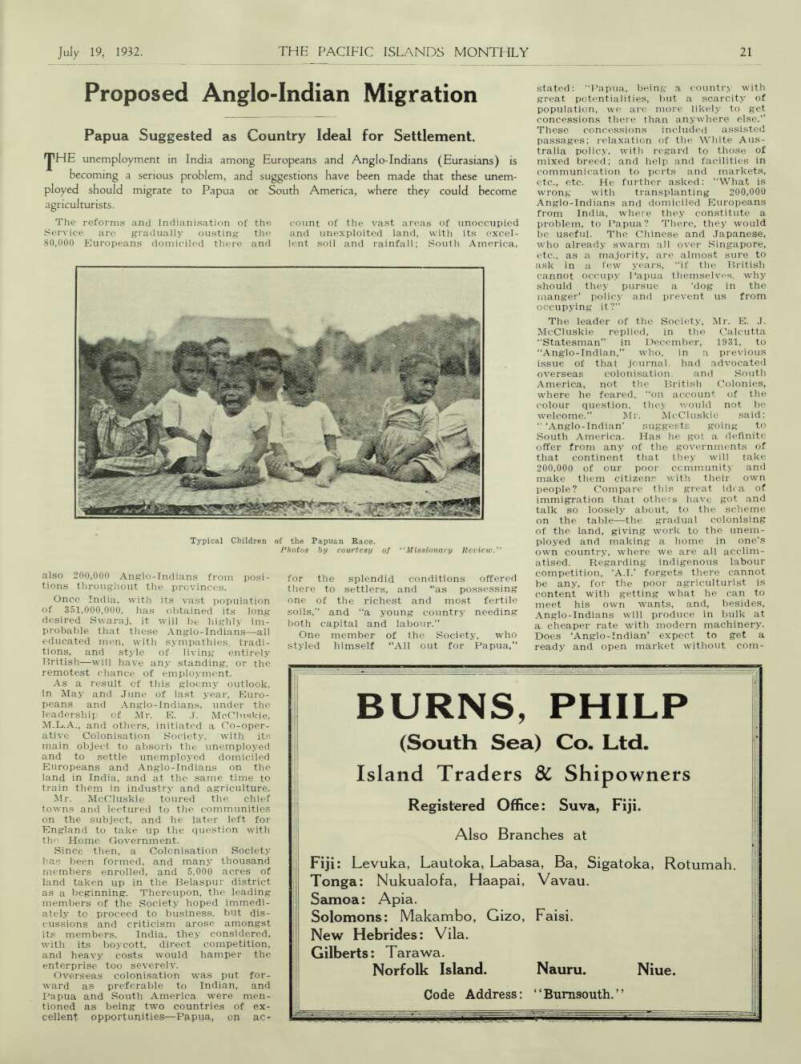
Typical Children of the Papuan Race.
Photos by courtesy of "Missionary Review.”
petition in South America or other countries, say Papua?”
As regards Papua, the members who favoured immigration there put for ward the proposition (if permission should be granted them), that:— Firstly, men should be sent out for preliminaries and to select sites; secondly, that another batch should follow, to erect huts and clear and fence; and, thirdly, areas for cows, poultry and for planting foodstuffs should be chosen; and “generally they should make things comfortable.”
Later, vessels lying idle would be char tered, ensuring cheap passages to colonists, who would be brought over in batches.
The members having little capital, their idea would be to work on com munistic lines; at all events, in the initial stages. The class of Anglo- Indian, which desires immigration, though not agriculturists, are all educated men, who hold or have held positions in Government offices.
Critics are not wanting in India, says one member who thinks that the community will never make colonists.
“The fact is we have never been called upon to try; we are not wanting in pluck, which was shown plainly in our fighting in Mespot.”
Coffee, cinchona, orchards, cattle, horse and mule breeding, besides agriculture, were the projects sug gested as the most likely means of livelihood in Papua.
Is Papuan Settlement
Desirable?
If, by any chance, the Imperial— Australian—Papuan Governments would entertain an influx of immigrants into the unoccupied areas in the hinter lands of Papua, either by Lake Murray or elsewhere in the West, it is questionable whether such an influx of new settlement would be altogether desirable either for the Papuan, or the immigrants themselves, who, un trained and inexperienced, would suffer great hardships and privations in so primitive a country as this.
Apart from the natives, who would undoubtedly be hostile, malaria would cripple their efforts to a great extent.
The hardships in Papua can be hardly realised by those who have not encountered them —only those ex perienced in its ways can understand the obstacles that would have to be overcome. The difficulties of transport are great, far greater than is usually supposed by those who do not know the conditions. “For it is easier,” said D’Albertis, the explorer, “to ascend the highest peaks of the European Alps with an alpenstock than to cross an ordinary hill in New Guinea,”
What was said then by D’Albertis, in 1875, could and would be said to-day by the newcomer, traversing remote and untouched, areas.
Transport by river also presents difficulties and is impractical, with the exception of the Fly River, which is navigable by launch for 600 miles.
However, all these set-backs could be overcome, given the time, money, energy, and courage, and if permission were granted for such a colossal venture.
There are vast areas of unoccupied lands in Western Papua, up the Fly River, the Purari, and other big rivers, where an influx of settlement might become a well organised community, where food, shelter, and clothing