Merchant.
Reg. Hockings, O.B.E.
Passing of Fine Type of Inlands Merchant.
Cortes is not dead, nor Drake, and Sir Phillip Sydney dies every few months, if you know where to look. —Kipling.
SURELY it was to that valiant com pany that Reginald Augustus Charles Hockings, who died at Makassar, on June 5, belonged. Every one who knew him recognised a per sonality that deserved the name of “great”, for the slightest acquaintance with the man, his sagacity, enterprise, open-handedness, and whole manner of living showed him to hold high ideals and to live up to them. He was “big” in every way.
As a successful pearler, a tower of strength to his colleagues and even to his rivals in business, as a generous friend to all his employees and aliens on the Island, and as a sportman and genial man of the world, he could not have failed to gain the affection and esteem of all Thursday Island; but his fame did not rest there. It ranged from political circles in the Common wealth, through the trials and tribula tions of a master pearler in Torres Strait in the days when this calling was regarded by many politicians as little short of criminal, as a wise and generous leader in half a hundred Malay kampongs, to its pinnacle as a trusted assistant cf the British War Machine.
Thursday Island may rightly claim him as its own, but his field of achievement travelled far beyond this little community and became inter national. Truly, the title “Tuan Besar,” given him by the Malays, was in every way deserving.
After an early business career with the firm of Parbury, Lamb & Co., during which he had many oppor tunities of visiting the North, Reg.
Hockings, in 1898, threw in his lot with the Torres Strait pearlers, as a partner with Mr. James Clark. Subsequently, unwise legislation of the day (1905) sent the greater part of T.I.’s fishing fleets right out of Australian waters, to the Aroe Islands, where they could be worked with less official inter ference. This flitting, which should have been regarded as a national tragedy, failed to prove to the ad ministration the folly of harassing commerce too far, and the old policy of pin-pricks continued.
In spite of this, in 1908, Hockings decided to return with Wanetta Fleet to Torres Strait, and, in doing so, roused fierce opposition by the authorities, who should have been only too glad to welcome back his enter prises in the North. Hockings suc ceeded in spite of this hostility. He knew his rights as a citizen of Aus tralia, and merely in exercising them he proved too strong for the Govern ment which opposed him, though few men would have attempted pearling
under such marked official disapproval.
Subsequently came the reformation of the Wanetta Pearling Company, from which he retired in 1929.
There are many undisclosed chapters in the life of this adventurous figure which would have added to his fame — none more so than his service during the war on special duly in connection with British Naval Patrol work, con cerning which he always maintained complete silence. We are, therefore,
unable to make any record of it, so the full story must remain untold. One may mention, however, that his work in this matter lay throughout the vast regions that separate Asia and Aus tralia, and it included many strange meetings and adventures. The chief objective in this field was to ensure oil fuel supplies for the British Navy, to counter the plots of enemy agents, and to track down the German raiders which caused such destruction to allied shipping. Hockings knew every hole and corner of the Malay Archi pelago, and his local knowledge was invaluable. In this battle of wits, he played a notable part, which was recog nised by the King, who conferred on him the Order of the British Empire.
His later years were largely spent in Boeton, where he had established a co conut plantation, with his usual successful powers of organisation. Here, it is no secret that he lived the life he loved above all others, a life that approxi mated that of an Eastern Rajah, ruling wisely and kindly a large com munity of Malays who came under his influence. The Dutch Government placed the highest confidence in his sagacity, utilising his services on more than one occasion in dealing with the natives, and appointing him vice consul for The Netherlands on Thurs day Island, where he upheld the in terests of many of their Malay sub
jects. He was no less successful in his dealings with the Japanese, and it is safe to say that his memory is en shrined in many a village in Japan Where old Wanetta divers are found.
To have gained the confidence and affection of two such widely different Asiatic races is no light thing, and we hazard the guess that it was some little touch of the Oriental tempera ment, discernible in his character, that made him so successful in this respect.
As a public man on Thursday Island, he will be remembered for his generous gift of a tennis court to the townsfolk, for his introduction of East Indian deer and other animals and birds into Torres Strait, and for his attempts to develop a coconut industry, to which end he imported a number of the finest Malayan seed nuts. This latter scheme failed for want of Nature’s response, but Hockings gave it every chance to succeed.
But it will be as the unofficial am bassador and upholder of the rights of local pearlers that he will be most greatly missed. His natural wisdom and diplomacy had its influence with successive Federal administrations, and it is no exaggeration to say that had Hockings’ efforts been withdrawn fifteen or twenty years ago the pearling industry would have suffered almost to extinction. Pearling is now in a fair way to receive fair treat ment, where formerly it was abused and persecuted, and it seems a coin cidence that the man who guided it through so many difficulties to a degree of safety should now be lost to us.
Men speak of Reg.’s “personality.”
There was nothing mysterious about this; it was compounded from his keen zest of life and his liking for the rest of humanity, always controlled by an innate wisdom of men and affairs which characterised him. His vitality lasted to the end, and his cables home, when all hope seemed lost, told of his gameness to the last.
Many and diverse were the people who loved him and looked to him for counsel—widely scattered the folk who
mourn his loss.
G.H.V.
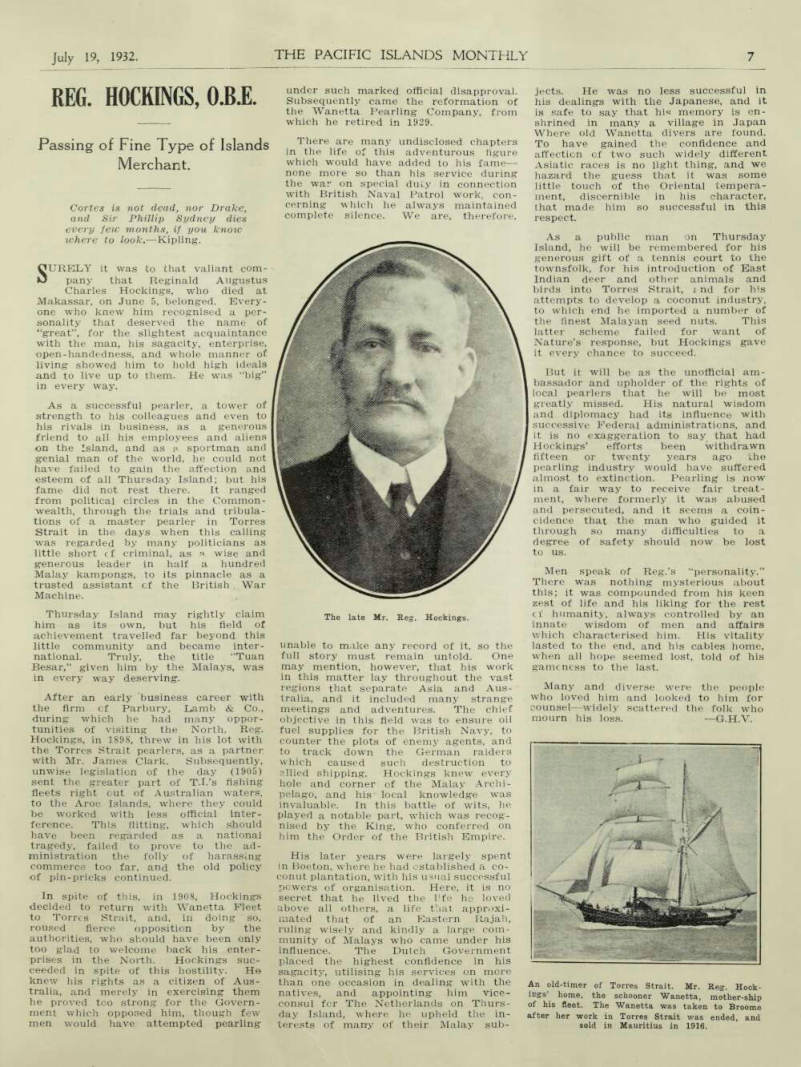
The late Mr. Reg. Hockings.
An old-timer of Torres Strait. Mr. Reg. Hook ings’ home, the schooner Wanetta, mother-ship of his fleet, The Wanetta was taken to Broome after her work in Torres Strait was ended, and sold in Mauritius in 1916.