Tobacco-Growing In The Territory Of New Guinea.
pp. 5-44 · Read in the full issue
(Specially written for “The Pacific Islands Monthly” by F. Robartson, Rabaul.)
SINCE 1930, when the low and fluc tuating price of copra caused so much concern, our planters seem to have at last realised the folly of “putting all their eggs in the one basket.”
Mainly in consequence of the low price obtainable for copra, their thoughts have turned to other crops as possible revenue producers, and tobacco-growing has received consider able thought and inquiry.
This idea has also been considerably strengthened of late, owing to the sharp advance in price of “native issue” stick tobacco, caused by the ad verse exchange on importations from America.
At this stage, I think it might be advisable to state as briefly as possible the history of the attempts at tobacco culture in this Territory, as far as I have been able to ascertain it from careful inquiry. Mr. Geo. Murray (Director of Agriculture) has given me able and valuable assistance.
The idea of tobacco growing here originated in 1900 or 1901, when the German authorities sent samples to Germany, the report upon which was most satisfactory. In the first and
second years in which shipments were made to Germany, a most satisfactory leaf was produced, which was used as a “cigar wrapper,” as the quality was considered to be quite equal to that of the fine Borneo and Sumatra tobacco.
High and remunerative prices were paid for these early shipments; but, for some reason, subsequent shipments showed a great falling off in quality, and the whole enterprise was dropped.
There have been long periods of apathy. Interest has been revived inter mittently since. Meanwhile, a little tobacco has been grown.
Early in 1908, six samples of soil were forwarded from the Jomba River area, in the Madang district, and also from Madang, to the Agricultural Research Department, Bremen.
In reporting on same, Drs. Woiss and Laband set out the necessary soil conditions and, in comment, stated that in the samples of soil received, the necessary conditions were fulfilled, in all samples, in both general structure and humus content. The humus in the samples varied from 6.18 per cent, minimum, to 12.05 per cent, maximum, which, it was stated, showed a percentage of humus rarely met with.
As a comparison, mention was made of the famous tobacco soil of Deli (Sumatra), which, according to Van Bebb, excelled in a large quantity of humus (four per cent); nitrogen 0.2
—0.3 per cent.; phosphoric acid 0.1—0.15 per cent.; and, in addition, other very favourable qualities.
Again referring to the six samples received from Madang and Jomba, it was stated that tiie power to retain moisture was very high, and, generally, they gave extraordinarily good results, the quality of the nitrogen varying be tween 0.333 per cent, and 0.769 per cent, and was consequently, superior to the tobacco soil of Sumatra. The quantity of “chalk” in these samples was sufficient, and the quantity of "Magneisium” was well balanced and in fav ourable proportion to that of the “chalk.” The Alkali Re-action found in the samples was a favourable sign, indicating sufficient airing of the soil. The Absorption Co-efficient according to Knop” was from 125.8 to 171 degrees, which was a most favourable percentage, being in the estimation of the quality and fertility of the soil, of considerable value. Potassium, of great importance in tobacco culture, Avas also found in sufficient quantities in all of the samples.
Shortly after this period, samples of soil from Bougainville district were also forwarded for analysis, and, upon exam
ination, they were reported as being
unsuitable for tobacco culture.
There appears to have been then a period of inactivity regarding tobacco culture, until 1911, when parcels of tobacco grown at Madang, Jomba and Mannam Island were shipped to
Germany.
The report, in this instance, was not altogether satisfactory, but never theless encouraging. The main objec tion appeared to be a too heavy leaf, and gross carelessness in the prepar ation.
In an extract from the German re port on the 1911 shipments, it is stated that the tobacco suffered through being "native grown,” and also in the treatment, fermentation, etc. It had not received anything like the care and attention which would be necessary to obtain a satisfactory European market.
In concluding this report, the experts stated that the whole character of the tobacco led them to earnestly recom mend renewed attempts, especially if the tobacco could be grown, treated, and packed in a manner similar to that of the shipments of some ten years earlier. In view of the great demand existing for the Sumatra leaf, it was considered highly desirable that the New Guinea product should be brought to a state of perfection which would enable it to be placed on the European market.
Again, in 1912, shipments were made of second-season tobacco, upon which it was reported that the sample was much better than the 1911 shipments, and realised double the price of same.
The shipment from Mannam Island was very superior, and came up to the standard of the fine Sumatra leaf.
German interest in tobacco culture appears to have ceased at this point.
Then came the war of 1914.
This matter again came into prom inence in 1917, during the military oc cupation, when a planter in the Madang district forwarded to Rabaul samples of unfermented and fermented tobacco of the "cigar-leaf type”.
The late Major H. O. Newport, who was at that time Director of Agricul ture, became greatly interested, and made every endeavour to find a market in Australia, but was unsuc cessful. He personally took these Madang samples to Australia for examination and report, and the planter subsequently received a report on his samples.
It was stated that the samples, in appearance, texture, and burning quali ties were similar to Borneo leaf, and to some extent similar to that of Sumatra.
The flavour and aroma were, at that time, distinct from anything then known on the Australian market. It was not objectionable, and could be safely used for blending, provided the percentage used was not excessive.
The fermented leaf, as submitted, was superior to the unfermented, and showed great promise.
The possibility of the cultivation of a heavier type of leaf for the manu facture of ‘‘trade twist tobacco” was looked into, but I am not now aware of the result.
If my memory serves me correctly, somewhere about that time, the ques tion of tobacco prices, manufacture, etc., came up for investigation by the Interstate Commission in Australia, and, in evidence, it was stated that manufacturers were bound by their agreements to use a very high per centage of American-grown leaf, which would only leave a small percentage to be filled with Australian-grown tobacco. The manufacturers were
then giving a price much below the intrinsic value, and, therefore, the prospects of a leaf, however good, grown in these Possessions, were con sidered remote for obtaining a market in Australia at a reasonable price.
During 1917, several planters had under consideration the question of tobacco culture, and this prompted the Department of Agriculture to endeavour to obtain seed from Aus traha. They were unsuccessful; but, I understand, eventually obtained small quantities of seed from Borneo or Sumatra.
Towards the end of 1921, a personal friend of mine, who was then District Officer of the Morobe district, advised the Administration that considerable quantities of leaf tobacco were grown in that district. This was being used extensively by planters and mis sionaries in the weekly issue to their indentured labourers, in lieu of the usual issue of the "twist stick tobacco.” This leaf was grown in small patches by the native villagers inland. It was "smoke” or "sun” dried packed into portable bundles, and then transported to the coast, where it was sold at about 6d. per lb.
Local and inland natives preferred this leaf to the imported American "stick tobacco,” but natives foreign to the district, who had not previously known the local articles, complained, and asked for the stick tobacco.
The officer mentioned that a mission schooner had brought in some 250 kilogrammes of the leaf tobacco, which had been sold to the Expropri ation Board, all of which would be used as a substitute for the “duty paid” stick tobacco. He made a sug gestion that an "excise” duty should be imposed on this leaf tobacco. This suggestion, however, was not favour ably received by the authorities in Rabaul at that time.
By 1922, great activity was shown in preliminary inquiries, but nothing eventuated.
Samples of three different varieties of tobacco leaf, as grown on the slopes of the Cromwell Ranges, were sent into Rabaul from the Morobe district,
by the officer of whom I have made mention. In his opinion, and from his inquiries, he was not in accord with the theory of the missions having in troduced the tobacco plant into the Territory, and, as far as he could trace, the plant was indigenous to New Guinea.
From observation, the tobacco seemed to thrive on inland plateaux, and yielded about 1 ton per hectare (2½ acres). The method employed in curing was very crude, different tribes employing different methods. One method was to cut off the entire plant near the ground and then hang it up in the shade of the house until a cer tain degree of dryness had been ob tained. Another method was to take the leaves, string them on a native rope, and then hang them in the shade to dry. As soon as sufficiently dried, the leaves were evenly packed into bundles of from 1 to 6 lbs, wrapped in green leaves from the bush and tied securely; these bundles were then hung over a fire for some days for further curing.
Shortly after the arrival of the Cromwell Range samples, some further samples of leaf reached Rabaul, this time from Marienberg, of samples grown in districts up the Sepik River.
It was stated that the planting of the Sepik River tobacco took place in May or June of each year.
Following on this, towards the end of 1922, samples of leaf arrived from Kavieng, grown on the Lalet Plateau.
Kieta then joined in with samples grown in that district. The District Officer from Morobe was very in terested in the question of tobacco cul ture, as on another occasion, whilst stationed at Gasmatta, he also sent in samples of leaf which he had secured from a village about 14 miles up the Pulie River. I think, as a result of the numerous inquiries that were being made, and the samples of leaf which had been sent in from almost every district in the Territory, a represen tative of one of the Australian tobacco manufacturers made a trip to the Ter
(Continued On Page 41.)
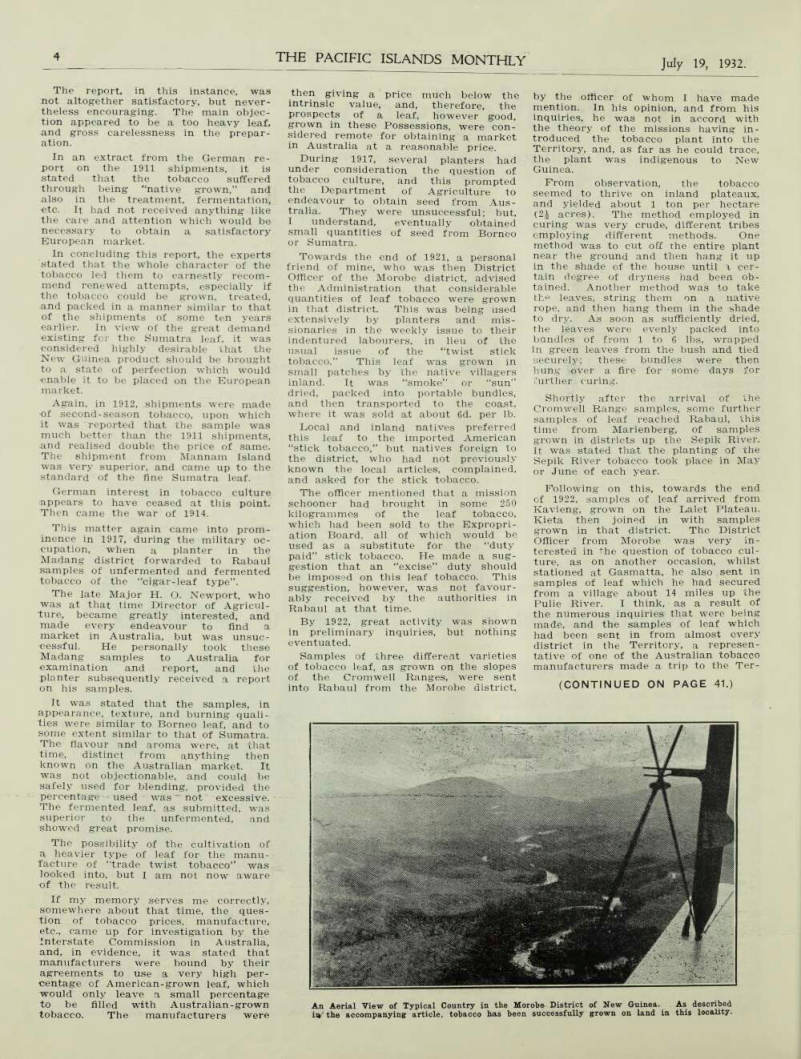
An Aerial View of Typical Country in the Morobe District of New Guinea. As described in the accompanying article, tobacco has been successfully grown on land in this locality.
ritory, with a view of investigating the possibilities. Quite a lot of informa tion was gathered on the subject, and numerous samples were taken to Aus tralia. The result of this visit was not known until March or April, 1923, and same was both unsatisfactory and most disappointing.
Although it was stated, in a letter from the manufacturers, that the samples were submitted to an expert, no information was given as to the result of his examination. The letter merely mentioned the fact that a more suitable type of leaf could be pur chased, at that time, at 9d. per lb., and that unless some preference in the matter of duty could be obtained, there was no prospect of a market being found in Australia for New Guinea grown leaf.
Throughout 1923, endeavour was made to secure special samples of seed from the Federated Malay States, Borneo, Sumatra, Java, etc., and even tually a small sample was received from an experimental station in East Java.
During 1923 and 1924, there were constant inquiries from planters in different parts of the Territory for in formation regarding tobacco culture, and a general correlation of local data was carried out by the Department of Agriculture in Rabaul.
The Department sent representative leaf samples of tobacco grown by natives in the hills behind Finschafen to The Imperial Institute, London, in March, 1925. This leaf tobacco was grown from Australian seed, imported by the Lutheran Mission, and the curing was done by the crude methods which I mentioned earlier. The report on the examination of this sample, which was received towards the end of 1925, was, on the whole, most en couraging.
The tobacco, after the removal of the mid ribs, gave the undermentioned results upon analysis:—Moisture, 14 per cent.; Nicotine, 4.10 per cent.; Nitrogen, 4.56 per cent.; Ash, 13.3 per cent. This result showed somewhat high proportions of nitrogen and nicotine.
Upon smoking in cigar form, the tobacco held fire reasonably well, but showed poor combus tion and yielded a black, charred ash. The flavour and aroma were found to be coarse and somewhat pungent. In the form of cigarettes, although the tobacco burned well, the same re marks applied as to coarseness and pungency, and, consequently, it was indicated that the leaf would be unsuitable for cigarette manufacture.
It showed somewhat similar properties when smoked as a pipe tobacco and was, therefore, considered suitable only for use in heavy shag and dark mixtures.
Manufacturers in London, to whom this leaf was submitted, were very favourably impressed by the appearance and character, and it was regarded as a very promising type.
One firm was prepared to receive trial bales of the tobacco, if of equal quality to the samples submitted, which it stated would be suitable for its requirements as a pipe to bacco. It considered that the leaves were of good shape, the butts well covered, and the midribs not too large. For its purpose, the veins were too wiry and the colour of the leaves too red to allow the tobacco to be used as a “cigar wrapper.”
Although the sample submitted was, therefore, unsuitable for cigars, its ap pearance indicated the possibility of growing satisfactory cigar leaf in New
Guinea, and steps might therefore be taken to improve the curing methods.
During the whole of 1926 and 1927, there was a considerable amount of correspondence between the Depart ment of Agriculture in this Territory, The Imperial Institute, the High Com missioner’s Office, and English firms of repute. This culminated in the despatch to England of a case of re presentative leaf samples, as grown in the various districts of this Territory.
One English firm made offers of pur chase, and indicated its price. How ever, as the only available supplies would have to be secured from natives, it was not considered advisable to go ahead, with the project, as no reliance could be placed on the native to carry out any promise of delivery.
Taking the whole of the facts into consideration, so far, it is noticeable that only “native grown” tobacco has been submitted or considered.
In view of the encouraging reports received, with proper, cultivation under European methods of planting and supervision, indications point to great possibilities ahead of us in this Territory, even if we only concerned ourselves with the production of the cheap tobacco which would be used in the manufacture of “stick tobacco” as issued to the indentured native labourer.
As far as I have been able to ascer tain, with one exception until recently, no real effort has ever been made by planters of this Territory to go into the question of tobacco culture as an in dustry.
The exception was in the case of the New Guinea Company during the period when they had this Territory under charter. They had a properly laid out tobacco plantation somewhere in the Madang district, which was staffed by and under the control of Malays and Chinese.
These people interfered with the na tives and, in the resultant reprisals, were massacred and killed off. For this and other reasons, the scheme was not a success and the New Guinea Com pany appears to have dropped tobacco culture as a business.
At the present time a certain local market exists for leaf tobacco, which is either obtained from native villages, or grown in small quantities on planta tions. Many of the plantations issue their labour line with half the weekly ration in leaf form and half in the form of the imported “stick.”
If, however, some sudden demand were to arise, either by a more general use of leaf, or from some outside de mand, available supplies would be quickly absorbed and we should have to plant up additional areas and wait for the crop to grow and mature. In these circumstances, there could be no continuity of supply until a consider able period had elapsed.
If it is not intended or desired at pre sent to consider the cultivation of special quality tobacco for cigar mak ing, etc., there is no doubt that the quality of the leaf which has already been grown, should be suitable for the manufacture of the “native stick to bacco,”
This form of a new industry has much to commend it, as the issue of tobacco in “leaf form” will never re place the “stick,” which has attained large dimensions as a form of “cur rency” between natives themselves and natives and Chinese traders. The de mand already exists for the “stick” to bacco, as our importations during tfie financial year ended the 30th June, 1931, amounted to 218,193 lbs., the value of which on invoice price at port of ship ment was £27,787.
There is consequently, in this form of manufacture, no necessity to endeavour to obtain an outlet through outside markets for our production for some considerable time. Local planters would greatly benefit by obtaining a cheaper tobacco and the £27,787 which now goes to America would remain in circulation in this Territory.
In subsequent consideration of out side markets, those of Europe would appear to offer the best scope, but the whole question would be one of im
proved quality, whereby an article could be produced which would be suit able for European requirements. Asso ciated with this, of course, would be the question of the price which could be obtained.
Another fact worthy of notice is the apparent difference between the expert reports received from Europe and those obtained from Australia. In the latter case, however, in reading- between the lines, I was forced to the conclusion that these reports savour of politics and policy.
Valuable facts are contained in an “Industrial and Commercial Geography,” by J. Russel Smith (Constable, Lon don) in which there are some graphs dealing with tobacco culture and manu facture. Even with the great quantities of tobacco grown in the various parts of the continent of Europe, the demand has always greatly exceeded the supply.
Russia, with a pre-war crop of 233 million pounds, was the leading tobacco growing country of Europe and with this production had practically no sur plus for export. Germany, which is now the largest European grower, with a production of 65 million pounds per annum, imports three times the quan tity it produces. Italy and France each grow 50 million pounds and import much more than this quantity. France leads the way in production as with careful fertilisation and cultivation they obtain about 1,500 lbs. to the acre.
The amount of duty collected in this Territory on 218,193 lbs. of native to bacco imported in 1931, calculated at 2/6 per lb., amounts to £27,274/2/6, and if we are able, in time, to manufacture our own requirements, and “excise duty” or some other form of compensa tion taxation must be considered.
Whilst collecting data for this article, I have met with opposition from more than one planter, who has asked me not to mention anything about recently grown local tobacco, in case the Ad ministration “wake up” in respect to the imposition of a form of duty.
I have not noticed any somnambu listic tendencies among Departmental Heads in this Territory—much the re verse.
Apart from experiments at the Gov ernment Experimental Station at the Keravat River, other private experi ments are being carried out. I recently saw a small box of locally-grown and manufactured “native stick twist to bacco.” In appearance, the local pro duct was quite equal to the best im ported American article. It was very uniform in both quality and the size of the sticks. I was informed that this tobacco which I had inspected could be sold profitably at 1/9 per lb. (of course, without the imposition of any form of duty). This was a remarkable figure, when compared with the present price of 5/2 per lb., in caddy lots, and 5/6 per lb. retail.
I do not wish in any way, to dampen the enthusiasm of those who have been experimenting in tobacco culture and the manufacture of stick tobacco, but I cannot stress too strongly some re marks which were made to me by the Director of Agriculture. He told me that tobacco culture, and especially the curing, was a highly specialised busi ness which required considerable prac tical experience which was not obtain able from books.
From the facts gathered, the venture would appear to be one well worth most serious consideration, and in the event of capital being obtained to
finance a project of this nature, the very best expert knowledge should be secured from some tropical country which has already made a success of the business.
It looks as though, after about three decades of half-hearted and abortive attempts at tobacco culture in this Ter ritory, present economic circumstances may force the issue, so that at least we may have in sight a sufficiency of locally-grown tobacco to fill our re quirements.
In conclusion, and to further stress the necessity of obtaining expert know ledge, I will mention the fact that at some time prior to 1922, a company in Papua imported an elaborate tobacco and cigar making plant from which they turned out large quantities of “twist stick tobacco” and cigars. The native tobacco was not a success, and was found to be dry and brittle, break ing into pieces when untwisted; it was tasteless and lacked the “tang” of the imported American tobacco which reeks so much of rum and molasses.
Eventually, the whole of this expensive plant was scrapped.