O. F. Nelson And New Zealand Government.
pp. 24-25 · Read in the full issue
To the Editor.
Sir, —The policy of your journal towards the vexed situation in Western Samoa has been a friendly and neutral attitude to both sides of the contro versy, displaying a desire to be help ful towards the attainment of that long-delayed settlement.
There are, however, certain inconsist encies, errors and omissions in your leading editorial of May 19, which I feel confident your sense of fairplay will cause you to find space in your next issue for this letter, giving, what I consider, is the Samoan point of view.
On the one hand, you state: “Tha stolid, unimaginative, well-drilled New Zealanders, very conscious of their excellent good purpose and Governmental rectitude, were driven by Samoan sulkiness from irritation to resent ment, and from resentment to a sternness that was close to brutality . . . .” and in the next paragraph you say that “Too many unsuitable men were sent to Samoa from New Zealand ... Far too many went to Samoa simply with the idea of enjoy ing a ‘cushy job’ in the pleasant, languorous surroundings of a lotus-eating land . . . .”
Samoan readers will interpret your re ference to “well-drilled New Zea landers” as men all specially trained and fitted for their jobs; whereas the second quotation given above is more in keeping with the actual position and forms one of the many complaints of the Samoans.
You say that “The Mau is making no effort to grasp New Zealand’s out stretched, friendly hand” and that “General Hart is doing well in a most
difficult, discour aging job”; but you make no refer ence to the friendly gestures made by the Samoans in their many letters and other com munications to the Government at Wellington and the Administrator at Apia, to not one of which have they even had the cour tesy to reply.
The obsolete poll tax still claims new victims, pol itical prisoners are made to plant bananas for ex port to New Zea
land; the law requiring the Samoans to get police permits before they may visit one another still stands unre pealed; neither have Orders-in-Council and regulations which have been found necessary by the Administration to de part from to placate the Mau been re voked. Other irritative tactics are fully described in the Samoan Petition, 1931, to the Three Powers.
Is it, therefore, any wonder that the Samoans still feel that in New Zea land’s “outstretched, friendly hand” is concealed a sharp dagger? This can not be said of the genuine, friendly gestures made by the Samoans which have so far been ignored by a “sulky” administration.
In your concluding paragraph you state: “The immediate future seems to lie largely in the hands of Mr. O. F. Nelson, influential Mau leader, whose period of banishment will ex pire soon. If the New Zealanders show no vin dictiveness, and Mr. Nelson is big enough to regard the future in terms of his country’s good, rather than allow his judgment to be coloured by the memory of his sufferings and his hatred of officialdom, the name of Mr. Nelson may yet be written very large in the history of Samoa. Events in Samoa in the next twelve months will be very interesting and significant.”
May I draw your attention to Clause 121 of “The Samoan Petition, 1931,” in which a list is given of the many let ters and communications sent by me to the Prime Minister at Wellington, also to Clause 117 of the same petition, giving details of my last petition to the New Zealand Parliament, all done in the effort to open up negotiations with the Government in the hope of an amicable settlement? To my petition, the parliamentary committee had no comment to make and to my many let ters, purely formal acknowledgments were all that were received.
Though I was born in Samoa, of a Samoan mother, the Government still persists in classing me a European, and thus a “foreigner” in my own native country; dual citizenship has been established in American Samoa, but not in Western Samoa as yet. The New Zealand Government refuse to re cognise me or my right to speak on behalf of the Samoan people, so what ever name you might give to the so called gestures made to the Samoans, that “friendly hand” has certainly not been “outstretched” to me.
Written petitions and prayers have often been made by representative New Zealanders, and others, to the Govern ment, to invite me and other Samoan leaders to a round-table conference in Wellington, but to all these, the Gov ernment have turned a deaf ear. So long as the Government maintain this uncompromising attitude towards me, it is not fair to blame me for their in ability to pacify the Samoans. Neither
is it fair to expect the Samoans to dis credit pne of their own, who has spent his leisure and his substance in their behalf, in order to save the faces of their white rulers.
After all, the Government have used their authority to inflict severe punish ment on me, for what they must now admit was at least partly due to their own bungling- methods, and have not let up one iota on their persecution of me, and will not even now recognise me, so it is hardly human to expect me to press any services I might be able to render where they are clearly not wanted.
At the same time, my home, my busi ness, my relations and my people are still in Samoa where my heart will ever be; I must naturally wish to return to Samoa; the Mandatory Government still holds the whip-end of the argu ment; and unless great changes come about in the near future, the end of my troubles is not yet.
I will, however, never sell my honour, my self-respect, nor the birthright of my people for my leisure, comfort, or convenience.
I am, etc.,
O. F. Nelson.
Auckland,
May 26, 1932.
EDITORIAL NOTE.—We were glad to pass for publication this courteous and well-reasoned letter. But our pleasure was tempered by other feelings when we read a copy of “The N.Z.
Samoan Guardian’’ of June 9, wherein Mr. Nel son covers the same ground, in very different phraseology and style. There we are told, either directly or by inference, that the editor of the “Pacific Islands Monthly” is ignorant of his sub ject, somewhat one-eyed, and guilty of “word spinning and rail-sitting.” Mr. N'elson goes on to discuss the Samoan problem with a fury and aggressiveness which give no indication of a spirit of compromise. And without a spirit of compromise there can be no way out of the present impasse. That has been the tenor of our argument from the beginning. The trouble is that Mr. Nelson is preoccupied with the past, with its injustices and its failures. We are not concerned with the past: we are anxious only to deal with the position as it is, and see Samoa restored to its natural condition of and tranquillity. We have appealed to Mr.
Nelson to be generous, to forget the past, nr to use his influence with his fellow Samoans to bring them closer to the New Zealand Adminis trators, so that there may be a compromise, and a settlement, with honour on both sides. But
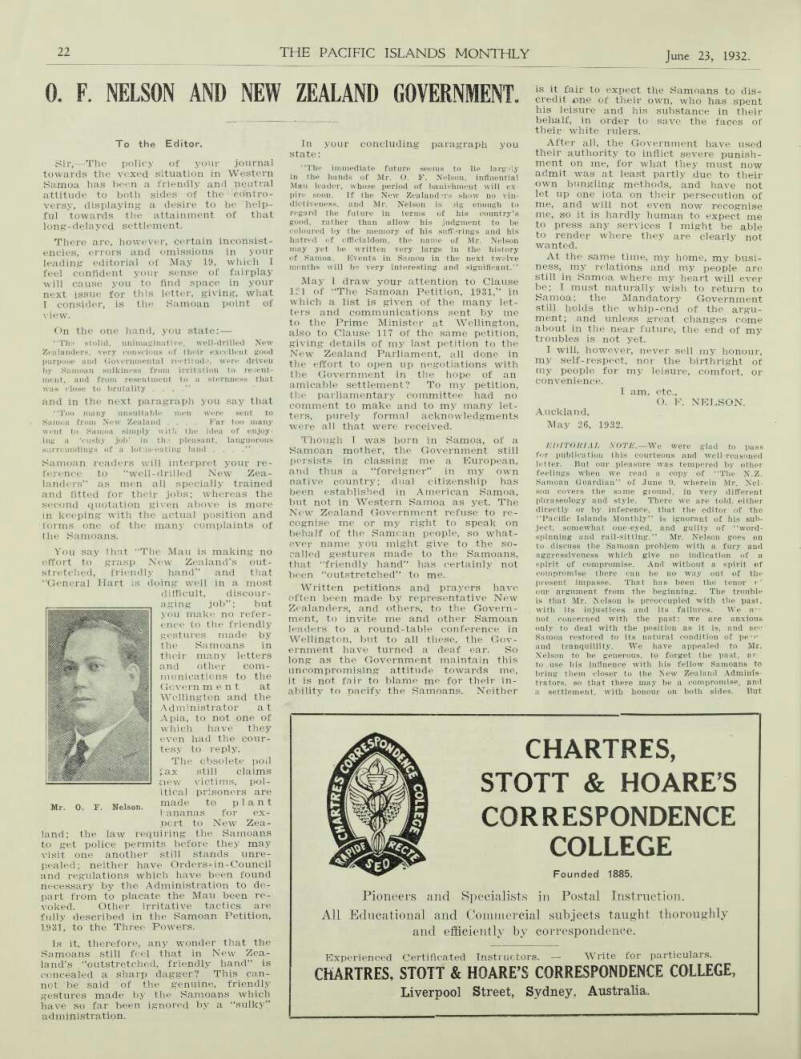
Mr. O. F. Nelson.
Mr. Nelson replies, savagely, that New Zealand is making no move towards compromise, and that "all the Man knows of that mailed list of New Zealand’s is that it still has a stranglehold on the throat of Samoa, and is trying to choke the very soul out of the people there.” And, again, ‘‘the New Zealand ostrich will not take its head out of the sand and face the facts.”
That is not being helpful—and it is not the language of compromise Has any real, sincere effort been made to bring the Administrator and the Mau together, since General Hart took charge Apparently not. The Mau, according to Mr. Nelson, ‘‘wrote him most respectfully and politely explaining why they had not accepted the official invitation to welcome him, and setting out very clearly the conditions and terms on which they would meet and confer with him.” But that is not the correct form of approach to a powerful and proud State. This frightful muddle cannot be cleaned up unless both sides meet in a calm at mosphere, with open minds, free from all “con ditions and terms.” Mr. Nelson can do more than any other man to help the Samoans out of their political troubles, but Mr. Nelson’s latest contribution to the discussion only emphasises our view that Western Samoa is “a continuing dis appointment.”