Colonel Bennett's Departure Ends
p. 23 · Read in the full issue
Disturbed Situation On Norfolk Is.
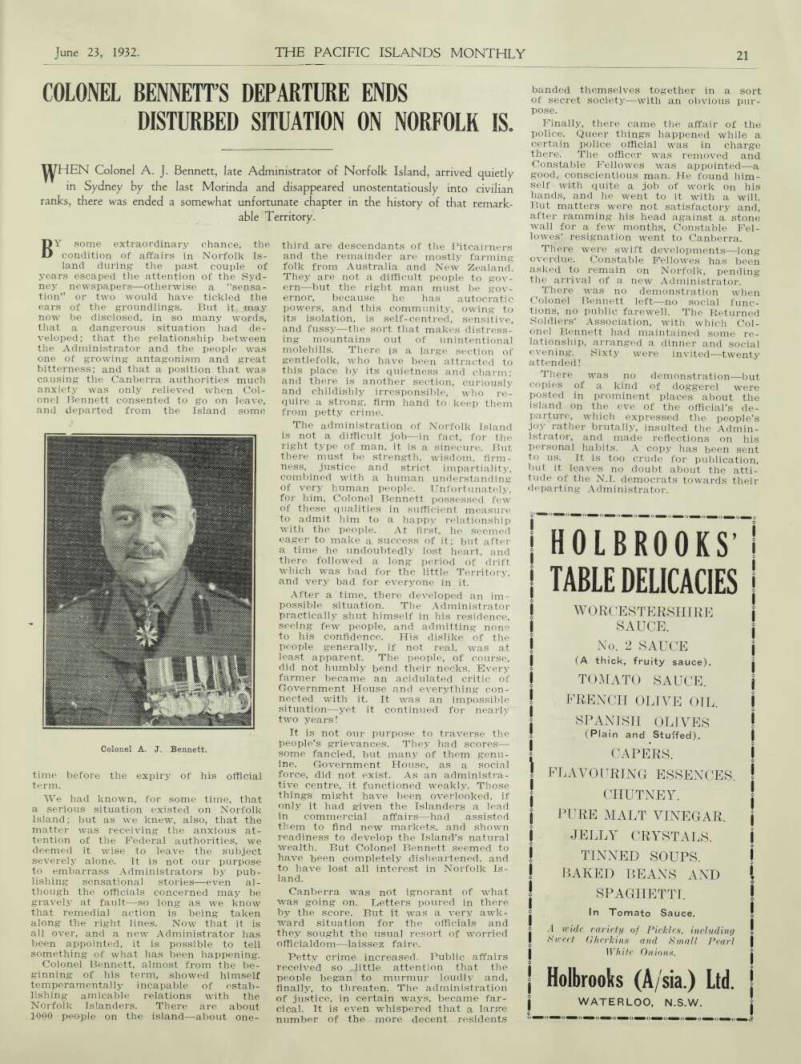
Colonel A. J. Bennett, late Administrator of Norfolk Island, arrived quietly in Sydney by the last Morinda and disappeared unostentatiously into civilian ranks, there was ended a somewhat unfortunate chapter in the history of that remark-
able Territory.
BY some extraordinary chance, the condition of affairs in Norfolk Island during the past couple of years escaped the attention of the Sydney newspapers—otherwise a “sensation” or two would have tickled the ears of the groundlings. But it may now be disclosed, in so many words, that a dangerous situation had developed; that the relationship between the Administrator and the people was one of growing antagonism and great bitterness; and that a position that was causing the Canberra authorities much anxiety was only relieved when Colonel Bennett consented to go on leave, and departed from the Island some
time before the expiry of his official term.
We had known, for some time, that a serious situation existed on Norfolk Island; but as we knew, also, that the matter was receiving’ the anxious attention of the Federal authorities, we deemed it wise to leave the subject severely alone. It is not our purpose to embarrass Administrators by publishing sensational stories —even although the officials concerned may be gravely at fault —so long as we know that remedial action is being taken along the right lines. Now that it is all over, and a new Administrator has been appointed, it is possible to tell something of what has been happening.
Colonel Bennett, almost from the beginning of his term, showed himself temperamentally incapable of establishing amicable relations with the Norfolk Islanders. There are about 1000 people on the island—about one-
third are descendants of the Pitcairners and the remainder are mostly farming folk from Australia and New Zealand.
They are not a difficult people to govern—but the right man must be governor, because he has autocratic powers, and this community, owing to its isolation, is self-centred, sensitive, and fussy—the sort that makes distressing mountains out of unintentional molehills. There is a large section of gentlefolk, who have been attracted to this place by its quietness and charm; and there is another section, curiously and childishly irresponsible, who require a strong, firm hand to keep them from petty crime.
The administration of Norfolk Island is not a difficult job—in fact, for the right type of man, it is a sinecure. But there must be strength, wisdom, firmness, justice and strict impartiality, combined with a human understanding of very human people. Unfortunately, for him, Colonel Bennett possessed few of these qualities in sufficient measure to admit him to a happy relationship with the people. At first, he seemed eager to make a success of it; but after a time he undoubtedly lost heart, and there followed a long period of drift which was bad for the little Territory, and very bad for everyone in it.
After a time, there developed an impossible situation. The Administrator practically shut himself in his residence, seeing few people, and admitting none to his confidence. His dislike of the people generally, if not real, was at least apparent. The people, of course, did not humbly bend their necks. Every farmer became an acidulated critic of Government House and everything connected with it. It was an impossible situation—yet it continued for nearly two years!
It is not our purpose to traverse the people’s grievances. They had scores— some fancied, but many of them genuine. Government House, as a social force, did not exist. As an administrative centre, it functioned weakly. Those things might have been overlooked, if only it had given the Islanders a lead in commercial affairs—had assisted them to find new markets, and shown readiness to develop the Island’s natural wealth. But Colonel Bennett seemed to have been completely disheartened, and to have lost all interest in Norfolk Island.
Canberra was not ignorant of what was going on. Letters poured in there by the score. But it was a very awkward situation for the officials and they sought the usual resort of worried officialdom—laissez faire.
Petty crime increased. Public affairs received so little attention that the people began to murmur loudly and, finally, to threaten. The administration of justice, in certain ways, became farcical. It is even whispered that a large number of the more decent residents
banded themselves together in a sort of secret society—with an obvious purpose.
Finally, there came the affair of the police. Queer things happened while a certain police official was in charge there. The officer was removed and Constable Fellowes was appointed—a good, conscientious man. He found himself with quite a job of work on his hands, and he went to it with a will.
But matters were not satisfactory and, after ramming his head against a stone wall for a few months, Constable Fellowes’ resignation went to Canberra.
There were swift developments—long overdue. Constable Fellowes has been asked to remain on Norfolk, pending the arrival of a new Administrator.
There was no demonstration when Colonel Bennett left—no social functions, no public farewell. The Returned Soldiers’ Association, with which Colonel Bennett had maintained some relationship, arranged a dinner and social evening. Sixty were invited—twenty attended!
There was no demonstration—but copies of a kind of doggerel were posted in prominent places about the island on the eve of the official’s departure, which expressed the people’s joy rather brutally, insulted the Administrator, and made reflections on his personal habits. A copy has been sent to us. It is too crude for publication, but it leaves no doubt about the attitude of the N.I. democrats towards their departing Administrator.
Colonel A. J, Bennett.