Products Of The South Seas.
p. 47 · Read in the full issue
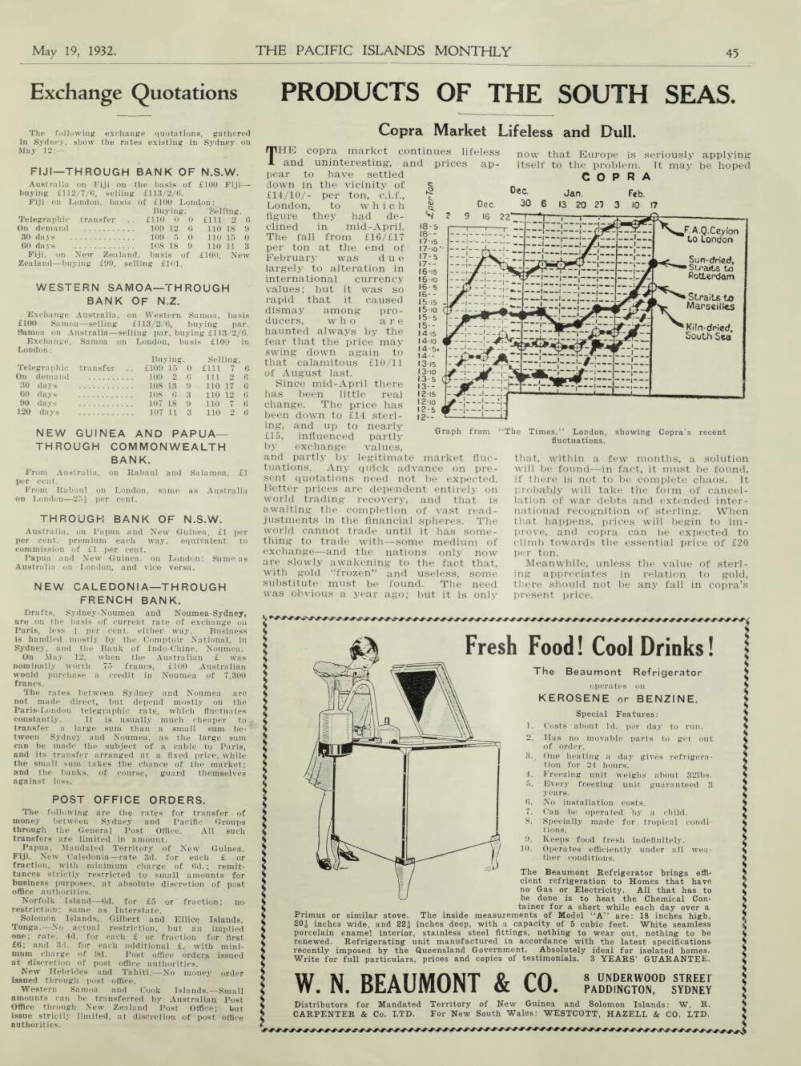
Copra Market Lifeless and Dull.
THE copra market continues lifeless and uninteresting, and prices ap
pear to have settled down in the vicinity of £14/10/- per ton, c.i.f., London, to which figure they had de clined in mid-April.
The fall from £16/£17 per ton at the end of February was due largely to alteration in international currency values; but it was so rapid that it caused dismay among pro ducers, who are haunted always by the fear that the price may swing down again to that calamitous £10/11 of August last.
Since mid-April there has been little real change. The price has been down to £14 sterl ing, and up to nearly £15, influenced partly by exchange values,
and partly by legitimate market fluc tuations. Any quick advance on pre sent quotations need not be expected.
Better prices are dependent entirely on world trading recovery, and that is awaiting the completion of vast read justments in the financial spheres. The world cannot trade until it has some thing to trade with —some medium of exchange—and the nations only now are slowly awakening to the fact that, with gold “frozen” and useless, some substitute must be found. The need was obvious a year ago; but it is only
now that Europe is seriously applying itself to the problem. It may be hoped
that, within a few months, a solution will be found —in fact, it must be found, if there is not to be complete chaos. It probably will take the form of cancel lation of war debts and extended inter national recognition of sterling. When that happens, prices will begin to im prove, and copra can be expected to climb towards the essential price of £20 per ton.
Meanwhile, unless the value of sterl ing appreciates in relation to gold, there should not be any fall in copra’s present price.
Graph from “The Times,” London, showing Copra’s recent fluctuations.