Rich Tourist
p. 33 · Read in the full issue
Traffic.
What South Seas Are Missing.
“WHY did I not know sooner about this place?” demanded Miss Lot tie Dingeinan, a wealthy Ameri can tourist, when she arrived in Syd ney on the “Mataram” on April 2 from the Solomon Islands.
Miss Dingeinan has had a surfeit of
old-world places, and was looking for “something new.” Quite on speculation —“I could get little information any where regarding the Solomons,” she says—she decided on a visit to the group and she has returned, filled with enthusiasm concerning the beauty, in terest and “unusualness” of this terri tory.
“You should boost the Solomons,” declared the young lady. “Let the world know about the fascination and charm of these South Sea Islands, and you will attract thousands of Ameri cans who are looking for something new.”
With these sentiments, all who know the South Seas will cordially agree.
What this tourist has said about the Solomons can be repeated, with equal truth, in reference to almost all the groups south of the Equator. Each group and territory has its special charm and peculiar interest.
She is equally correct in saying that tourists from the world outside of Aus tralasia do not visit the South Seas because they know nothing about them. Excellent publicity concerning tourist attractions in the South Pacific is carried out in Australia and New Zealand by Burns, Philp and Co. Ltd and the Union S.S. Co. Ltd.; but in the older world there is nothing at all of the nature of strong, arresting adver tisements, calculated to induce travel lers to seek the sunshine and colour, unusualness and romance of the Pacific Islands. Yet the opportunity is there wide open and beckoning. What Am erica has done for the West Indies and Hawaii, Australasia can do for the South Pacific: for, when it comes to tourist attractions,, the South Sea Is lands can lose both the West Indies and Hawaii.
This is not the time to make a tour ist effort. The world, economically, is too sick at present to think about travelling for pleasure. But the world is not going to stay sick, indefinitely
Great Britain—that amazing Peter Pan among the nations —is leading the world out of the morass; and, perhaps, in 1933, we may begin to regain norm ality. When that time comes, we should be ready with some effort to bring the wandering pleasure-seeker and his money into the South Seas.
It is only a matter of intelligent co operation, properly directed. Everyone recognises the need, and the opportun ity. There are tourist committees or bureaus in nearly all of the larger Is lands centres; and the shipping com panies interested are more than ready to assist.
No one has funds at present, either for advertising or for travelling; but there is nothing to prevent all inter ested in South Seas tourist traffic get ting together now, so as to prepare for a really worth-while co-operative effort when times improve. There should be sufficient funds provided to permit effective publicity in the older world; and there should be a central bureau, so efficiently organised that it could bring a party from London or New York, and arrange all bookings ahead, irrespective of whether they wanted to visit the Morobe goldfield in New Guinea or Stevenson’s tomb in Samoa, or romantic Papeete or whether they wanted to stalk deer in New Caledonia or catch big fish in Fiji. It is all a matter of co-operation and organisation.
A month in New Guinea or Fiji can provide an infinitely wider and better diversity of attraction than a month in Hawaii or Bermuda; and it is time that the South Seas interests were made aware of the valuable traffic that they are missing.
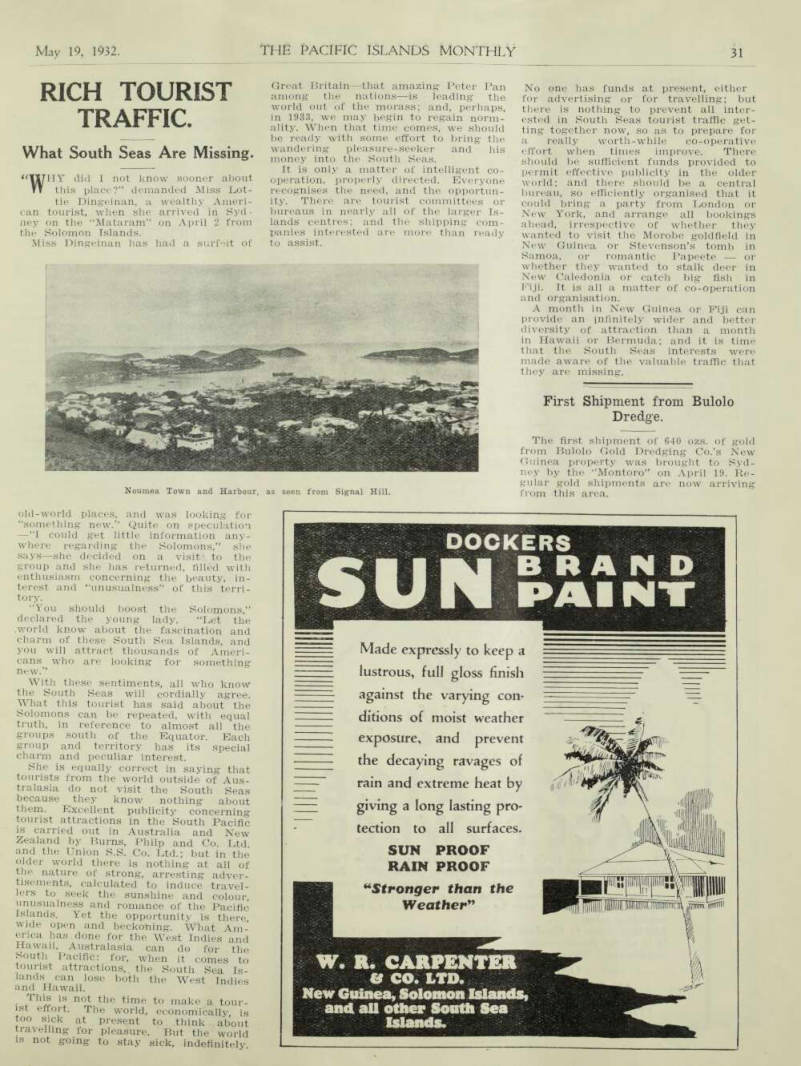
Noumea Town and Harbour, as seen from Signal Hill.