Fiji Pineapples.
p. 25 · Read in the full issue
Survey of Encouraging Pro gress In Recent Years.
From Our Own Correspondent.
SUVA, April 20.
THE pineapple industry in Fiji is passing through strenuous times.
Three companies are interested, one being the Hawaiian Pineapple Co., whose interests, however, are confined to an experimental station on a block of some 50,000 acres.
The other companies have been en gaged in the planting and canning of pines under two different sets of con ditions. One company, the Fijian Pine apple Co., consists very largely of New Zealand capital and is backed by the Ann of Messrs. L. D. Nathan and Co.
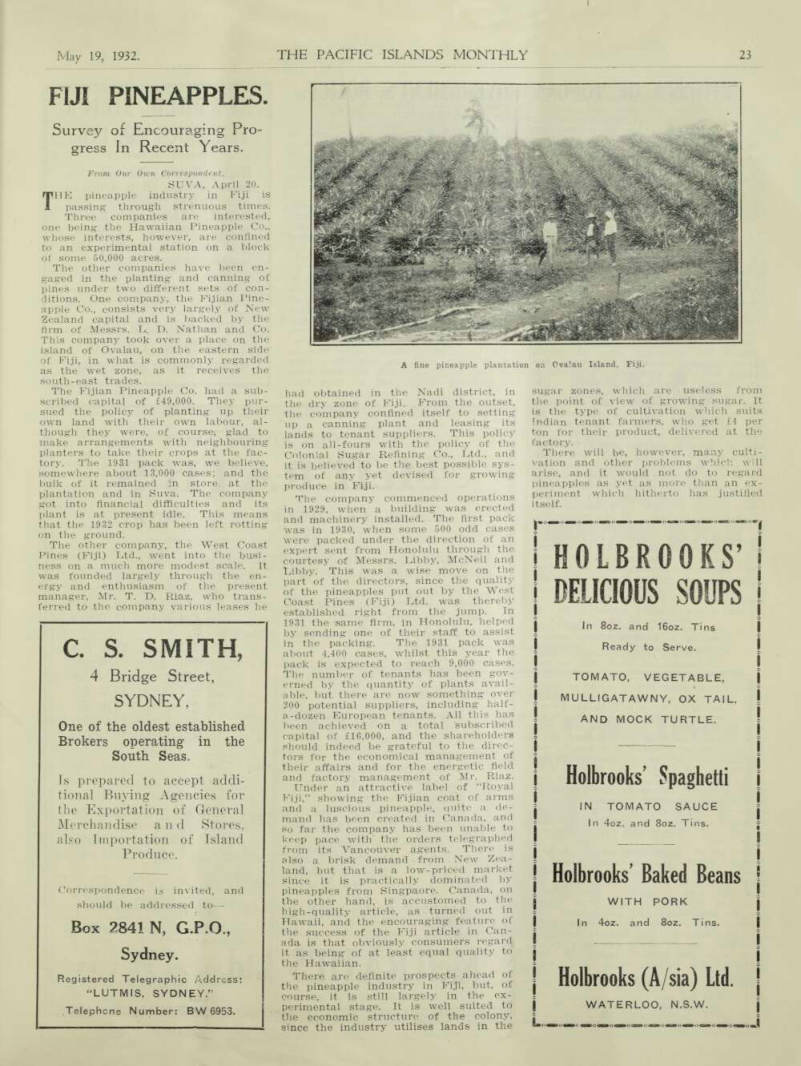
This company took over a place on the island of Ovalau, on the eastern side of Fiji, in what is commonly regarded as the wet zone, as it receives the south-east trades.
The Fijian Pineapple Co. had a sub scribed capital of £49,000. They pur sued the policy of planting up their own land with their own labour, al though they were, of course, glad to make arrangements with neighbouring planters to take their crops at the fac tory. The 1931 pack was, we believe, somewhere about 13,000 cases; and the bulk of it remained in store at the plantation and in Suva. The company got into financial difficulties and its plant is at present idle. This means that the 1932 crop has been left rotting on the ground.
The other company, the West Coast Pines (Fiji) Ltd., went into the busi ness on a much more modest scale. It was founded largely through the en ergy and enthusiasm of the present manager, Mr. T. D. Riaz, who trans ferred to the company various leases he
had obtained in the Nadi district, in the dry zone of Fiji. From the outset, the company confined itself to setting up a canning plant and leasing its lands to tenant suppliers. This policy is on all-fours with the policy of the Colonial Sugar Refining Co., Ltd., and it is believed to be the best possible sys tem of any yet devised for growing produce in Fiji.
The company commenced operations in 1929, when a building was erected and machinery installed. The first pack was in 1930, when some 500 odd cases Were packed under the direction of an expert sent from Honolulu through the courtesy of Messrs. Libby, McNeil and Libby. This was a wise move on the part of the directors, since the quality of the pineapples put out by the West Coast Pines (Fiji) Ltd. was thereby established right from the jump. In 1931 the same firm, in Honolulu, helped by sending one of their staff to assist in the packing. The 1931 pack was about 4,400 cases, whilst this year the pack is expected to reach 9,000 cases.
The number of tenants has been gov erned by the quantity of plants avail able, but there are now something over 200 potential suppliers, including half a-dozen European tenants. All this has been achieved on a total subscribed capital of £16,000, and the shareholders should indeed be grateful to the direc tors for the economical management of their affairs and for the energetic field and factory management of Mr. Riaz.
Under an attractive label of “Royal Fiji,” showing the Fijian coat of arms and a luscious pineapple, quite a de mand has been created in Canada, and so far the company has been unable to keep pace with' the orders telegraphed from its Vancouver agents. There is also a brisk demand from New Zea land, but that is a low-priced market since it is practically dominated by pineapples from Singpaore. Canada, on the other hand, is accustomed to the high-quality article, as turned out in Hawaii, and the encouraging feature of the success of the Fiji article in Can ada is that obviously consumers regard it as being of at least equal quality to the Hawaiian.
There are definite prospects ahead of the pineapple industry in Fiji, but, of course, it is still largely in the ex perimental stage. It is well suited to the economic structure of the colony, since the industry utilises lands in the
sugar zones, which are useless from the point of view of growing sugar. It is the type of cultivation which suits Indian tenant farmers, who get £4 per ton for their product, delivered at the factory.
There will be, however, many culti vation and other problems which will arise, and it would not do to regard pineapples as yet as more than an ex periment which hitherto has justified itself.
A fine pineapple plantation on Ovabau Island, Fiji.