Another Hurricane.
Singular Ill-fortune of New Hebrides Planters.
SINGULAR ill-fortune has befallen the New Hebrides planters in the mat ter of destruction by cyclones this season.
In February, as reported in this jour nal, a terrific hurricane swept through New Caledonia and the New Hebrides.
Much damage was done in central New Caledonia, while in the New Hebrides the islands which particularly suffered were those in the central division, especially Malekula and Epi.
The New Hebrides planters had no sooner finished counting their losses and taken neart of grace again than another hurricane swept down upon them and, so far as is known, it has done much damage.
The cyclone appears to have affected the central and northern islands. It struck Vila during Monday night, April 25, and continued during the early part of Tuesday. Houses and stores in Vila were unroofed, lighters were sunk in Vila Harbour, trading cutters were driven ashore and much damage done to plantations. The cyclone came down at 8 p.m. from the north-east, veered to the south and attained terrific vel ocity during the night.
An enormous amount of damage was done on Efate (Vila is situated on a sheltered harbour on the western side of Efate) but no estimate has been re ceived of the loss.
There are, up to the time of going to press, no particulars of the further damage that has been done in the is lands north of Vila.
“Malinoa” Ashore And Re
Floated.
The Burns, Philp inter-island steamer, “Malinoa,” was caught in the hurricane and apparently made a game fight of it. She was, however, driven ashore on to a reef off the coast of Aoba, about 10 o’clock on Tuesday night, April 26.
Passengers, with provisions and mails, were landed safely and efforts to re float the ship continued for several days. She was fast by the stern on a coral boulder and exposed to south easterly and northerly weather, and bumped heavily at high water. The position of the vessel was regarded as hopeless, and the well-known “Mak anibo,” which was lying idle in Sydney, was hurriedly commissioned and des patched to the New Hebrides on May 5 to take up the “Malinoa’s” running.
Splendid work, apparently, was done
Captain Perry, because quite unexpect edly, with the use of powerful ground tackle carried on the “Malinoa,” they succeeded in refloating the vessel on May 4 and getting her safely into port.
Surveyors left by the “Makambo” on May 5 to examine the “Malinoa.” It is announced that the “Makambo” will carry on the service in the meantime.
The February Hurricane.
The February hurricane completely destroyed about 20 per cent, of all co conut trees on the island of Epi.
Lacon’s plantations were seriously af fected and Hagen’s plantations were practically destroyed. Out of 23 build ings on Lacon’s plantations, only two remained intact. Extensive plantations of cocoa and coffee completely disap peared. The Government, for two months, has been feeding the labour gangs on Epi. There was only slight damage at Malekula.
There was damage done on Ambrym.
The volcano on Ambrym has been for some time making alarming noises, suggesting the possibility of another eruption.
French Government’S
Financial Aid.
From Our Own Correspondent.
VILA, April 20.
After the terrific hurricane, which swept through New Caledonia and the New Hebrides in February, the French Government sent up two inspectors to the New Hebrides to report and esti mate the damage. As a result, the Government is forwarding relief to the extent of 3,000,000 francs to be divided amongst the New Hebridian planters and 7,000,000 for the New Caledonian.
This, of course, is a help, but com pared with the losses, a mere drop in the ocean, as the coconuts, which re cover at all, will not bear for at least three years and there are the dead losses of those which were totally ruined.
Of the New Hebrides, Epi, Pauma and the South of Ambrym suffered the most. On one plantation at Epi an area covering 300 acres of cocoa and coffee was demolished entirely and can only be abandoned.
It is estimated at present that at least 20 per cent of the produce on the Epi plantations is ruined but the actual losses cannot be ascertained for about six months.
by the crew of the “Malinoa,” under
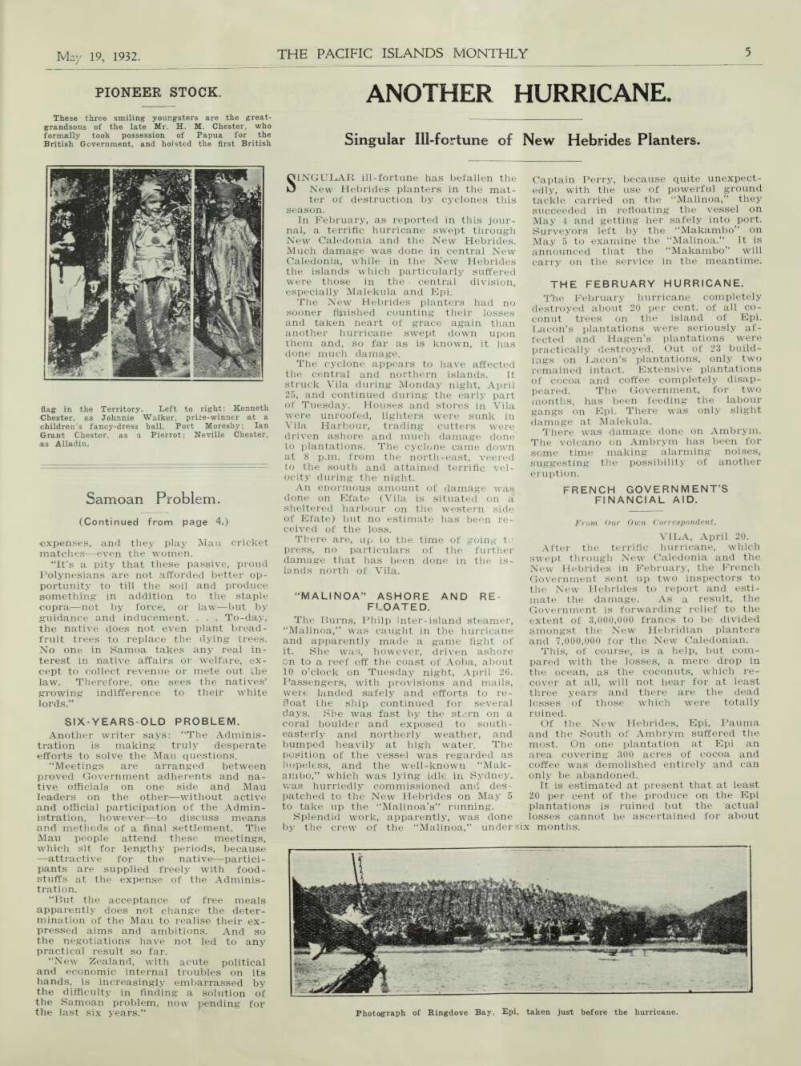
Photograph of Ringdove Bay, Epi, taken just before the hurricane.