Products Of The South Seas.
p. 47 · Read in the full issue
Exchange Fluctuations Upset Copra Market.
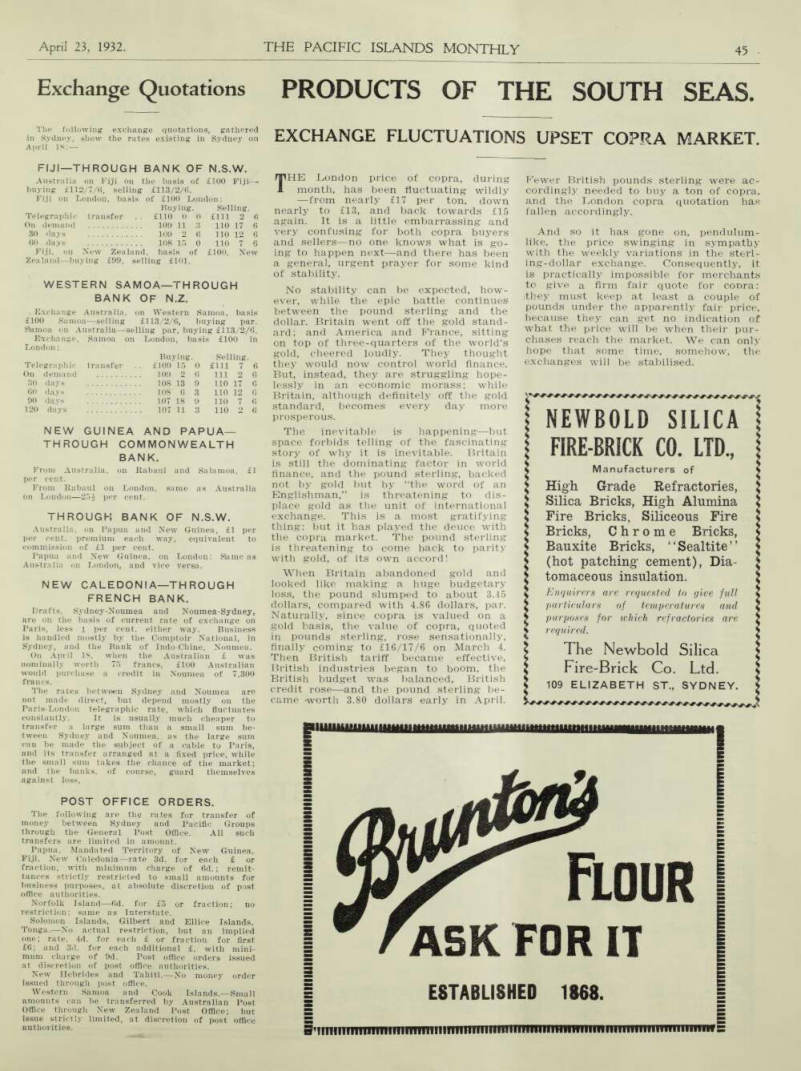
THE London price of copra, during month, has been fluctuating wildly —from nearly £17 per ton, down nearly to £13, and back towards £15 again. It is a little embarrassing and very confusing for both copra buyers and sellers —no one knows what is go ing to happen next —and there has been a general, urgent prayer for some kind of stability.
No stability can be expected, how ever, while the epic battle continues between the pound sterling and the dollar. Britain went off the gold stand ard; and America and France, sitting on top of three-quarters of the world’s gold, cheered loudly. They thought they would now control world finance.
But, instead, they are struggling hope lessly in an economic morass; while Britain, although definitely off the gold standard, becomes every day more prosperous.
The inevitable is happening—but space forbids telling of the fascinating story of why it is inevitable. Britain is still the dominating factor in world finance, and the pound sterling, backed not by gold but by “the word of an Englishman,” is threatening to dis place gold as the unit of international exchange. This is a most gratifying thing: but it has played the deuce with the copra market. The pound sterling is threatening to come back to parity with gold, of its own accord!
When Britain abandoned gold and looked like making a huge budgetary loss, the pound slumped to about 3.45 dollars, compared with 4.86 dollars, par.
Naturally, since copra is valued on a gold basis, the value of copra, quoted in pounds sterling, rose sensationally, finally coming to £16/17/6 on March 4.
Then British tariff became effective, British industries began to boom, the British budget was balanced, British credit rose—and the pound sterling be came worth 3.80 dollars early in April.
Fewer British pounds sterling were ac cordingly needed to buy a ton of copra, and the London copra quotation has fallen accordingly, And so it has gone on, pendulum like, the price swinging in sympathy with the weekly variations in the sterl ing-dollar exchange. Consequently, it is practically impossible for merchants give a firm fair quote for copra: they must keep at least a couple of Pounds under the apparently fair price, they can get no indication of what the price will be when their pur chases reach the market. We can only hope that some time, somehow, the exchanges will be stabilised.