Tonga’S Economic
pp. 38-40 · Read in the full issue
Condition.
[To the Editor.]
Sir, —May I encroach upon your valuable space to make some reference
to the economic condition of Tonga, which is far worse to-day than de scribed in your columns during last year by “Ikai Ka Ka,” “Joga Maa Joga” and “Veracity”?
Before proceeding to do so, however, there is a statement in your issue of October 23 last, under the heading, “Conditions in Tonga,” from your own correspondent, so typical of him that I cannot refrain from alluding to it. He says:—“l raise my hat to Mr. M. T.
Greene, much travelled foreign corre spondent, who, after a lengthy stay in the Friendly Islands, states in your July issue that ‘if New Zealand wants an example to follow it could take some points from the Crown Protectorate of Tonga—l have never seen a happier native people!’”
Mr. Greene’s lengthy stay was about five weeks. If we want any opinion of the happiness of the Tongan people we can get a much more reliable one than anything Mr. Greene can furnish by consulting men in our midst, who have lived here for anything from 30 to 50 years. No one, except perhaps your own correspondent, would pay any at tention to these journalists who blow in here from time to time, sniff around like stray dogs and are off again.
The rest of the article needs no comment. It is just a collection of meatless bones.
In your issue of the 23rd November last under the heading, “Tongan Ban anas,” also from your own correspond ent, our hopes are raised by an eulo gistic account of a “big contract with New Zealand”—by optimistic refer ence to “20,000 cases of bananas per month by the end of 1932”—and a pur chasing power of £50,000 per annum to be transferred from Australia to New Zealand. All absolute bunk! There never has been any such contract.
There is no such contract now.
The facts are as follow:—Terms of a contract have been discussed between the Government of Tonga and A. B.
Donald Ltd. of Auckland. No contract has ever been signed. The Government of Tonga has, however, guaranteed the natives 4/- per case delivered at Nu kualofa, any profit over a certain figure, if realised, to be divided among the shippers at the end of the year.
Three shipments have gone forward,
so far. The first made a profit, the second about wiped out that profit, and
the third made a howling loss. The banana business at the moment seems to be tottering to its fall.
And now with regard to the eco nomic condition of Tonga. In the Tonga Government Gazette, No. 2, of January 27, 1932, will be found the official figures of the total exports from the Kingdom during 1931. In the Ton gan Government Gazette, No. 11, of August 10, 1931, will be found the budget for the current financial year, which is to raise a revenue of £71,315 — an utter impossibility. The value f.o.b. of the produce exported during 1931 was £82,817, and the amount to be ex pended by the Government of Tonga £69,045, represents eighty-three per cent. (83%) of the Kingdom’s income, even at its f.o.b. value. When the British Government allowed their taxa tion to rise to one-third of the national income, a crisis of the first magnitude was considered to have arisen, a Nat ional Government was formed, an ap peal to the people was made, and the big spenders were annihilated at the polls.
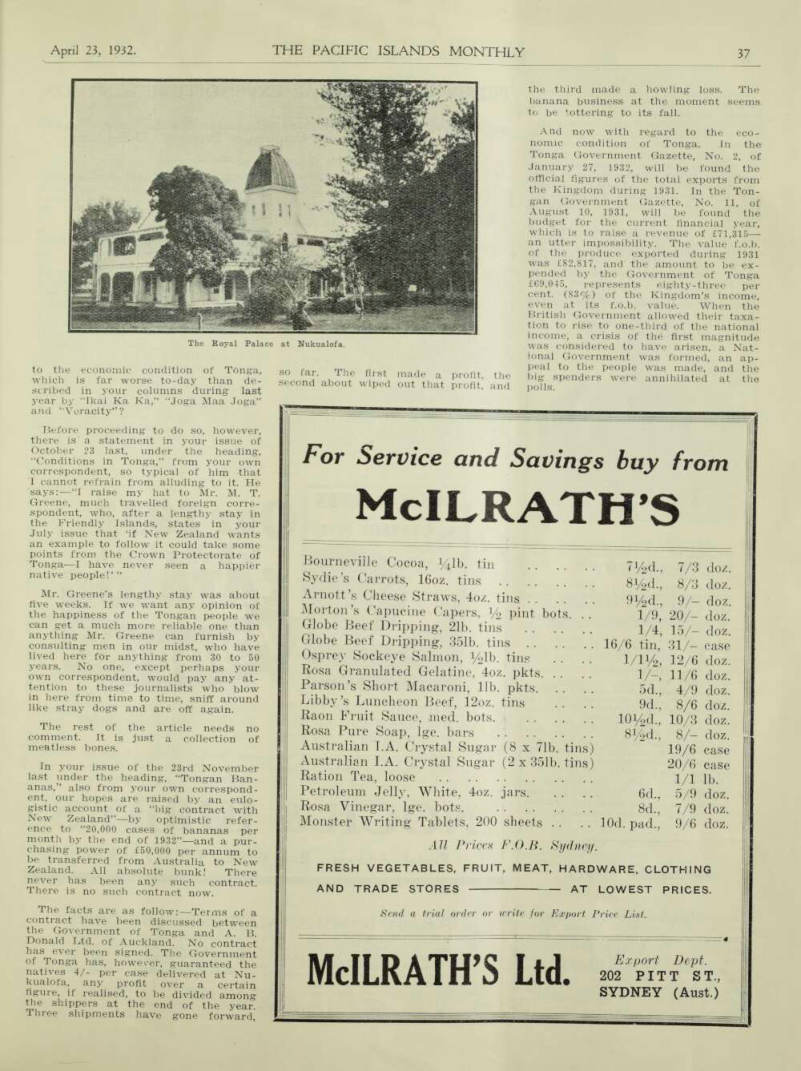
The Royal Palace at Nukualofa.
The Government of Tonga appar ently is responsible to nobody. The Legislative Assembly is made up of nine official members and seven nom inated members, forming together a block of sixteen against the seven elected representatives of the people. (The Europeans in the Kingdom have no representation whatsoever, but they are amenable both to Tongan law and to British law; they are Europeans or Tongans, just as it suits the British or Tongan authorities.) By what means can this orgy of hare-brained expenditure be stopped, nepotism abolished, and a just equili brium as between the various interests in the State brought about? What is the British Agent and Consul doing about it? What is the High Commis sioner for the Western Pacific doing about it? And, finally, who or what does the British Protectorate of the Tongan Islands protect? 1 am, etc.,
Spartan.
Nukualofa, March 1, 1932.