Solomons?
p. 34 · Read in the full issue
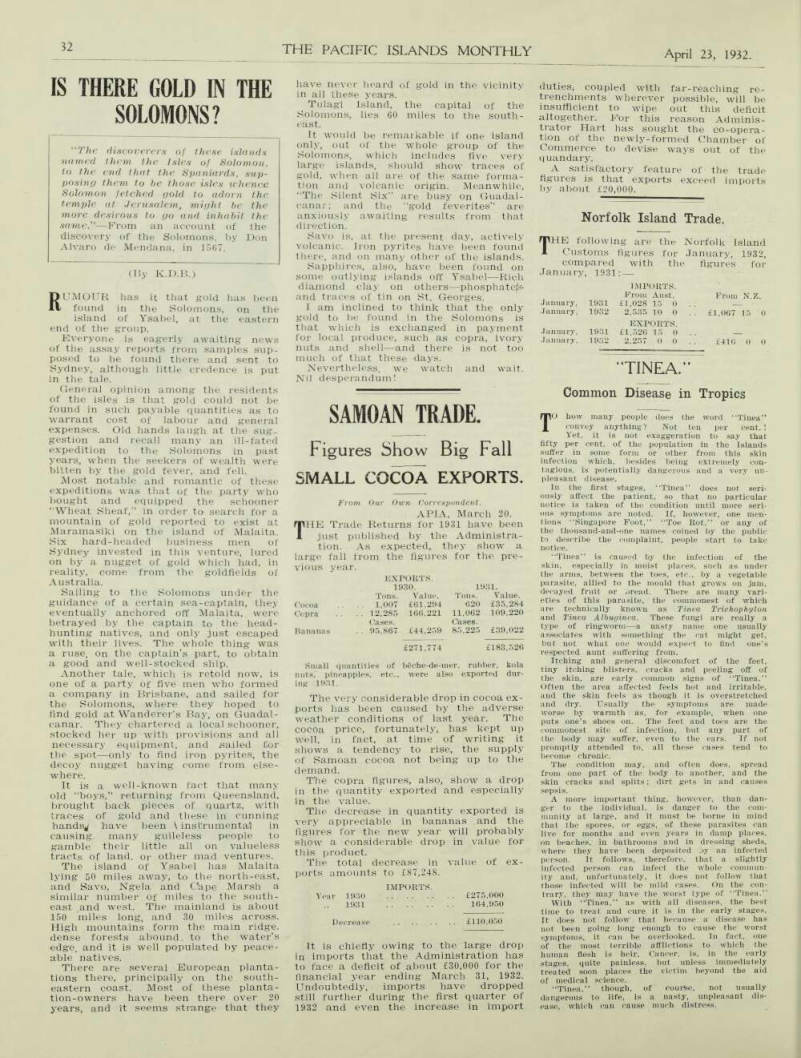
Is There Gold In The
“The discoverers of these islands named them the Isles of Solomon, to the end that the Spaniards, sup posing them to be those isles whence Solomon fetched gold to adorn the temple at Jerusalem, might be the more desirous to go and inhabit the same.” —From an account of the discovery of the Solomons, by Don Alvaro de Mendana, in 1567.
(By K.D.B.)
RUMOUR has it that gold has been found in the Solomons, on the island of Ysabel, at the eastern end of the group.
Everyone is eagerly awaiting news of the assay reports from samples sup posed to be found there and sent to Sydney, although little credence is put in the tale.
General opinion among the residents of the isles is that gold could not be found in such payable quantities as to warrant cost of labour and general expenses. Old hands laugh at the sug gestion and recall many an ill-fated expedition to the Solomons in past years, when the seekers of wealth were bitten by the gold fever, and fell.
Most notable and romantic of these expeditions was that of the party who bought and equipped the schooner “Wheat Sheaf,’’ in order to search for a mountain of gold reported to exist at Maramasiki on the island of Malaita.
Six hard-headed business men of Sydney invested in this venture, lured on by a nugget of gold which had, in reality, come from the goldfields of Australia.
Sailing to the Solomons under the guidance of a certain sea-captain, they eventually anchored off Malaita, were betrayed by the captain to the head hunting natives, and only just escaped with their lives. The whole thing was a ruse, on the captain’s part, to obtain a good and well-stocked ship.
Another tale, which is retold now, is one of a party of five men who formed a company in Brisbane, and sailed for the Solomons, where they hoped to find gold at Wanderer’s Bay, on Guadal canal They chartered a local schooner, stocked her up with provisions and all necessary equipment, and sailed for the spot—only to find iron pyrites, the decoy nugget having come from else where.
It is a well-known fact that many old “boys,’’ returning from Queensland, brought back pieces of quartz, with traces of gold and these in cunning hands have been instrumenta1 in causing many guileless people to gamble their little all on valueless tracts of land, or other mad ventures.
The island of Ysabel has Malaita lying 50 miles away, to the north-east, and Savo, Ngela and Cape Marsh a similar number of miles to the south east and west. The mainland is about 150 miles long, and 30 miles across.
High mountains form the main ridge, dense forests abound to the water’s edge, and it is well populated by peace able natives.
There are several European planta tions there, principally on the south eastern coast. Most of these planta tion-owners have been there over 20 years, and it seems strange that they
have never heard of gold in the vicinity in all these years.
Tulagi Island, the capital of the Solomons, lies 60 miles to the south east.
It would be remarkable if one island only, out of the whole group of the Solomons, which includes five very large islands, should show traces of gold, when all are of the same forma tion and volcanic origin. Meanwhile, “The Silent Six” are busy on Guadal canal ; and the “gold feverites” are anxiously awaiting results from that direction.
Savo is, at the present day, actively volcanic. Iron pyrites have been found there, and on many other of the islands.
Sapphires, also, have been found on some outlying islands off Ysabel—Rich diamond clay on others—phosphatefs and traces of tin on St. Georges.
I am inclined to think that the only gold to be found in the Solomons is that which is exchanged in payment for local produce, such as copra, ivory nuts and shell —and there is not too much of that these days.
Nevertheless, we watch and wait.
Nil desperandum!