The Problem Of The Native Debtor.
p. 29 · Read in the full issue
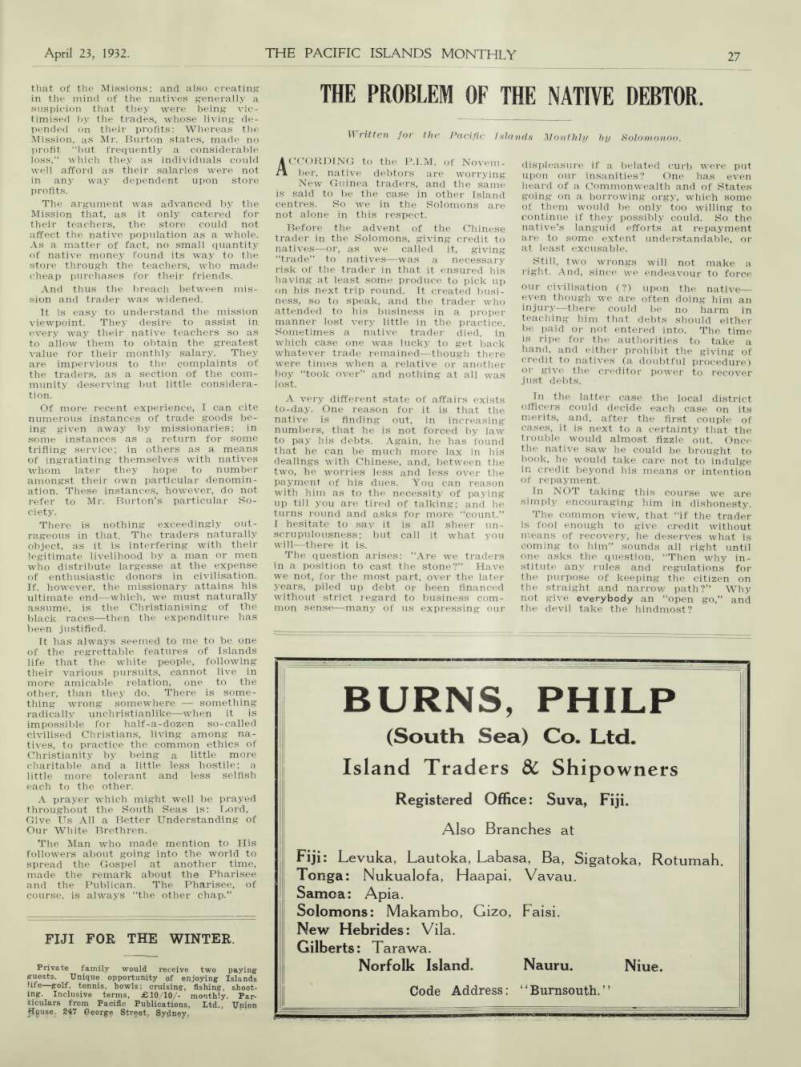
Written for the Pacific Islands Monthly hy Solomonoo.
ACCORDING to the P.I.M. of Novem ber, native debtors are worrying New Guinea traders, and the same is said to be the case in other Island centres. So we in the Solomons are not alone in this respect.
Before the advent of the Chinese trader in the Solomons, giving credit to natives —or, as we called it, giving “trade” to natives —was a necessary risk of the trader in that it ensured his having at least some produce to pick up on his next trip round. It created busi ness, so to speak, and the trader who attended to his business in a proper manner lost very little in the practice.
Sometimes a native trader died, in which case one was lucky to get back whatever trade remained —though there were times when a relative or another boy “took over” and nothing at all was lost.
A very different state of affairs exists to-day. One reason for it is that the native is finding out, in increasing numbers, that he is not forced by law to pay his debts. Again, he has found that he can be much more lax in his dealings with Chinese, and, between the two, he worries less and less over the payment of his dues. You can reason with him as to the necessity of paying up till you are tired of talking; and he turns round and asks for more “count.”
I hesitate to say it is all sheer un scrupulousness; but call it what you will—there it is.
The question arises: “Are we traders in a position to cast the stone?” Have we not, for the most part, over the later years, piled up debt or been financed without strict regard to business com mon sense—many of us expressing our
displeasure if a belated curb were put upon our insanities? One has even heard of a Commonwealth and of States going- on a borrowing orgy, which some of them would be only too willing to continue if they possibly could. So the native’s languid efforts at repayment are to some extent understandable, or at least excusable.
Still, two wrongs will not make a right. And, since we endeavour to force our civilisation (?) upon the native— even though we are often doing him an injury—there could be no harm in teaching him that debts should either be paid or not entered into. The time is ripe for the authorities to take a hand, and either prohibit the giving of credit to natives (a doubtful procedure) or give the creditor power to recover just debts.
In the latter case the local district officers could decide each case on its merits, and, after the first couple of cases, it is next to a certainty that the trouble would almost fizzle out. Once the native saw he could be brought to book, he would take care not to indulge in credit beyond his means or intention of repayment.
In NOT taking this course we are simply encouraging him in dishonesty.
The common view, that “if the trader is fool enough to give credit without means of recovery, he deserves what is coming to him” sounds all right until one asks the question, “Then why in stitute any rules and regulations for the purpose of keeping the citizen on the straight and narrow path?” Why not give everybody an “open go,” and the devil take the hindmost?