Rabaul’S Special Appeal
p. 24 · Read in the full issue
To Touring Australians.
In this article, Gordon Thomas reminds Australian tourists that they can visit a rich tropical country of fascinating interest and beauty at moderate cost—because it is the only big Pacific Islands Territory where the Australian £ holds its original value.
EVERY year—more especially during the winter months—there is a gen eral exodus from Australia of tour ists seeking a few months’ change of scene and climate. They travel to Colombo, Singapore, Hong Kong, Hawaii, Fiji, and Manila. They seek the sunshine and the fascination of change; new faces, fresh scenes and making contact with individuals whose interests differ from the daily com panions of their work-a-day world.
I have lounged in the coolness of the Galle Face, tripped to Mount Lavinia and Kandy and dined within the mag nificence of the G.O.H. at Colombo. I have delighted in the myriad lights of Hongkong and Kowloon, and idled over coffee in the “Moana,” beside Wai kiki, in Honolulu; even the cool spa ciousness of the “Pacific” in Suva has charmed me; but none of these resorts —these much-advertised paradises for the tourist —can compare with the primitive beauty of Rabaul and the surrounding tropical grandeur which lies practically untouched by the dis figuring hand of civilised man.
Rabaul and its outports hold a wealth of fascination for the tourist.
There are advantages that touch the purse—and that, in these hard times, is no small matter. There is no difficulty of exchange: Australian currency is in use. Australian laws prevail, and the bulk of the white population is Aus tralian, most of them sun-baked, cheerful Diggers who, after the War, sought pastures new and are now con tent to call this land their home.
Steamer communication leaves little to be desired. The B.P. line of steamers arrive every three weeks, and the E. and A. boats call once a month.
Inter-island steamers —some of which have very comfortable passenger ac commodation —are constantly leaving for island tours; and periodical calls are made by steamers of the R.P.N. and N.D.L. lines.
Pine motor roads extend for miles along cool, palm-fringed avenues, with primitive native leaf-huts half-hidden from the road. There are fine surfing and swimming baths. On the out skirts of Rabaul are thermal hot springs, where sufferers from rheuma tism can find solace. Tennis, golf, cricket, and baseball clubs are flour ishing institutions; while cinema and dances cater for evening entertain ment.
For those tourists desirous of quiet and peace there are several private homes, situated some distance from Rabaul, open to receive guests, and it is here that contact may be made with
the more primitive native life—off the beaten track of steamers and motor cars.
For the more adventurous there is the trip to the goldfields, up to Wau and Edie Creek, where aeroplane flights may be had and inspections made of the mines that soon will be world famous for the riches they produce.
There are at present three good, up to-date hotels in the Rabaul-Kokopo district. Should the tourist traffic in crease, no doubt some enterprising in dividual will erect a modern building to cater exclusively for the tourist trade.
A holiday trip to New Guinea would be a tour never to be regretted, and is an undertaking highly recommended to the tired business-man and his city fagged family.
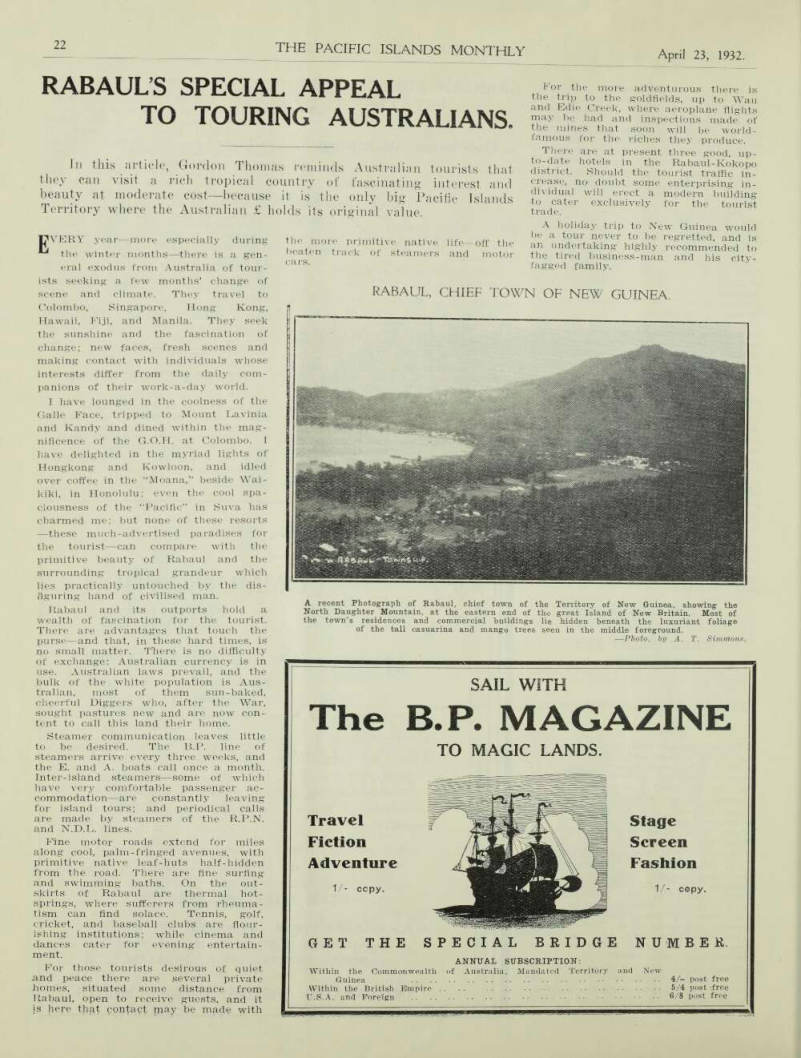
Rabaul, Chief Town Of New Guinea.
A recent Photograph of Rabaul, chief town of the Territory of New Guinea, showing the North Daughter Mountain, at the eastern end of the great Island of New Britain. Most of the town’s residences and commercial buildings lie hidden beneath the luxuriant foliage of the tall casuarina and mango trees seen in the middle foreground. -Photo, by A. T. Simmons.