New Administrator For
pp. 8-9 · Read in the full issue
Romantic Norfolk Island.
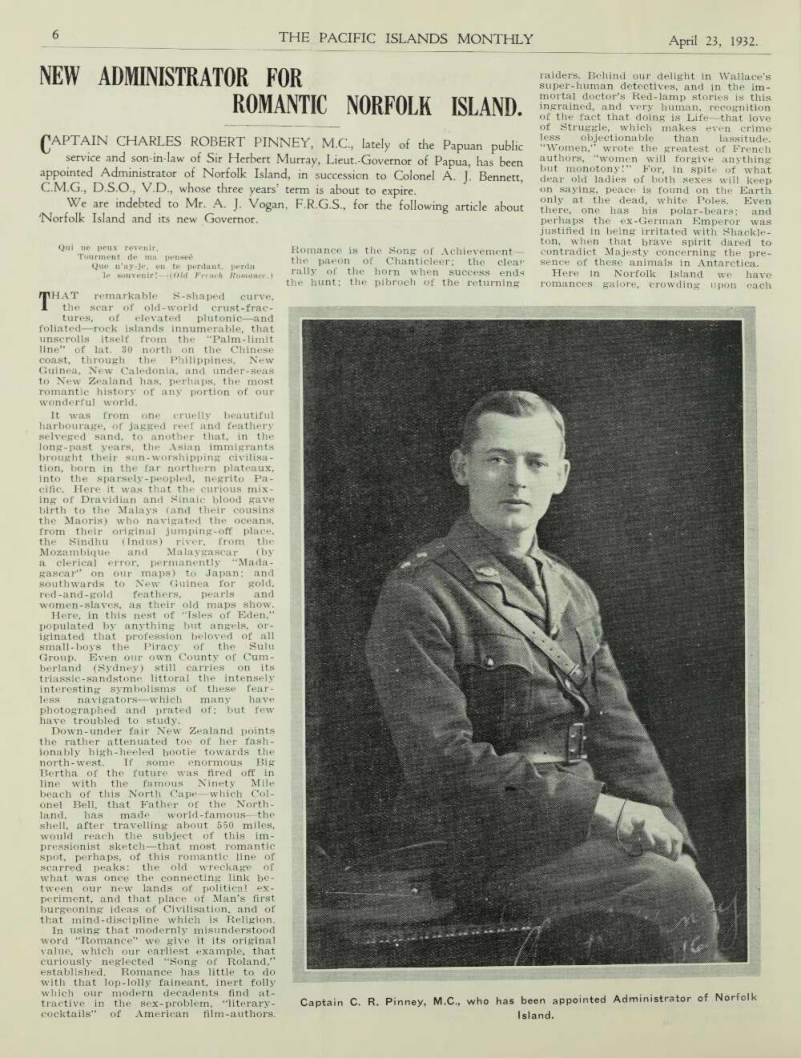
CAPTAIN CHARLES ROBERT PINNEY, M.C, lately of the Papuan public service and son-in-law of Sir Herbert Murray, Lieut.-Governor of Papua, has been appointed Administrator of Norfolk Island, in succession to Colonel A. J. Bennett, C.M.G., D.S.O., V.D., whose three years’ term is about to expire.
We are indebted to Mr. A. J. Vogan, F.R.G.S., for the following article about Norfolk Island and its new Governor.
Qui ne peux revenir, Tourment de ma penseé Que n’ay-je, en te perdant, perdu le souvenir!— (Old French Romance.) THAT remarkable S-shaped curve, the scar of old-world crust-frac tures, of elevated plutonic—and foliated —rock islands innumerable, that unscrolls itself from the “Palm-limit line" of lat. 30 north on the Chinese coast, through the Philippines, New Guinea, New Caledonia, and under-seas to New Zealand has, perhaps, the most romantic history of any portion of our wonderful world.
It was from one cruelly beautiful harbourage, of jagged reef and feathery selveged sand, to another that, in the long-past years, the Asian immigrants brought their sun-worshipping civilisa tion, born in the far northern plateaux, into the sparsely-peopled, negrito Pa cific. Here it was that the curious mix ing of Dravidian and Sinaic blood gave birth to the Malays (and their cousins the Maoris) who navigated the oceans, from their original jumping-off place, the Sindhu (Indus) river, from the Mozambique and Malaygascar (by a clerical error, permanently “Mada gascar" on our maps) to Japan; and southwards to New Guinea for gold, red-and-gold feathers, pearls and women-slaves, as their old maps show.
Here, in this nest of “Isles of Eden,” populated by anything but angels, or iginated that profession beloved of all small-boys the Piracy of the Sulu Group. Even our own County of Cum berland (Sydney) still carries on its triassic-sandstone littoral the intensely interesting symbolisms of these fear less navigators—which many have photographed and prated of; but few have troubled to study.
Down-under fair New Zealand points the rather attenuated toe of her fash ionably high-heeled bootie towards the north-west. If some enormous Big Bertha of the future was fired off in line with the famous Ninety Mile beach of this North Cape—which Col onel Bell, that Father of the North land, has made world-famous —the shell, after travelling about 550 miles, would reach the subject of this im pressionist sketch —that most romantic spot, perhaps, of this romantic line of scarred peaks: the old wreckage of what was once the connecting link be tween our new lands of political ex periment, and that place of Man’s first burgeoning ideas of Civilisation, and of that mind-discipline which is Religion.
In using that modernly misunderstood word “Romance" we give it its original value, which our earliest example, that curiously neglected “Song of Roland," established. Romance has little to do with that lop-lolly faineant, inert folly which our modern decadents find at tractive in the sex-problem, “literary cocktails" of American film-authors.
Romance is the Song of Achievement— the paeon of Chanticleer; the clea rally of the horn when success ends the hunt; the pibroch of the returning
raiders. Behind our delight in Wallace’s super-human detectives, and in the im mortal doctor’s Red-lamp stories is this ingrained, and very human, recognition of the fact that doing is Life—that love of Struggle, which makes even crime less objectionable than lassitude.
“Women," wrote the greatest of French authors, “women will forgive anything but monotony!" For, in spite of what dear old ladies of both sexes will keep on saying, peace is found on the Earth, only at the dead, white Poles, Even there, one has his polar-bears; and perhaps the ex-German Emperor was justified in being irritated with Shackle ton, when that brave spirit dared to contradict Majesty concerning the pre sence of these animals in Antarctica.
Here in Norfolk Island we have romances galore, crowding upon each
Captain C. R. Finney, M.C., who has been appointed Administrator of Norfolk Island.
other’s heels —Struggles; horrors of bleak convict days: North American whaler episodes; the great Bishop Sel wyn’s quarter of a century of Mission endeavour; the rendezvous of latter day Pacific pirates and cut-throats — the last of whom still resides (in the odour of sanctity) in New Zealand; and hardy ruffians who gave moonshine poison for stolen pearls and returned New Caledonian “fibres” and “recide vistes” “to their wives and their rela tions,’’ in spite of an exasperated gendarmerie.
Then again, to the westward, as if fencing off her Island-bashfulness from the uncouth, familiarity of her huge, hot neighbour Australia, are the ter rible, nightmare reefs and shoals of the Elizabeth and the Middleton, “where horror broods and mem’ry faints in dread" over countless sea-tragedies.
So it is most fitting that the Lyons government should have appointed for
so truly romantic a spot a new Admin istrator with a most delightfully inter esting and heroic past.
Captain Charles Robert Pinney, M.C., late Secretary for Lands and Director of Mines and Agriculture in Papua, was born in Ripponlea in Victoria, where his mother still lives —his father being dead. He has three brothers — one in business in Victoria.
Although I have known him so long I have never heard anything of what I am now going to relate; and probably the new Administrator (who is still up north) may not like my giving the pub lic what, like the typical Australian military hero he is, he never refers to in any way. I have discovered a letter signed by the great General Sir Wil liam Birdwood, directed to Captain Pinney. It says: “This is a letter to congratulate you most heartily upon the presen tation to you of the Military Cross, in recognition of your good work
during the operations near Zonne becke, on 26th of October. I know that you displayed great gallantry and skill in leading the attack in Decline Copse, and, although you were subjected to a severe shell-fire in forming up, you took the position without a hitch, and held it against a subsequent counter attack. Thank you so much for your good service!”
Captain Finney was with the 6th Battalion, A.I.F., and went in 1914 to the Great War, where he was wounded twice and took part in the Gallipoli affair —which, like the Charge of Bala clava, was at once an exhibition of supreme courage and endurance by soldiers and the muddled reasonings of over-fed politicians at Home.
“It was a dark and stormy night, when two travellers might have been descried” (here my appropriate quota tion must end) crossing the torpedo infested Channel towards war-dis tracted England in the year 1916. One of these was the daughter of our hon oured Lieut.-Governor of Papua, since then created a Knight-Commander, Sir J. H. P. Murray; she was leaving school to attend the wedding of her uncle, Major Murray, D.S.O., M.C., etc. The other passenger was Captain Pinney, aforesaid, who had received a command from the King to come and be con gratulated by his Majesty at Bucking ham Palace.
There were other passengers, no doubt; but, with the license of the raconteur, they remain in doubt whilst the “fierce fight that beats upon a throne,” or other prominently official position, touches the centre of the stage. I would like to dwell on the first meeting; and those that followed.
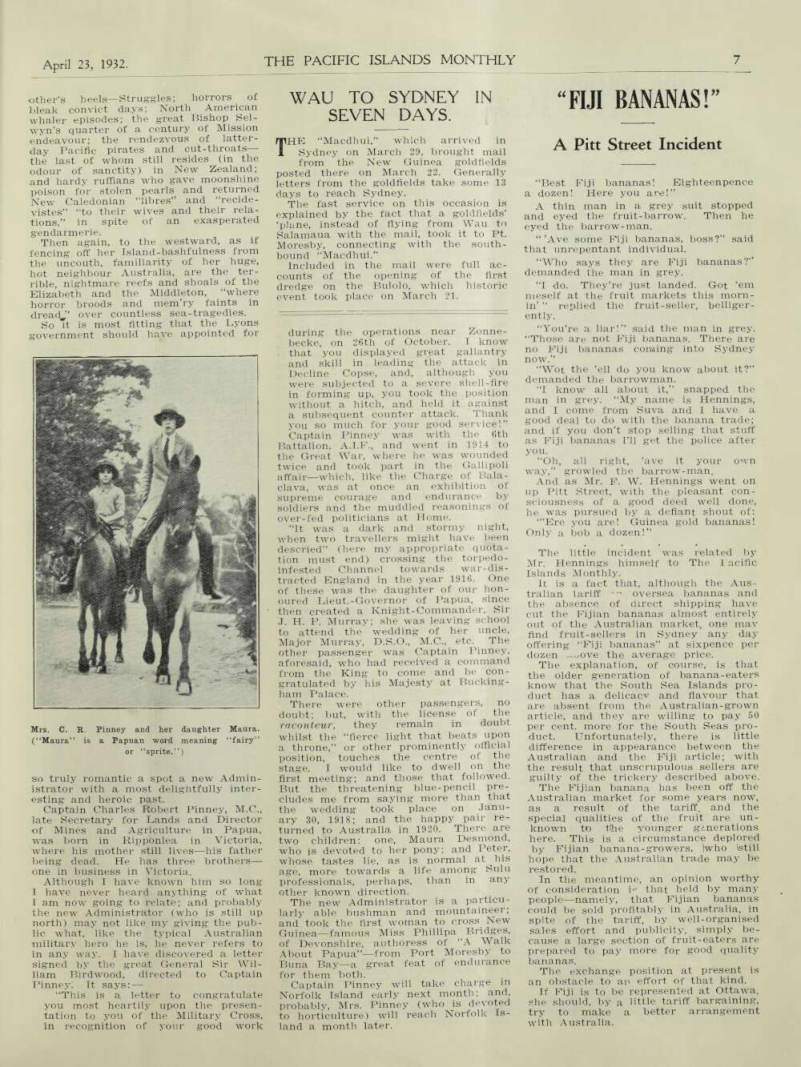
But the threatening blue-pencil pre cludes me from saying more than that the wedding took place on Janu ary 30, 1918; and the happy pair re turned to Australia in 1920. There are two children: one, Maura Desmond, who is devoted to her pony; and Peter, whose tastes lie, as is normal at his age, more towards a life among Sulu professionals, perhaps, than in any other known direction.
The new Administrator is a particu larly able bushman and mountaineer; and took the first woman to cross New Guinea —famous Miss Phillipa Bridges, of Devonshire, authoress of “A Walk About Papua”—from Port Moresby to Buna Bay—a great feat of endurance for them both.
Captain Pinney will take charge in Norfolk Island early next month; and, probably, Mrs. Pinney (who is devoted to horticulture) will reach Norfolk Is land a month later.
Mrs. C. R. Pinney and her daughter Maura. (“Maura” is a Papuan word meaning “fairy” or “sprite.”)